










Paras Healthcare Limited’s New Hospitals Reach 18.7% Margin
Key highlights
- Paras Health’s Srinagar and Kanpur cluster reached an 18.7% operating EBITDA margin in H1 FY27.
- New-hospital occupancy rose to 68.4% in H1 FY27 from 27.8% in H1 FY26.
- Kanpur occupancy increased to 78.4% from 22.7%, while its EBITDA margin improved to 15.6%.
- Paras Health plans to open more Kanpur beds by the end of FY27 from a total 435-bed capacity.
powered by IRIS
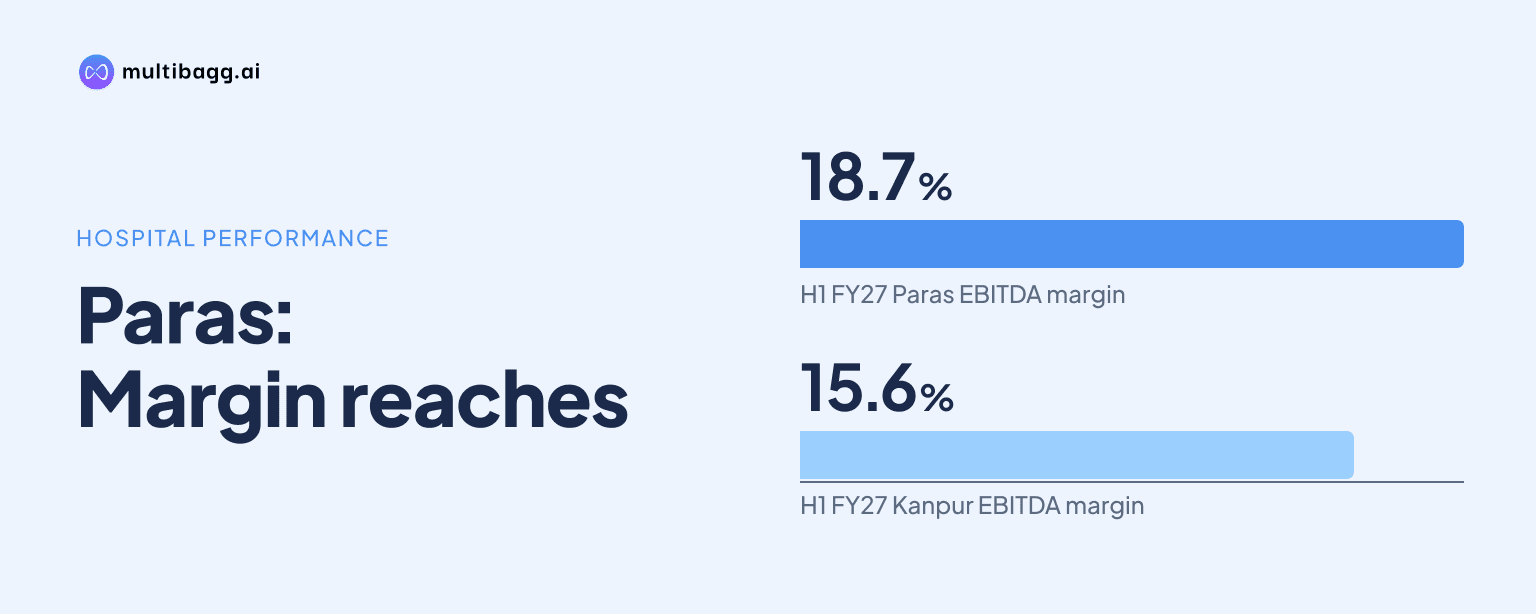
Paras Healthcare Limited’s Srinagar and Kanpur hospitals reported an 18.7% operating earnings before interest, tax, depreciation and amortisation (EBITDA) margin in H1 FY27, reversing a Rs 13 crore operating EBITDA loss in FY26 as occupancy increased to 68.4% from 27.8% a year earlier.
Know Paras Healthcare inside out
Results, valuation, peers and who's buying, in one view.
How did Paras Health’s new hospitals become EBITDA-profitable?
Paras Health’s Srinagar and Kanpur cluster became EBITDA-profitable as revenue rose 139% year on year in Q2 FY27 and 147% in H1 FY27. Management said both hospitals were EBITDA-profitable in Q2 FY27, when the cluster generated Rs 15.8 crore of operating EBITDA, after recording a Rs 13 crore operating EBITDA loss in FY26.
For H1 FY27, the new-hospital cluster generated more than Rs 25 crore of operating EBITDA and posted an 18.7% margin. Management said this ramp occurred faster than at its earlier hospitals and attributed it to the ability to increase utilisation and specialty activity after the initial stabilisation phase.
The new hospitals outpaced Paras Health’s other cohorts in revenue growth, although their margin remained below that of mature hospitals. The mature cohort of Gurgaon, Patna, Panchkula and Darbhanga grew H1 FY27 revenue 9.1%, while the emerging Ranchi and Udaipur cohort grew 43.2%, compared with 147% at Srinagar and Kanpur.
What occupancy increase supported Paras Health’s turnaround?
Occupancy at Paras Health’s new-hospital cluster rose by 4,060 basis points to 68.4% in H1 FY27 from 27.8% in H1 FY26. A basis point is one-hundredth of a percentage point. Management said low occupancy and stabilisation costs had initially reduced profitability, while higher occupancy enabled the hospitals to absorb their operating cost base.
Kanpur provided the clearest disclosed hospital-level example. Its occupancy rose to 78.4% in H1 FY27 from 22.7% in H1 FY26, and its EBITDA margin improved to 15.6% from negative 22.8%. Management linked the change to operating leverage, added empanelments, more clinicians and a specialty-focused mix covering tertiary and quaternary care.
Across Paras Health, group occupancy reached 73% in H1 FY27 from 59% a year earlier, while occupied bed days increased 23.9% to 201,000 from 162,000. Inpatient volumes grew 27.3% and outpatient volumes increased 20.4%, alongside average revenue per occupied bed rising to Rs 48,900 from Rs 48,400 and average length of stay declining to 2.8 days from 2.9 days.
How do Paras Health’s hospital cohorts compare?
Paras Health’s new hospitals delivered the fastest H1 FY27 revenue expansion, but the mature cohort retained the highest operating EBITDA margin at 28.9%. The emerging cohort’s 18.3% margin was close to the new-hospital cluster’s 18.7%, reflecting different stages of capacity utilisation and operating maturity.
The mature cohort increased its H1 FY27 operating EBITDA margin by 330 basis points, while the emerging cohort’s margin rose from 12.4% in H1 FY26 to 18.3%. Emerging-hospital occupancy increased to 68.6% from 49.1%, showing that Ranchi and Udaipur also benefited from higher use of installed capacity.
Udaipur was softer in Q2 FY27 because a Rajasthan government scheme was under review and temporarily suspended across multiple hospitals in the state, management said. Paras Health said cash and insurance business recovered about 30% to 40% of its state-government business, while management expressed hope that the scheme would restart.
Got a follow-up? Ask IRIS
Which actions and costs shaped Paras Health’s margins?
Paras Health attributed the new-hospital turnaround to higher occupancy, greater specialty treatment and rising outpatient and inpatient footfalls. Management also said it was tracking clinical and surgical mix by hospital and doctor, with more complex specialty work forming one of four stated growth levers alongside new-hospital ramp-up, volume growth and disciplined capacity additions.
At the group level, operating EBITDA increased 58% to Rs 225 crore in H1 FY27 from Rs 142 crore in H1 FY26, and the operating EBITDA margin expanded to 23.0% from 18.1%. The chief financial officer said material costs improved by more than 3% through procurement efficiencies, formulary compliance and case mix, while doctor costs improved by 70 basis points despite additional hiring.
The H1 FY27 payer mix was 32% cash or self-pay, 24% insurance and 44% government schemes and public-sector undertakings. That mix matters for operations because management cited empanelment additions in Kanpur, while it identified payor mix, settlement cycles and certain lumpy payments as factors behind group receivables increasing to Rs 518 crore at September-end from Rs 350 crore in March.
What capacity and funding plans could affect Paras Health next?
Paras Health plans to open more beds in Kanpur by the end of FY27, where roughly half of the 435-bed capacity had been opened. Management said two wings remained to be operationalised, meaning the disclosed 78.4% H1 FY27 occupancy was achieved before the full planned capacity was available.
Beyond Kanpur, management identified a Golf Course Extension, Gurgaon project and a 500-bed Ludhiana expansion expected next year as selective capacity additions. H1 FY27 capital expenditure was Rs 90 crore across units and payments for the Gurgaon project, with management describing its approach as disciplined new capacity rather than providing a financial forecast.
The company reported gross borrowings of Rs 979 crore and cash of Rs 360 crore at September-end, resulting in net debt of Rs 620 crore. It had repaid Rs 375 crore of term debt from the Rs 500 crore fresh issue, and management put pro forma net debt after repayment at Rs 143 crore; H1 FY27 operating cash flow was Rs 68 crore despite a Rs 172 crore working-capital movement.
Conclusion
Paras Health’s H1 FY27 performance shows the Srinagar and Kanpur cluster moving from a Rs 13 crore operating EBITDA loss in FY26 to more than Rs 25 crore of operating EBITDA in the half year. The 18.7% margin and 147% revenue growth indicate a sharp improvement in new-hospital utilisation, although the 28.9% margin at mature hospitals shows the remaining gap to the group’s more established units.
The next disclosed operational milestone is the opening of Kanpur’s remaining two wings by the end of FY27, followed by the planned 500-bed Ludhiana expansion next year. Investors will also watch receivables, which rose to Rs 518 crore at September-end, and whether the suspended Rajasthan government scheme resumes for Udaipur, as management identified collections and payor-related settlements as priorities.