










Paras Health’s new hospitals turn EBITDA-positive in H1 FY27
Key highlights
- Paras Health’s new hospitals reported Rs 25.6 crore of operating EBITDA in H1 FY27 versus a Rs 13.3 crore loss in H1 FY26.
- New-hospital occupancy rose from 27.8% in H1 FY26 to 68.4% in H1 FY27.
- New-hospital revenue increased 147.1% year on year to Rs 146.3 crore in H1 FY27.
- Paras Health’s consolidated operating EBITDA margin rose 480 basis points to 23.0% in H1 FY27.
powered by IRIS
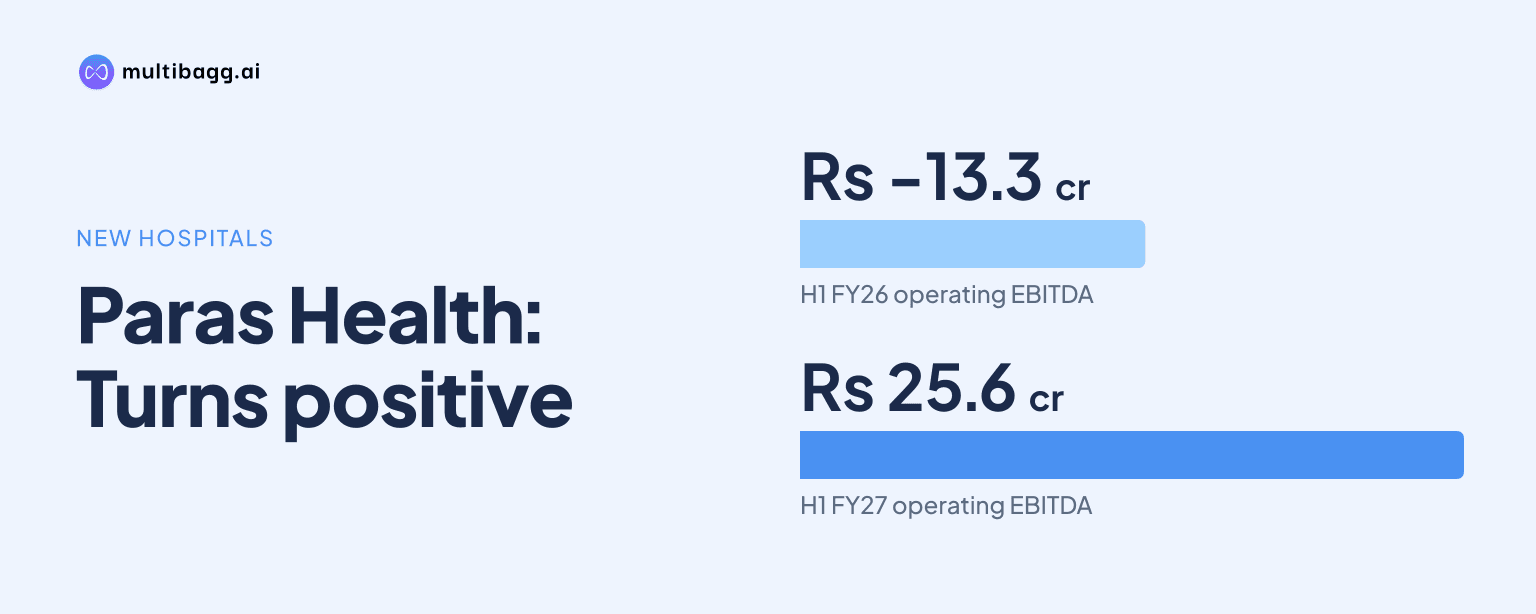
Paras Health’s new-hospital cohort generated operating EBITDA of Rs 25.6 crore in H1 FY27, reversing a Rs 13.3 crore loss in H1 FY26, as bed occupancy rose from 27.8% to 68.4%. The Srinagar and Kanpur hospitals also increased revenue 147.1% year on year to Rs 146.3 crore.
Know Paras Healthcare inside out
Results, valuation, peers and who's buying, in one view.
How did Paras Health’s new hospitals become EBITDA-positive?
Paras Health’s new hospitals became EBITDA-positive in H1 FY27 through a substantial rise in utilisation and revenue at Srinagar and Kanpur. Their hospital-level operating EBITDA moved by Rs 38.9 crore, from a loss of Rs 13.3 crore in H1 FY26 to a profit of Rs 25.6 crore in H1 FY27. Operating EBITDA excludes other income, consistent with the company’s reported operating EBITDA definition.
The new cohort’s revenue grew to Rs 146.3 crore in H1 FY27 from Rs 59.2 crore a year earlier, while occupancy increased by 40.6 percentage points to 68.4%. Its operating EBITDA margin was 17.5% in H1 FY27; the prior-year margin was shown as n.m. because the cohort reported a loss. Paras Health classifies Srinagar and Kanpur as new hospitals, meaning facilities less than four years old.
What does the Q2 FY27 performance show about the ramp-up?
Paras Health’s Q2 FY27 numbers show that the new-hospital ramp-up continued after the first quarter, with cohort revenue rising 138.8% year on year to Rs 84.4 crore. Bed occupancy at these hospitals increased to 78.1% in Q2 FY27 from 34.4% in Q2 FY26, while operating EBITDA reached Rs 15.8 crore versus a Rs 3.1 crore loss a year earlier.
The Q2 operating EBITDA margin for the new cohort was 18.7%, slightly above its 17.5% H1 FY27 margin. Q2 revenue of Rs 84.4 crore represented more than half of the H1 total of Rs 146.3 crore, while Q2 operating EBITDA of Rs 15.8 crore accounted for a majority of the Rs 25.6 crore H1 result. This period comparison indicates that the cohort’s reported profitability was concentrated more heavily in the second quarter.
How did Paras Health’s new hospitals compare with older cohorts?
Paras Health’s new hospitals recorded the fastest H1 FY27 revenue growth among its three hospital cohorts, although their revenue base remained below the mature and emerging groups. New-hospital revenue rose 147.1%, compared with 43.2% for emerging hospitals and 9.1% for mature hospitals. New-hospital occupancy also improved more than the other cohorts, rising from 27.8% to 68.4%.
Mature hospitals remained the largest earnings contributor, reporting Rs 188.4 crore of operating EBITDA and a 28.9% margin in H1 FY27. Emerging hospitals delivered Rs 33.5 crore, up 110.9% year on year, with an 18.3% margin. The new cohort’s Rs 25.6 crore was lower than the emerging cohort’s earnings but came after a prior-year loss, and its 17.5% margin was 0.8 percentage points below the emerging cohort’s level.
Got a follow-up? Ask IRIS
What does the hospital ramp-up mean for Paras Health’s H1 FY27 results?
Paras Health’s hospital-level ramp-up coincided with consolidated revenue growth of 25.1% to Rs 981.2 crore in H1 FY27 and operating EBITDA growth of 58.4% to Rs 225.2 crore. The consolidated operating EBITDA margin increased 480 basis points to 23.0% from 18.1%. The cohort figures do not add up to consolidated operating EBITDA because they are measured before corporate overheads.
The company operated the same 2,211-bed capacity and 1,502 operational beds in both H1 FY26 and H1 FY27. Across the network, occupied bed days rose 23.9% to 200,700 and overall occupancy rose to 73.0% from 59.0%, while inpatient volumes increased 27.3% to 71,300. With no reported increase in bed capacity, the disclosed figures point to higher use of the existing operational base as a contributor to revenue and margin expansion.
What are the relevant profitability and mix indicators?
Paras Health reported profit after tax of Rs 90.0 crore in H1 FY27, compared with Rs 11.4 crore in H1 FY26, and the profit-after-tax margin rose to 9.0% from 1.4%. Reported EBITDA, which includes other income, increased 54.7% to Rs 240.1 crore, with a reported EBITDA margin of 24.1% compared with 19.5% a year earlier.
The case mix changed during the same period. Government schemes and public-sector undertakings accounted for 44% of payor mix in H1 FY27, up from 31% in H1 FY26, while self-pay declined to 32% from 43%. The six specialties grouped as CONGOR, comprising cardiac, oncology, neurosciences, gastro sciences, orthopaedics and sports injury, and renal sciences, accounted for 74% of the specialty mix, compared with 75% a year earlier.
Conclusion
Paras Health’s new hospitals shifted from a Rs 13.3 crore operating EBITDA loss to a Rs 25.6 crore profit in H1 FY27 as occupancy climbed to 68.4% and revenue reached Rs 146.3 crore. The result occurred alongside higher network utilisation, with consolidated occupancy at 73.0%, and it complemented earnings growth in the mature and emerging cohorts.
The next measure to watch is whether Srinagar and Kanpur sustain their Q2 FY27 occupancy of 78.1% and operating EBITDA margin of 18.7%. Paras Health’s presentation says the new hospitals are expected to follow a similar growth trajectory through further occupancy improvement, additions of specialties and operating leverage; the source does not provide a timing or numerical target for that progression.