










Paras Health Udaipur shifts to cash and insurance after pause
Key highlights
- Paras Health said Rajasthan’s temporarily suspended state scheme softened Udaipur in Q2 FY27.
- Udaipur cash and insurance business recovered almost 30%-40% of prior state government business, according to management.
- Government schemes and public-sector undertakings represented 44% of Paras Health’s H1 FY27 payer mix.
- Paras Health’s emerging Ranchi-Udaipur cohort grew revenue 27.2% year on year in Q2 FY27.
powered by IRIS
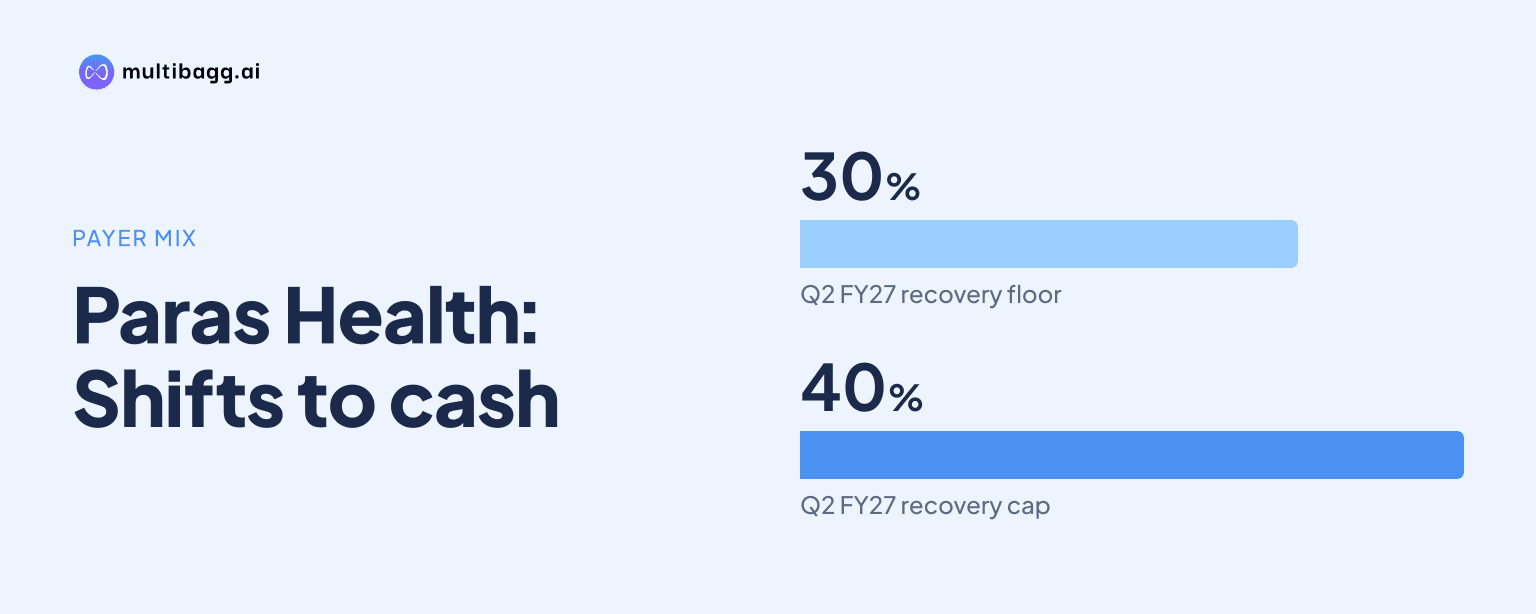
In Q2 FY27, Paras Healthcare Limited said a temporary suspension of a Rajasthan state government scheme softened Udaipur’s performance, but cash and insurance business grew in absolute terms and recovered almost 30%-40% of the prior state-scheme business. Management is pursuing lower dependence on government-funded patients across its hospitals.
Know Paras Healthcare inside out
Results, valuation, peers and who's buying, in one view.
Why was Paras Health's Udaipur performance softer?
Paras Health said Udaipur was softer in Q2 FY27 because the state government scheme in Rajasthan was under review and had been temporarily suspended across multiple hospitals in the state. Chief Operating Officer Vineet Aggarwal said the review involved both the state and central governments. Management did not provide Udaipur-specific revenue, patient-volume, occupancy or margin figures for the quarter, so the precise financial impact was not quantified on the call.
The interruption matters because government schemes and public-sector undertakings remained a substantial part of Paras Health’s consolidated payer mix. In H1 FY27, cash or self-pay represented 32% of business, insurance accounted for 24%, and government schemes plus public-sector undertakings made up the remaining 44%. The disclosed Rajasthan disruption therefore occurred while government-linked business was still the group’s largest payer category.
How is Paras Health replacing Udaipur's scheme-funded business?
Paras Health said it has increased cash and insurance business in Udaipur in absolute terms, recovering almost 30%-40% of what it had generated through the entire state government business. Management described the change as an improvement in the hospital’s overall payer mix, rather than giving a separate Udaipur cash, insurance or government-scheme percentage. The stated response is to build non-government patient channels while the scheme remains suspended.
Management said it is taking multiple future initiatives in Udaipur and across its units to reduce dependence on government-scheme business. The transcript did not identify those initiatives, set a targeted payer-mix percentage, or give a deadline for reducing the exposure. Aggarwal said Paras Health remained hopeful that the scheme would restart for Rajasthan hospitals, including its Udaipur facility, at which point management expects operating leverage to resume.
The shift toward privately funded care sits alongside a group-level improvement in utilisation. Paras Health’s occupancy reached 76.3% in Q2 FY27, compared with 62.5% in Q2 FY26, a rise of 1,380 basis points. For H1 FY27, group occupancy was 73%, against 59% a year earlier, while occupied bed days increased 23.9% to 201,000 from 162,000. Those figures show broader volume growth, but they do not isolate whether Udaipur’s replacement business fully offset its scheme disruption.
Got a follow-up? Ask IRIS
How did Paras Health's Udaipur cohort perform despite the disruption?
Paras Health’s emerging-hospital cohort, comprising Ranchi and Udaipur, reported revenue growth of 27.2% in Q2 FY27 and 43.2% in H1 FY27, although management said Ranchi had an exceptional quarter. Because the company reports the two facilities together, the cohort’s growth cannot be used to determine Udaipur’s standalone revenue trajectory. The combined result does not disclose how much Udaipur contributed to the reported growth.
The emerging cohort’s operating earnings before interest, tax, depreciation and amortisation, or EBITDA, rose more than 46% in Q2 FY27 and 110.9% in H1 FY27. Its H1 FY27 EBITDA margin reached 18.3%, compared with 12.4% in H1 FY26, an increase of 586 basis points. Occupancy in the same cohort climbed to 68.6% from 49.1%, a gain of 1,950 basis points, indicating higher utilisation across Ranchi and Udaipur combined.
The comparison with mature hospitals shows the remaining margin difference between cohorts. Paras Health’s mature cohort of Gurgaon, Patna, Panchkula and Darbhanga delivered a 29.6% operating EBITDA margin in Q2 FY27 after revenue grew 8.5%. Emerging hospitals grew faster, but their H1 FY27 margin of 18.3% was 10.6 percentage points below the mature cohort’s 28.9% H1 margin. The Rajasthan scheme suspension is a disclosed factor affecting Udaipur within that emerging cohort.
What do Paras Health's wider results say about payer risk?
Paras Health reported consolidated revenue of Rs 511 crore in Q2 FY27, up 23% year on year and 8.6% sequentially from Q1 FY27. Operating EBITDA, excluding other interest income, was Rs 120 crore, compared with Rs 81.7 crore a year earlier, while operating EBITDA margin was 23.5%, according to the Managing Director’s opening remarks. The result shows that Udaipur’s softer performance did not prevent group revenue and operating profit growth during the quarter.
For H1 FY27, revenue was Rs 981 crore, up 25% year on year, and operating EBITDA was Rs 225 crore versus Rs 142 crore in H1 FY26. Operating EBITDA margin rose to 23.0% from 18.1%, with management attributing most of the improvement to a more than 3% reduction in material cost through procurement efficiencies, formulary compliance and case mix. Management also cited a 70-basis-point improvement in doctor cost as operating leverage increased despite new hiring.
Payer mix also affects collections, not only revenue composition. Receivables increased to Rs 518 crore at September 2026 from Rs 350 crore in March 2026, which management linked to payer-mix change, settlement cycles and lumpy payments from certain payer groups. Paras Health reported blended days sales outstanding, or DSO, of about 92 days and described receivables as a management priority. Operating cash flow in H1 FY27 was Rs 68 crore despite a negative working-capital movement of Rs 172 crore.
Conclusion
Paras Health’s disclosure identifies a specific payer-mix disruption in Udaipur rather than a group-wide growth reversal. Rajasthan’s suspended state scheme softened the hospital, but management said cash and insurance business recovered almost 30%-40% of prior state-scheme business. At the consolidated level, Q2 FY27 revenue grew 23% to Rs 511 crore, while the Ranchi-and-Udaipur cohort still recorded 27.2% revenue growth.
The next disclosed uncertainty is whether Rajasthan restarts the scheme and whether Paras Health can further replace government-funded business without it. Management gave no restart date, no Udaipur-specific revenue target and no revised payer-mix target. Subsequent disclosures on receivables will also matter, after receivables increased by Rs 168 crore between March and September 2026 and management cited payer mix and settlement cycles as causes.