










Paras Healthcare receivables reach Rs 518 crore, DSOs hit 92 days
Key highlights
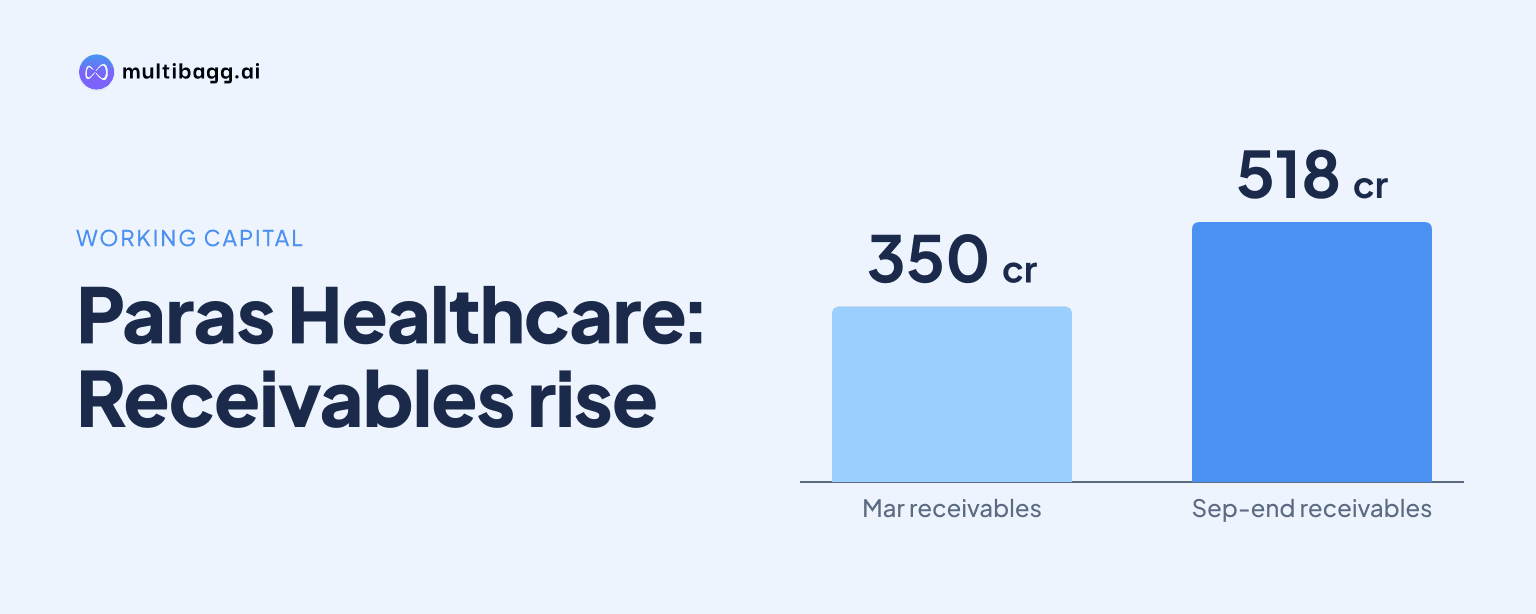
- Paras Healthcare's receivables increased Rs 168 crore from Rs 350 crore in March to Rs 518 crore at September-end.
- Paras Healthcare's blended DSOs rose from about 79 days in March to 92 days in H1 FY27.
- Paras Healthcare generated Rs 68 crore of OCF after Rs 172 crore of working-capital absorption in H1 FY27.
- Paras Healthcare's newer hospitals increased H1 FY27 revenue 147% year on year and generated more than Rs 25 crore of operating EBITDA.
powered by IRIS
Paras Healthcare Limited reported receivables of Rs 518 crore and blended days sales outstanding, or DSOs, of about 92 days at September-end in H1 FY27, contributing to Rs 172 crore of working-capital absorption and Rs 68 crore of operating cash flow. Management linked the increase to business growth, payer-mix changes, settlement cycles and newer-hospital empanelments.
Know Paras Healthcare inside out
Results, valuation, peers and who's buying, in one view.
Why did Paras Healthcare absorb Rs 172 crore of working capital?
Paras Healthcare absorbed Rs 172 crore of working capital in H1 FY27, principally as receivables increased and collection timing changed across payer groups. The company generated Rs 68 crore of operating cash flow, or OCF, in the half year despite that movement, while consolidated revenue increased 25% year on year to Rs 981 crore.
Management said the 25% growth in business was one driver of the working-capital movement. The chief financial officer also cited a greater proportion of empanelments at newer hospitals, as well as payer-mix changes, settlement cycles and lumpy payments from certain payer groups, as factors behind the higher debtor balance.
Paras Healthcare reported an H1 FY27 payer mix of 32% cash or self-pay, 24% insurance, and 44% government schemes and public-sector undertakings, or PSUs. Management did not provide receivable balances or collection days separately for these categories, but called receivable management a priority and described the 92-day blended DSO as under control.
How did Paras Healthcare's receivables and DSOs change?
Paras Healthcare's receivables rose Rs 168 crore from Rs 350 crore in March to Rs 518 crore at September-end, while blended DSOs increased by 13 days from about 79 days to 92 days. Management specifically discussed the March-to-September movement when explaining the H1 FY27 working-capital absorption.
Profit growth exceeded OCF in the reported period. Paras Healthcare recorded profit after tax, or PAT, of Rs 90 crore in H1 FY27, compared with Rs 44 crore for all of FY26, while OCF was Rs 68 crore in the first half after the Rs 172 crore working-capital outflow. The figures show that the disclosed increase in receivables affected the timing of cash generation.
Operating performance also rose in Q2 FY27. Revenue was Rs 511 crore, up 23% year on year and 8.6% sequentially, while operating earnings before interest, tax, depreciation and amortisation, or EBITDA, increased to Rs 120 crore from Rs 81.7 crore a year earlier. For H1 FY27, operating EBITDA grew 58% to Rs 225 crore and its margin rose to 23% from 18.1% in H1 FY26.
Management attributed the margin change mainly to a material-cost improvement of more than 3%, citing procurement efficiencies, formulary compliance and case mix. It also reported a 70-basis-point improvement in doctor cost from operating leverage despite hiring across hospitals, including the newer facilities. These operating improvements did not remove the cash effect of higher receivables during H1 FY27.
Got a follow-up? Ask IRIS
How are newer hospitals and empanelments affecting Paras Healthcare?
Paras Healthcare said additional empanelments at its newer hospitals were a factor behind higher debtors and the rise in DSOs to 92 days. Srinagar and Kanpur, the newer-hospital cohort, increased H1 FY27 revenue 147% year on year and generated operating EBITDA of more than Rs 25 crore, compared with negative Rs 13 crore in FY26.
Management said its early strategy in Srinagar and Kanpur was to fill beds faster through empanelments. It said all insurance and government-scheme empanelments in Kanpur were complete by the November 6, 2026 earnings call, although it did not disclose receivables attributable separately to Kanpur or Srinagar.
The newer hospitals' occupancy increased to 68.4% in H1 FY27 from 27.8% in H1 FY26. Kanpur's occupancy rose to 78.4% from 22.7% over the same comparison, and management said roughly half of its 435-bed capacity had been opened, leaving two wings to be operationalised by the end of FY27.
Management said it sees scope to improve cash, insurance and corporate business, referred to as CTC, after completing the newer hospitals' empanelments. It cited marketing initiatives to expand the consultation funnel and convert consultations into admissions, but did not provide a target for cash-pay mix, insurance mix, receivables or DSOs.
What else could affect Paras Healthcare's cash conversion?
Paras Healthcare spent Rs 90 crore on capital expenditure in H1 FY27 across units and on payments for its Gurgaon 2 project, separate from the Rs 172 crore working-capital movement. Management also plans to open about 200 to 250 beds in Kanpur and Ranchi, taking operational beds from 1,500 closer to 1,800 within existing capacity.
The balance sheet changed after the initial public offering, or IPO. Paras Healthcare reported gross borrowings of Rs 979 crore and cash of Rs 360 crore at September-end, resulting in net debt of Rs 620 crore. It said Rs 375 crore of term debt had been repaid from the Rs 500 crore fresh issue, with pro forma net debt of Rs 143 crore after repayment.
Management also explained a Rs 50 crore fixed deposit classified as other financial assets. It said the longer-term deposit was with regular bankers and had been reclassified under audit standards rather than shown as a current bank balance; management linked the deposit to an Rs 80 crore equity infusion received in April 2025.
Udaipur's Q2 FY27 performance was softer because a Rajasthan state-government scheme was temporarily suspended across multiple hospitals, management said. Paras Healthcare said Udaipur's cash and insurance business had recovered almost 30% to 40% of the state-government business, while the company works to reduce dependence on government-scheme business across units.
Conclusion
Paras Healthcare paired 25% H1 FY27 revenue growth to Rs 981 crore and PAT of Rs 90 crore with a substantial increase in funds tied up in receivables. The rise to Rs 518 crore in receivables and 92 days in blended DSOs resulted in Rs 172 crore of working-capital absorption, limiting OCF to Rs 68 crore despite higher operating EBITDA.
What to watch next is whether DSOs settle as management expects as payer mix evolves and newer-hospital empanelments mature. Paras Healthcare has not given a DSO target, while it plans 200 to 250 additional operational beds in Kanpur and Ranchi and has 300 beds at Gurgaon 2 and 500 beds at Ludhiana planned over the next 12 to 18 months.