










Paras Health targets 3,011 beds by 2028 with new hospitals
Key highlights
- Paras Health targets about 3,011 beds by 2028, compared with 2,211 beds in FY26.
- Gurugram II is planned as a 300-bed hospital for 2027.
- Ludhiana is planned as an approximately 500-bed hospital for 2028.
- Paras Health reported FY26 revenue from operations of Rs 1,606 crore and occupancy of 62%.
powered by IRIS
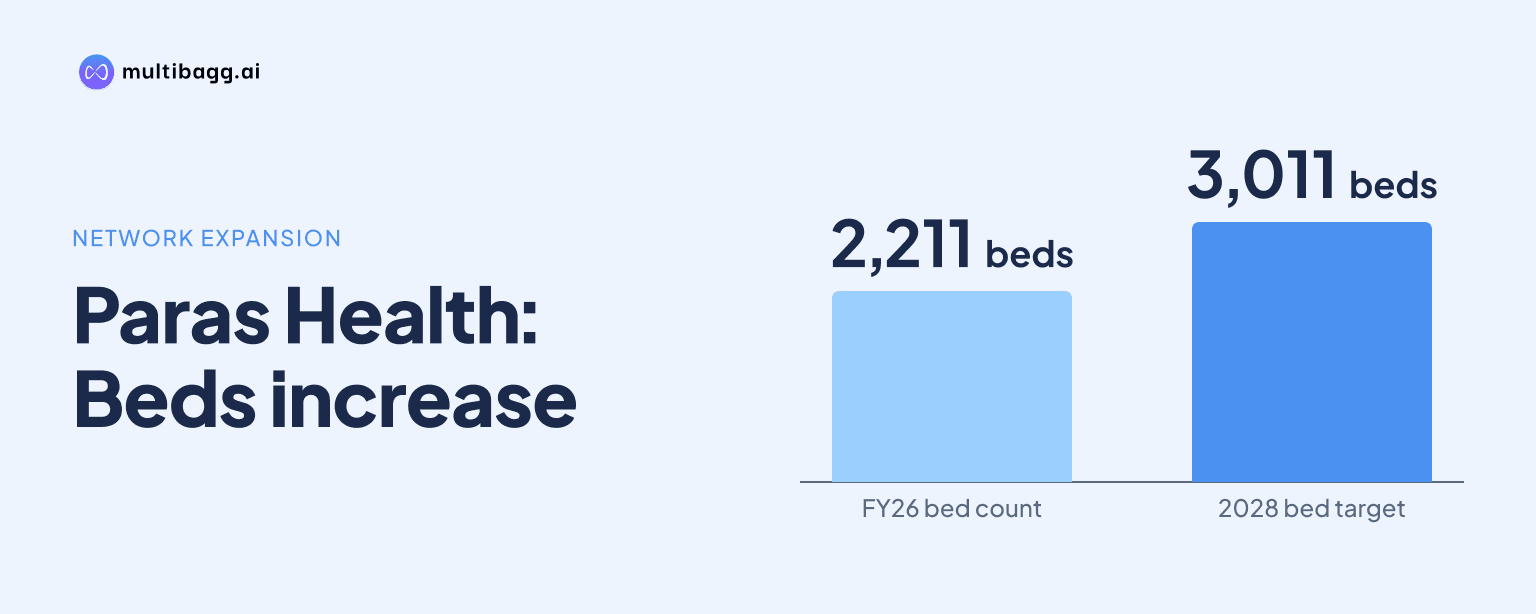
Paras Healthcare, referred to in its presentation as Paras Health, plans to expand from 2,211 beds in FY26 to about 3,011 beds by 2028, led by a 300-bed Gurugram II hospital planned for 2027 and a roughly 500-bed Ludhiana hospital planned for 2028. The two projects represent about 800 additional beds.
Know Paras Healthcare inside out
Results, valuation, peers and who's buying, in one view.
How will Paras Health reach about 3,011 beds by 2028?
Paras Health plans to reach about 3,011 beds by adding 300 beds in Gurugram and about 500 beds in Ludhiana to its FY26 base of 2,211 beds. The presentation identifies eight hospitals across five states and one Union Territory in FY26, with two upcoming hospitals taking the network to 10 facilities by 2028.
The targeted increase of about 800 beds represents approximately 36% of the FY26 network capacity. Paras Health reported revenue from operations of Rs 1,606 crore in FY26 from the existing platform, which had 338,321 occupied bed days and occupancy of 62%. The presentation does not provide revenue, occupancy, margin or profit targets for the two planned hospitals.
The capacity figures combine the presentation's current-network data with its project timeline. Gurugram II is listed at 300 beds and Ludhiana at 500 beds in the timeline, although the network overview describes both upcoming capacities as approximate. The presentation does not disclose phased commissioning plans for either project.
What are the Gurugram II and Ludhiana expansion plans?
Paras Health plans a 300-bed Gurugram II hospital for 2027 and an approximately 500-bed Ludhiana hospital for 2028. Gurugram II would extend Paras Health's presence in its longest-established market, where its first 300-bed hospital opened in 2006. Ludhiana would be a new city for the stated network.
Ludhiana is the larger proposed project, with about 200 more beds than Gurugram II. At approximately 500 beds, it would also exceed the 435-bed Kanpur hospital, which is the largest individual existing facility listed in the presentation. Gurugram II would match the 300-bed capacity shown for the original Gurugram hospital and Ranchi.
The presentation does not identify either upcoming hospital as owned, fixed-rent, revenue-share or public-private partnership operated. It also does not disclose project cost, land or building arrangements, staffing requirements, accreditation plans or a more specific opening date than 2027 for Gurugram II and 2028 for Ludhiana.
How is Paras Health's existing hospital network structured?
Paras Health's existing 2,211-bed network uses owned, fixed-rent, revenue-share and partial fixed-rent structures, including a public-private partnership, or PPP, model at Ranchi. The four mature hospitals, defined as operating for more than seven years, account for 1,076 beds: Gurugram with 300, Patna with 392, Darbhanga with 100 and Panchkula with 284.
Gurugram is owned, while Patna and Panchkula operate on revenue share plus partial fixed rent and Darbhanga operates on revenue share. Patna opened in 2013 and was accredited by the National Accreditation Board for Hospitals and Healthcare Providers, or NABH, in 2016. Panchkula, opened in 2018, has an Atomic Energy Regulatory Board-licensed radiotherapy centre, according to the presentation.
The two emerging hospitals, both opened in 2019, provide another 500 beds: Udaipur has 200 owned beds and Ranchi has 300 beds under revenue share plus partial fixed rent through a PPP model. Ranchi was upgraded to 300 beds in FY2023. The two newer hospitals add 635 beds, comprising Srinagar's 200 fixed-rent beds opened in 2023 and Kanpur's 435 fixed-rent beds opened in 2024.
Hospitals opened from 2019 onward account for 1,135 beds, compared with 1,076 beds in the four mature hospitals. This means the newer and emerging group has 59 more beds than the mature group, while the proposed 800-bed addition would further change the network's capacity mix. The presentation does not state which of the existing operating structures will be used for the two planned projects.
Got a follow-up? Ask IRIS
Why is Paras Health focusing on North Indian markets?
Paras Health is focusing on North Indian markets because its presentation identifies lower hospital-bed density and a stated capacity shortfall in the region. It cites 14 to 15 beds per 10,000 people in North India, compared with 29 to 30 beds per 10,000 in South India, and estimates a North Indian shortfall of about 424,714 beds.
The presentation estimates North India's healthcare industry could grow at a compound annual growth rate, or CAGR, of 10% to 12% between FY26 and FY30, reaching Rs 3.6 lakh crore to Rs 3.8 lakh crore by FY30. These are market estimates in the presentation, rather than forecasts for Paras Health's own revenue or earnings.
Paras Health's eight current locations are Gurugram, Panchkula, Patna, Udaipur, Darbhanga, Srinagar, Kanpur and Ranchi. The presentation states that about 60% of India's population lives in North and East India. Its planned 2028 Ludhiana entry would add a Punjab location, while Gurugram II would deepen capacity in Haryana.
What does Paras Health's FY26 operating base show before expansion?
Paras Health reported Rs 1,606 crore of revenue from operations and Rs 43.8 crore of profit after tax in FY26 before the planned capacity additions. It also reported average revenue per occupied bed, or ARPOB, of Rs 47,398, an average length of stay, or ALOS, of 2.9 days, and a CONGOR share of 75%.
The FY26 network had 1,011 doctors and 1,665 nurses supporting 2,211 beds. At 62% occupancy, Paras Health recorded 338,321 occupied bed days. The presentation does not estimate how many doctors, nurses, occupied bed days or revenue the Gurugram II and Ludhiana hospitals may add.
Paras Health's balance sheet showed property, plant and equipment plus capital work-in-progress of Rs 703.5 crore at September 2026, compared with Rs 702.3 crore at March 2026. Right-of-use assets were Rs 521.4 crore at September 2026, down from Rs 531.1 crore at March 2026. These reported asset categories sit alongside the varied owned and rental structures used across the existing hospital base.
Conclusion
Paras Health has set out a defined capacity path from 2,211 FY26 beds to about 3,011 beds by 2028, with Gurugram II and Ludhiana accounting for the full planned increase of about 800 beds. The expansion would build on a network whose 1,135 beds opened from 2019 onward already exceed the 1,076 beds in its four mature hospitals.
The next disclosed milestones are the planned 2027 opening of Gurugram II and the planned 2028 Ludhiana entry. Key unresolved matters are the operating structures, project spending, commissioning progress and staffing plans for the two facilities, none of which the presentation specifies.