










Paras Healthcare Q2 FY27 Revenue Rises 23% to ₹511 Crore
Key highlights
- Paras Healthcare reported Q2 FY27 revenue of ₹510.9 crore, up 22.8% year-on-year.
- Q2 FY27 operating EBITDA rose 47.0% to ₹120.2 crore, and margin increased 390 basis points to 23.5%.
- H1 FY27 revenue reached ₹981.2 crore, up 25.1%, while operating EBITDA rose 58.4% to ₹225.2 crore.
- Receivables stood at ₹518 crore and H1 FY27 operating cash flow was ₹68 crore.
powered by IRIS
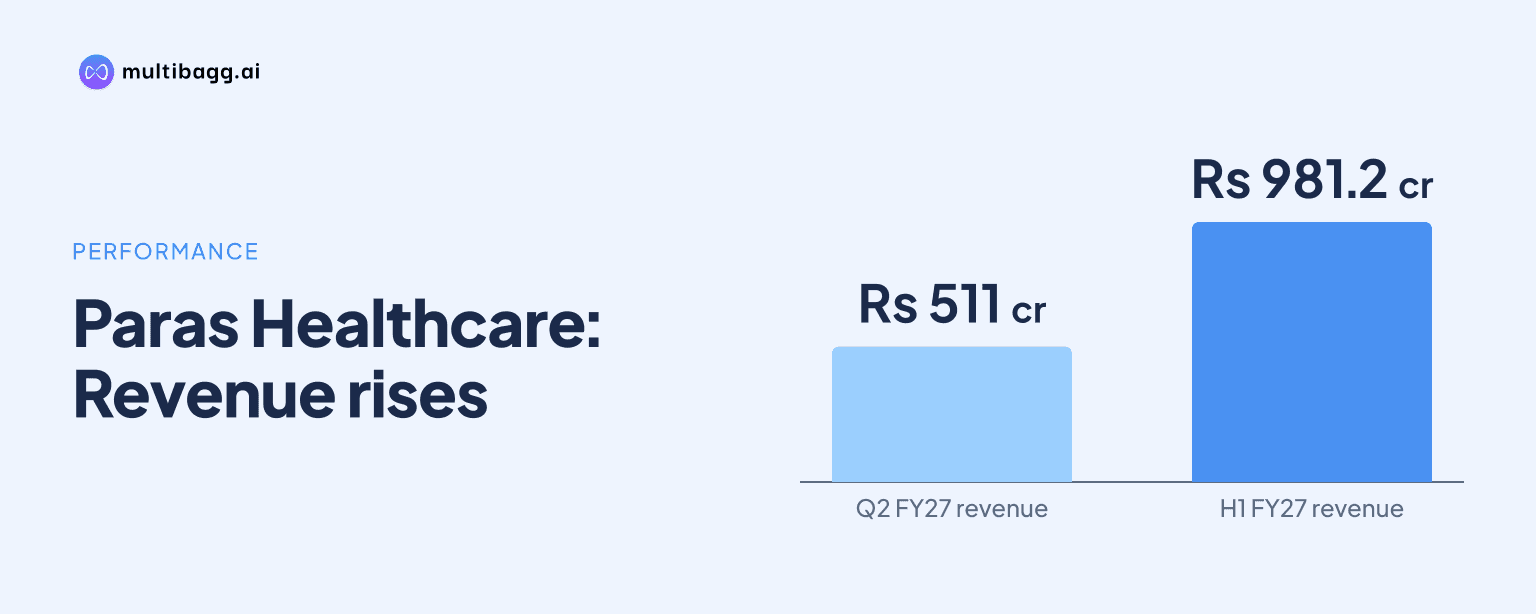
Paras Healthcare Limited reported consolidated Q2 FY27 revenue of ₹511 crore, up 23% year-on-year, while operating EBITDA increased 47% to ₹120 crore and the operating EBITDA margin improved by 390 basis points to 23.5%. The performance reflected growth in emerging hospitals, additional beds at Kanpur and Ranchi, and improved operating leverage.
Know Paras Healthcare inside out
Results, valuation, peers and who's buying, in one view.
How did Paras Healthcare perform in Q2 FY27?
Paras Healthcare recorded revenue from operations of ₹510.9 crore in Q2 FY27, broadly in line with the rounded ₹511 crore figure discussed on the earnings call. Revenue was 22.8% higher than the year-earlier quarter and 8.6% above the preceding quarter. Total income for the quarter was ₹517 crore.
Operating EBITDA, excluding other income, rose 47.0% year-on-year to ₹120.2 crore. This lifted the operating EBITDA margin to 23.5%, an improvement of 390 basis points from the prior-year period. Reported EBITDA was ₹126.6 crore, up 42.5% year-on-year.
Profit after tax rose to ₹40.3 crore in Q2 FY27 from ₹12.4 crore a year earlier. Consolidated profit before tax was ₹54.2 crore, compared with ₹19.8 crore in the corresponding quarter of FY26. Finance costs stood at ₹33.8 crore during the quarter.
The company held its Q2 and H1 FY27 earnings call on 6 November 2026, hosted by JM Financial. The call recording was subsequently made available on the company website.
What drove the quarterly revenue and margin increase?
Paras Healthcare said emerging hospitals contributed materially to revenue growth, while the operationalisation of beds in Kanpur and Ranchi supported network expansion. Management also said new hospitals had become EBITDA-profitable, indicating progress in the ramp-up of recently added capacity.
The company linked the margin improvement to rapid cohort maturation and better operating leverage. In a hospital network, newer facilities typically carry fixed costs before patient volumes build. The Q2 results indicate that higher utilisation and revenue growth at newer units contributed to a stronger consolidated margin.
Management also highlighted a focus on improving case mix through higher-margin quaternary care programmes, including liver and kidney transplants. The stated objective is to sustain operating EBITDA margins above 24%, although no numeric revenue or earnings guidance was provided during the call.
What do the H1 FY27 numbers show?
For the first half of FY27, Paras Healthcare reported revenue of ₹981.2 crore, up 25.1% year-on-year. Total income reached ₹996.1 crore. The first-half growth rate was higher than the Q2 rate, showing continued expansion through the first six months of the financial year.
Operating EBITDA for H1 FY27 increased 58.4% to ₹225.2 crore, while reported EBITDA rose 54.7% to ₹240.1 crore. Profit after tax for the half year was ₹90.0 crore, compared with ₹11.4 crore in the year-earlier period. Consolidated profit before tax rose to ₹102.3 crore from ₹25.7 crore.
The difference between revenue growth and faster EBITDA growth reflects the operating leverage discussed by management. However, the company also reported H1 finance costs of ₹64.0 crore, which remains relevant when assessing the relationship between operating performance and net profitability.
Got a follow-up? Ask IRIS
How is Paras Healthcare expanding its hospital network?
Paras Healthcare operates eight hospitals across six states and one Union Territory. Management said its strategy is centred on North and East India, with an emphasis on bringing tertiary and quaternary care closer to patients in these regions.
The company has two upcoming hospitals, including greenfield projects in Gurgaon and Ludhiana. Management said these projects are expected to add capacity over the next 18 months. Its stated network target is 3,011 beds by 2028.
Management also noted that specialist talent availability is uneven across its operating regions, with Darbhanga identified as a particular challenge. This is significant because hospital expansion depends not only on physical beds but also on the ability to recruit and retain clinical teams capable of delivering specialised care.
What are the key issues investors should monitor?
Higher receivables were a near-term point of attention. Receivables rose to ₹518 crore, while H1 operating cash flow was ₹68 crore. The gap between reported profitability and operating cash generation is relevant for investors because collections influence liquidity and the pace at which debt can be repaid.
The Rajasthan scheme suspension was also identified as a watchpoint in call summaries, alongside payer mix and Udaipur's scheme exposure. The provided material does not quantify the financial effect of the suspension, so its impact cannot be assessed from the disclosed information.
Debt reduction was described as a support for the company’s growth plan and balance-sheet position. But the disclosed finance cost of ₹64.0 crore for H1 FY27 shows that borrowing costs remain a meaningful item in the consolidated financial results.
Conclusion
Paras Healthcare delivered stronger Q2 and H1 FY27 financial performance, with revenue growth accompanied by a larger increase in operating EBITDA and a 390-basis-point quarterly margin expansion. Emerging hospitals, added capacity in Kanpur and Ranchi, and a shift towards specialised care were the principal operational factors cited by management.
Investors will watch the ramp-up of the Gurgaon and Ludhiana projects, progress towards the 3,011-bed target by 2028, receivable collections, and the effect of the Rajasthan scheme suspension. Management has stated a goal of sustaining operating EBITDA margins above 24%, but it did not provide numeric guidance on the earnings call.