










PNGS Reva says EBOs need 15-18 months to meaningfully aid earnings
Key highlights
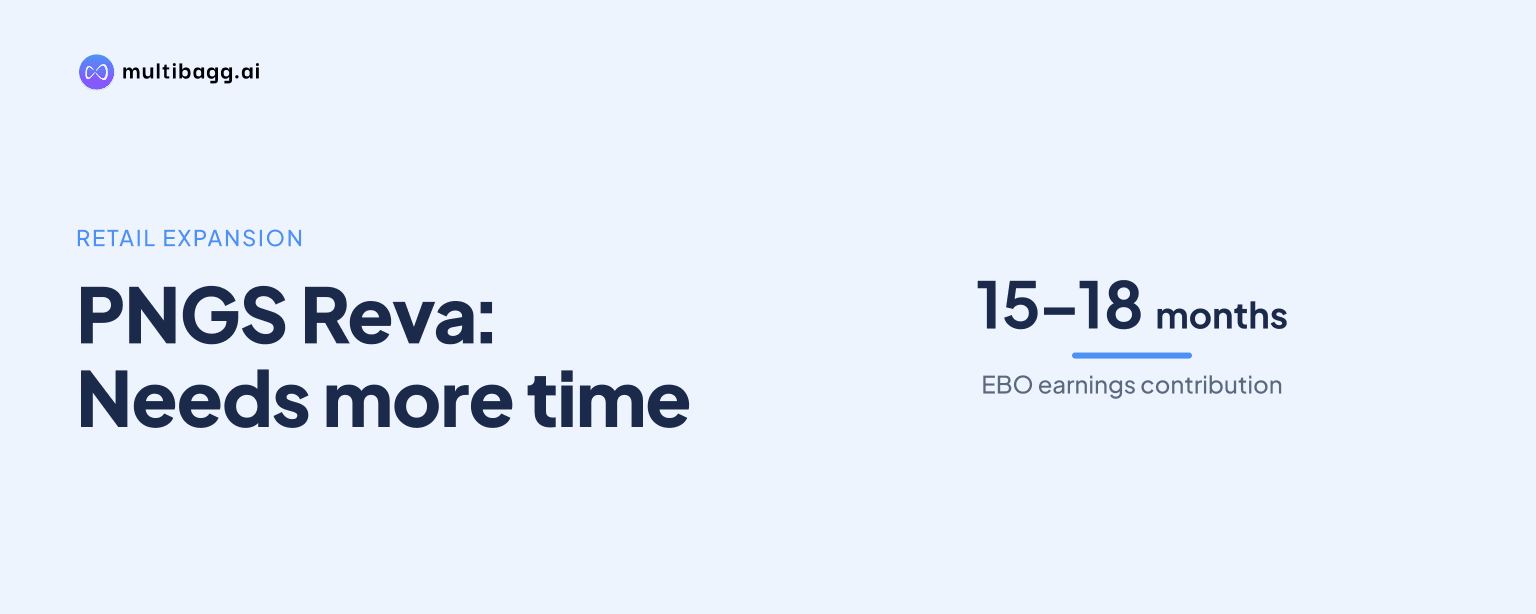
- PNGS Reva says each EBO needs 15 to 18 months for a meaningful earnings contribution.
- H1 FY27 EBITDA was Rs 63 crore, up 103% year on year, with a 26.3% margin.
- Management expects at least three EBO additions in H2 FY27 under its 15-store, 24-month plan.
- A 1,200-square-foot EBO requires Rs 12 crore to Rs 15 crore of inventory, according to management.
powered by IRIS
PNGS Reva Diamond Jewellery Limited says newly opened exclusive brand outlets, or EBOs, need 15 to 18 months before they contribute meaningfully to earnings, while H1 FY27 earnings before interest, tax, depreciation and amortisation, or EBITDA, margin reached 26.3%. Management said early-stage outlet marketing costs could move the full-year margin by about 200 basis points.
Know PNGS Reva Diamond Jewellery inside out
Results, valuation, peers and who's buying, in one view.
How long will PNGS Reva’s new EBOs take to aid earnings?
PNGS Reva said EBOs contribute to costs during their early period and generally require 15 to 18 months to make a meaningful contribution to earnings. Management made that assessment while discussing whether the 26.3% EBITDA margin reported in H1 FY27 could continue through the full year as the company expands its EBO network.
The company distinguishes initial sales from a meaningful earnings contribution. Management said stores generate sales before reaching that point, but a constructive contribution requires profitable sales that also support company-level profitability. At the October 30, 2026 call, PNGS Reva said its oldest EBO was 12 months old and that EBOs being established then should begin making constructive contributions from Q4 FY28.
Why could PNGS Reva’s margins change as it opens EBOs?
PNGS Reva said new EBOs could put pressure on percentage margins because marketing costs increase before outlets mature. Management said EBITDA margin may move by plus or minus 200 basis points during the rollout, with 100 basis points equal to one percentage point.
That outlook follows higher reported margins in the first half. H1 FY27 EBITDA was Rs 63 crore, up 103% year on year, and EBITDA margin rose to 26.3% from 19.6% in H1 FY26. In Q2 FY27, EBITDA was Rs 29 crore, up 49% year on year, while its margin increased to 23.8% from 18.7% a year earlier.
The timing of new openings and associated marketing spending can therefore affect margin percentages alongside sales at mature stores. Management said Q3 FY27 had started strongly: sales over the 10 Navaratri and Dussehra days were 35% higher overall year on year, while Dussehra-day sales rose 62%.
How many EBOs is PNGS Reva planning to add?
PNGS Reva plans to complete 15 EBOs over 24 months and said it expects at least three additions in H2 FY27. Management said it had completed five outlets and expected another within one or two weeks, leaving nine of the 15-outlet commitment to be completed over the next 18 to 20 months, potentially before schedule.
The company also said it had six EBOs operating at the time of its update, including Wakad, Paud Road, Amanora Mall, Nashik, Jaipur and Bavdhan. Wakad was established before the initial public offering at the end of September, Paud Road in the last week of March, Amanora Mall in the first week of July, Nashik at the end of August, and Bavdhan opened on the day of the call.
Management said it is focusing more on Tier 1 cities and, outside Maharashtra, expects to prefer mall locations over high streets. It said Tier 2 and Tier 3 cities would be considered only where the potential is identified. The EBO rollout sits alongside the shop-in-shop, or SIS, format, which management said was the main contributor to the currently reported results.
Got a follow-up? Ask IRIS
What capital does PNGS Reva need for each EBO?
PNGS Reva said a typical EBO averages about 1,200 square feet and requires Rs 2 crore to Rs 2.5 crore per location for initial marketing and infrastructure, alongside inventory. Management said inventory represents about 70% to 80% of total store capital, with the remainder covering infrastructure and initial marketing.
Inventory requirements increase with store size. Management estimated Rs 10 crore to Rs 12 crore for a 1,000-square-foot store, Rs 12 crore to Rs 15 crore for a 1,200-square-foot outlet, and Rs 15 crore to Rs 18 crore for a 1,500-square-foot location. Infrastructure includes furniture, signage, audio-visual screens, air conditioning, generators, computers and weighing equipment.
PNGS Reva leases rather than buys premises, so property acquisition is not included in store investment. Management cited rents of Rs 300 to Rs 700 per square foot a month; at Rs 500 per square foot for a 1,200-square-foot outlet, monthly rent would be about Rs 6 lakh and a six-month lease deposit would be around Rs 30 lakh to Rs 40 lakh.
What financial performance accompanies PNGS Reva’s rollout?
PNGS Reva reported H1 FY27 revenue excluding gold sales of Rs 239 crore, which management said was 76% higher year on year on a jewellery-to-jewellery comparison. Reported Q2 FY27 revenue from operations was Rs 121 crore, up 17%, because the prior-year comparison included larger business-to-business sales of exchanged gold scrap.
Management said it is retaining exchanged gold for captive consumption as its fabricated jewellery requirements grow, instead of recording sizeable scrap-gold sales. H1 FY27 gross profit rose 90% year on year to Rs 79 crore, while profit after tax was Rs 51 crore, up 151%, with a margin of 21.2%.
The company’s sales mix remains principally showroom-led. Management said more than 70% of jewellery sales come from ready goods in showrooms, while customer orders account for no more than 30%. Its e-commerce platform, revadiamonds.com, is intended mainly to show the product catalogue and bring customers to stores rather than become a sizeable online-sales channel.
Conclusion
PNGS Reva’s expansion plan creates a stated near-term trade-off between adding outlets and receiving their earnings contribution. The company is committing inventory, marketing, infrastructure and lease deposits before EBOs reach the 15-to-18-month period management associates with meaningful earnings, even as H1 FY27 EBITDA margin rose to 26.3% from 19.6%.
The next marker is H2 FY27, when management expects at least three additional EBOs under its 15-store, 24-month plan. Management has also said margins may move by about 200 basis points during the rollout, while it expects EBOs being opened now to begin making constructive contributions from Q4 FY28.