










Radiant targets one-third of revenue from direct clients
Key highlights
- Radiant aims to increase direct-client revenue from about 20% to one-third within a year or two.
- Radiant is close to 80,000 annual touch points, while the industry handles fewer than 2 lakh points across 2 crore retail outlets.
- Radiant said cash handled was about Rs 1.6 lakh crore in the last year and current year, while cash per store declined marginally.
- Management expects a 12% to 15% price revision to show clearly in the fourth quarter.
powered by IRIS
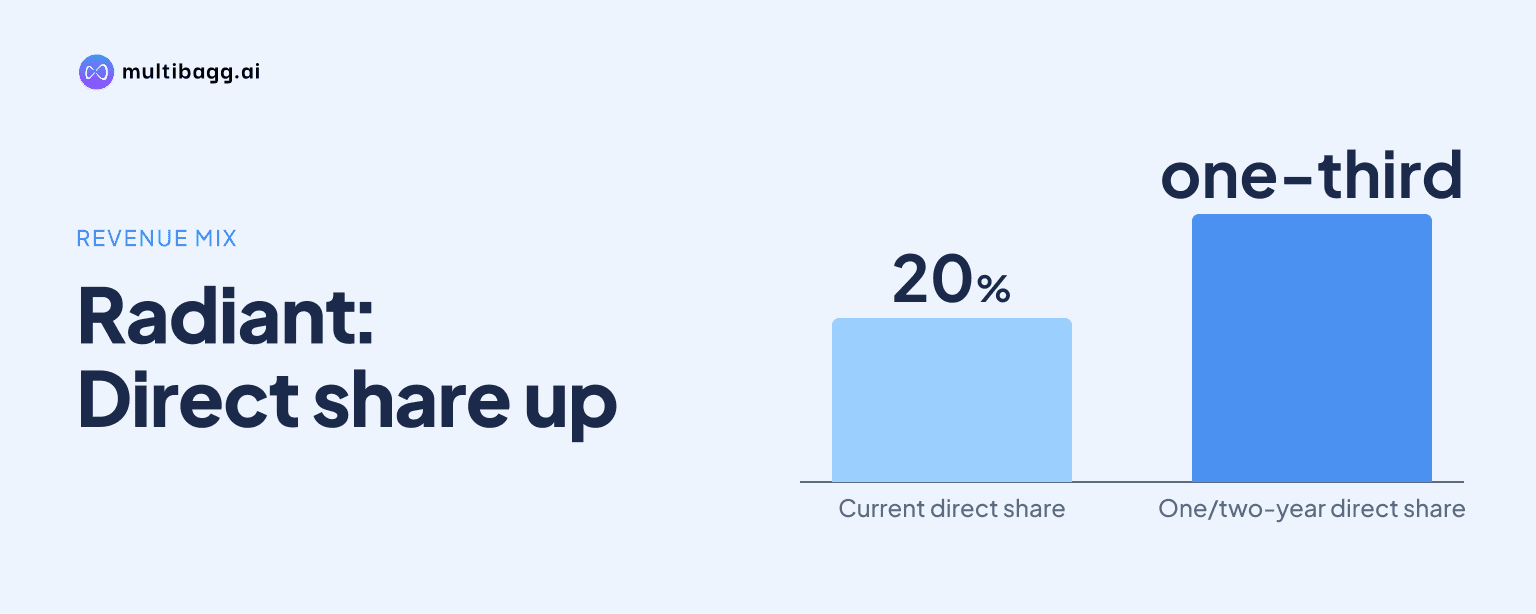
Radiant aims to raise direct clients from about 20% to one-third of revenue within a year or two, responding to slower bank-led growth by pursuing organised retail, non-banking financial companies, hospitals and government business. Management said India has 2 crore retail outlets while the industry handles fewer than 2 lakh points, implying about 1% penetration.
Know Radiant Cash Management Services inside out
Results, valuation, peers and who's buying, in one view.
Why is Radiant expanding direct client sales?
Radiant is expanding direct sales because business-point growth supplied by banks has been less robust than it was before the company’s listing. About 80% of revenue still comes through banks and 20% from direct customers, meaning bank mandates remain the principal route to market even when the end customer is an e-commerce company or an organised retailer.
Management’s target is for direct customers to account for one-third of revenue in a year or a couple of years. It said it has hired senior, sector-specific resources to win clients directly, with the effort intended to supplement rather than replace bank-originated work. The pricing mechanism does not distinguish between direct and bank clients, according to management.
The strategy follows muted core growth of 5% to 7% in the past, which management described as an aberration rather than its long-term expectation. Radiant’s stated aspiration is mid-teens revenue growth, but management did not give a dated revenue target or a numerical direct-client acquisition target beyond the one-third revenue-mix objective.
Which sectors is Radiant targeting for direct clients?
Radiant is focusing its direct-sales effort on organised retail, non-banking financial companies, hospitals and government businesses, where management sees prospects to add new clients and substantial cash volumes. By contrast, it is already present with almost all major participants in e-commerce, e-commerce logistics and railways, limiting the scope to add points in those established areas.
Management attributed low penetration in the target sectors partly to banks’ historic approach. Retail cash management was offered as a premium value-added service rather than a standard offering, it said, and public-sector banks other than State Bank of India (SBI) generally do not offer the service. Management said SBI represents about 50% of the market size, leaving a customer pool that it characterised as largely untapped.
Radiant’s commercial proposition starts at 2,500 rupees a month for collecting up to Rs 1 lakh a day over 26 days. That works out to less than 100 rupees per visit, management said. It compared its overall charge with credit-card merchant discount rates of about 2%, or 200 basis points, and said its cash-management charge is roughly 20 to 25 basis points. A basis point is one-hundredth of a percentage point.
How large is Radiant’s cash-management market opportunity?
Radiant sees the opportunity primarily in expanding the number of collection points rather than relying on higher cash handled at existing locations. It is close to 80,000 touch points in a calendar year and estimates the industry handles fewer than 2 lakh points, against India’s 2 crore retail outlets. Management said this leaves industry penetration at about 1%.
Radiant said it believes it has about 40% to 45% of the retail cash-management market by point count. That position does not mean existing locations are producing more cash per store: cash handled was about Rs 1.6 lakh crore in the last year and in the current year, while the number of points rose steadily. Management therefore reported a marginal decline in cash handled per store over that period.
The company is not basing its growth plan on same-store cash growth. Instead, it expects new points to add cash volume even if some existing points see lower collections. Management also cited currency in circulation growing at 8% to 10% a year across the economy, while cautioning that Radiant’s own cash volumes have been growing at a lower pace than it would like.
Got a follow-up? Ask IRIS
What could support Radiant’s profitability while direct sales scale up?
Radiant expects a 12% to 15% price revision, largely from banks, to be the main near-term profitability driver. Management said most price revisions would be implemented by December, with some taking effect from November 1. It expects a clearer impact in the fourth quarter and a steadier benefit in the following financial year.
The price action was prompted by rising manpower costs and minimum wages, management said. Manpower accounts for 70% of total costs, and the company said guard costs remain high in certain states, although the issue is not widespread in the North East and central states. There is no fuel-cost pass-through, which leaves fuel costs outside the stated pricing mechanism.
Management identified three further levers besides price. First, it expects losses at Radiant Acemoney and Radiant Valuable Logistics to be arrested, with both businesses expected to contribute positively to earnings before interest, taxes, depreciation and amortisation and profit after tax in coming quarters. Second, Radiant is pursuing technology-led cost reductions, particularly where artificial-intelligence tools could optimise the labour-heavy operating model. Third, direct-client growth is intended to lift revenue over the longer term.
Radiant Acemoney was nearly at break-even in the quarter discussed on the call, management said. Radiant Valuable Logistics increased revenue by 35% between the first and second quarters, and management said it expected that business to move above break-even before the end of the current financial year. These are management expectations, not reported completed outcomes.
How does the direct-client plan change Radiant’s growth outlook?
Radiant’s direct-client plan changes the growth model from one mainly dependent on banks adding end customers to one where it must source and explain its service directly to clients. Management said banks had previously driven much of the company’s growth by offering cash-management services to more customers, but that route is no longer generating the same level of new business.
The transition also means execution will matter. Management said it is deploying subject-matter experts in sectors where it sees a significant opportunity, but acknowledged investors must wait to see how effective those measures are. The one-third direct-revenue aim is therefore an aspiration linked to hiring and sales development, not a committed forecast.
Cash-volume growth is an additional variable. Management said cash circulation is increasing, yet Radiant’s roughly Rs 1.6 lakh crore of cash handled has been broadly flat across the last year and current year. The company’s stated approach is to counter slower cash per store by increasing the network beyond its current nearly 80,000 touch points.
Conclusion
Radiant is seeking to shift its revenue mix toward direct clients because bank-led expansion has slowed, while its target sectors remain lightly penetrated. The company’s case rests on moving direct revenue from 20% to one-third, converting a market of 2 crore retail outlets that currently has fewer than 2 lakh industry-served points, and supporting margins through price revisions and cost measures.
The next indicators are whether most of the 12% to 15% price increase is in place by December, whether the fourth-quarter effect appears as management expects, and whether Radiant Acemoney and Radiant Valuable Logistics move to positive contribution before the current financial year ends. Investors can also track progress toward the company’s mid-teens revenue-growth aspiration and its direct-client revenue-mix target.