










Radiant's 12%-15% Price Hikes Set Up Q4 Margin Recovery
Key highlights
- Radiant's standalone EBITDA margin fell to 7.62% in Q2 FY27 from 15.2% a year earlier.
- Radiant secured 12% to 15% client price increases, with most implementation expected by December 2026.
- Manpower-related costs account for 70% of Radiant's total cost base.
- Direct clients contributed 19.2% of Q2 FY27 revenue, versus 15.7% in Q2 FY26.
powered by IRIS
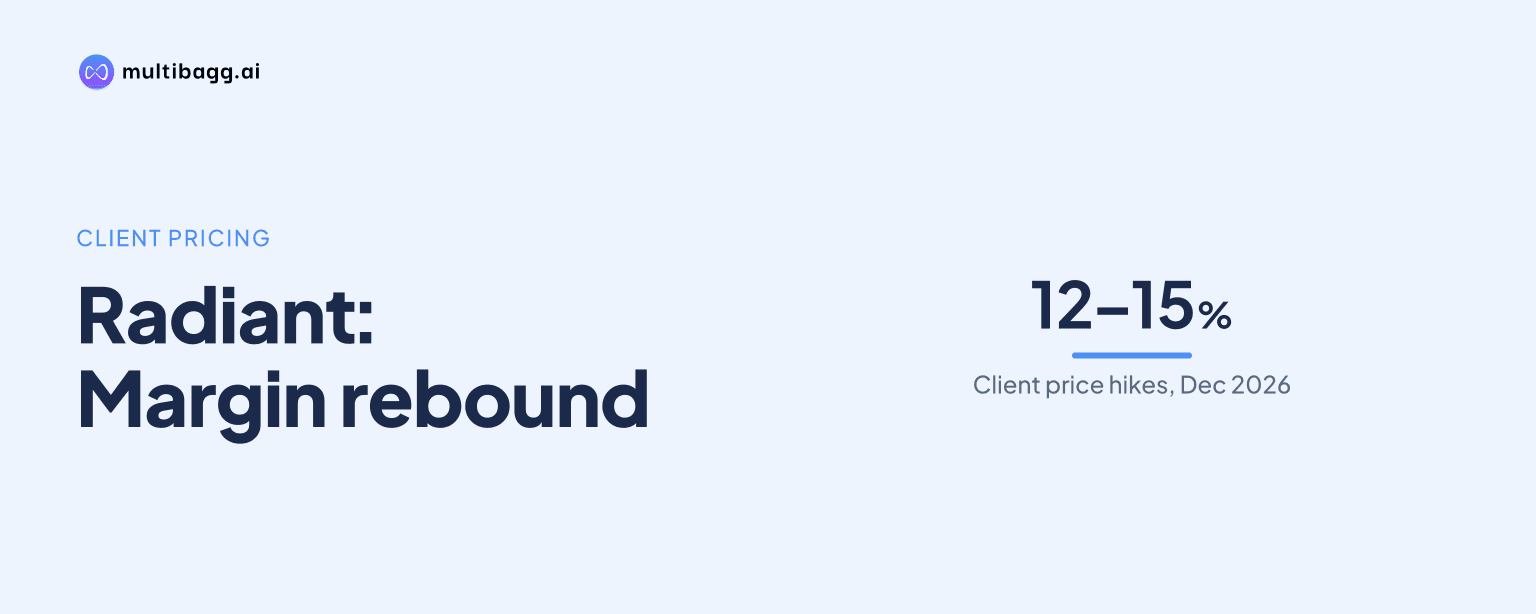
Radiant Cash Management Services Limited secured 12% to 15% price increases from a majority of clients after its standalone EBITDA margin fell to 7.62% in Q2 FY27 from 15.2% a year earlier. Management said the revisions are being implemented through the December quarter and should be clearly visible in Q4 FY27.
Know Radiant Cash Management Services inside out
Results, valuation, peers and who's buying, in one view.
Why did Radiant's EBITDA margin fall in Q2 FY27?
Radiant's standalone EBITDA, or earnings before interest, tax, depreciation and amortisation, margin fell 7.58 percentage points year on year to 7.62% in the quarter ended September 30, 2026, while consolidated EBITDA margin declined to 6.8% from 13.1%. Consolidated revenue still rose 4.4% year on year to Rs 112 crore, and standalone revenue grew 7.52%, but those gains did not absorb the increase in operating costs.
The main cause was higher manpower-related expense, which management said represents 70% of total costs. Minimum-wage revisions in certain states, higher driver and gunmen costs, service charges for cash activities, a shortage of licensed gunmen in several southern states, and higher van costs raised the cost base in Q2 FY27. Management said wages can be above minimum levels in some southern states, while North and Central India have generally faced less pressure.
Cash handled was flat at Rs 41,000 crore in Q2 FY27, a period management described as a lean season. The retail cash-management business grew 6.2% from a year earlier, supported by banking, financial services and insurance, or BFSI, and organised retail, with some recovery in e-commerce logistics. Railways, petroleum and e-commerce experienced sluggish growth, limiting the operating leverage available from higher revenue.
What price increases has Radiant obtained from clients?
Radiant has obtained price revisions of 12% to 15% from a majority of clients, mainly through interim increases from banks rather than waiting for formal contract renewals. Management said the industry had jointly raised the effect of higher manpower and minimum-wage costs with banks, and almost all of its bank clients had provided price increases.
The benefit will not begin on one common date because bank-level implementation dates and rates differ. Some revised rates began from November 1, 2026, and management said most should be implemented by December 2026. It therefore expects the impact to be clearer in Q4 FY27 and more consistent in the following financial year, but did not provide a specific EBITDA margin target.
About 80% of Radiant's business is routed through banks, while direct clients account for roughly 20%. Management said multinational and private-sector banks were the main initial recipients of the revisions. Public-sector banks have asked Radiant to discuss increases with end customers, a process management said would take longer than the bank-led adjustments.
The price revisions do not include an automatic fuel-cost pass-through. Management explicitly said there is no fuel pass-through formula, leaving van and fuel-related costs exposed to changes outside the new pricing. It also said it had no clear visibility on when the shortage of licensed gunmen in certain states would ease, leaving a potential continuing cost variable after the December implementation period.
Got a follow-up? Ask IRIS
When will Radiant's higher prices affect profitability?
Radiant expects some benefit during Q3 FY27 and a definite, clearer effect from Q4 FY27 because the revised pricing is being applied through the December quarter. Management said the Q4 outcome should reflect the changes more fully, while the next financial year should receive a steadier contribution once the different bank effective dates have passed.
Management declined to support an analyst's estimate that the price increase alone could lift standalone EBITDA margin to about 20%. It said cash-flow patterns, operating volumes, individual bank rates and contract mechanics differ, making a precise margin estimate inappropriate. The disclosed expectation was for a significant improvement, rather than a numerical profitability forecast.
Radiant reported a profit after tax, or PAT, margin of 3.5% and return on capital employed, or ROCE, of 5.4% in Q2 FY27. Management attributed its expectation of improvement to four mechanisms: higher prices, cost reduction, a lower drag from newer businesses, and eventually faster growth in the core retail cash-management operation.
Working capital remained comparatively stable despite the margin decline. Debtors were about 80 days of revenue in September 2026, although management said lower collections that month were a one-time issue settled in the first week of October. Cash and cash equivalents were about Rs 150 crore at September 30, 2026, including cash used in retail cash-management operations, while net debt was nil.
What other measures could improve Radiant's profitability?
Radiant is deploying artificial intelligence tools and other technology in manpower-intensive functions including route management, banking, reconciliation and billing. Management identified technology-led cost reduction as a recovery lever because manpower accounts for 70% of total costs. The programme is intended to reduce the same cost burden that cut standalone EBITDA margin from 15.2% to 7.62% year on year.
Radiant Valuable Logistics generated revenue of Rs 2.99 crore in Q2 FY27, up 35% sequentially from Q1 FY27. Its profitability remained a concern, but management said it had brought in a new team for business development and load-factor improvement and was confident the business could achieve profitability by the end of FY27. Reducing its losses would improve group earnings before the unit makes a substantial positive contribution.
Radiant Acemoney reached near EBITDA break-even in Q2 FY27 after moving towards transaction income, sound-box deployments, point-of-sale machines and quick-response, or QR, codes following the discontinuation of the Payments Infrastructure Development Fund subsidy in December 2025. The fintech subsidiary had close to 20,000 business correspondents, deployed 21,000 sound boxes in the quarter, and facilitated transaction volume of about Rs 200 crore.
Radiant's direct-client business is another longer-term growth lever. Direct clients represented 19.2% of Q2 FY27 revenue, compared with 18.4% in the preceding quarter and 15.7% a year earlier. The company served 79,374 points across 15,165 pin codes and 9,217 locations at September 30, 2026, with point coverage up 5% year on year, and management said its aspiration is mid-teens revenue growth.
Conclusion
Radiant's Q2 FY27 result shows that labour-intensive cost inflation overwhelmed modest revenue growth: consolidated revenue rose 4.4% to Rs 112 crore, but standalone EBITDA margin fell to 7.62%. The 12% to 15% client repricing is management's principal response, supplemented by technology-based cost actions and efforts to reduce losses at Radiant Valuable Logistics and Radiant Acemoney.
The next marker is Q4 FY27, when management expects the bank-led revisions to be clearly visible after most implementation by December 2026. Management also plans to pursue profitability at Radiant Valuable Logistics by FY27-end, scale transaction-led fintech revenue, and raise direct-client revenue beyond its Q2 FY27 share of 19.2%; progress against those plans will determine how broad any margin recovery becomes.