










Radiant Acemoney nears EBITDA breakeven after revenue pivot
Key highlights
- Radiant Acemoney reached near-EBITDA breakeven in Q2 FY27 after PIDF subsidies ended in December 2025.
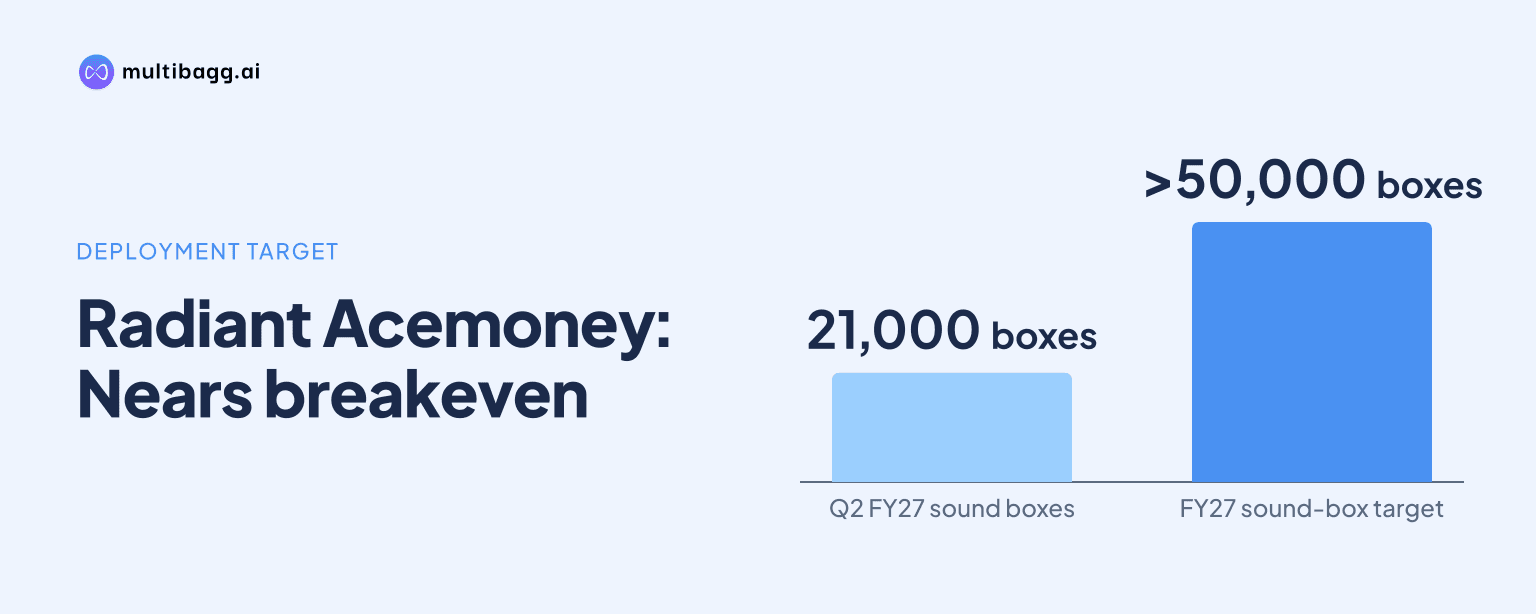
- Radiant Acemoney freshly deployed 21,000 sound boxes and facilitated nearly Rs 200 crore of transactions in Q2 FY27.
- Radiant Acemoney had close to 20,000 business correspondents as of the September 2026 quarter.
- Management targets more than 50,000 Radiant Acemoney sound-box deployments in FY27.
powered by IRIS
Radiant Acemoney reached near earnings before interest, tax, depreciation and amortisation (EBITDA) breakeven in Q2 FY27 after moving away from PIDF subsidies discontinued in December 2025, supported by 21,000 fresh sound-box deployments and transaction volume of nearly Rs 200 crore during the September 2026 quarter.
Know Radiant Cash Management Services inside out
Results, valuation, peers and who's buying, in one view.
Why did Radiant Acemoney reach near-EBITDA breakeven in Q2 FY27?
Radiant Acemoney reached near-EBITDA breakeven because revenue grew through sound-box orders, transaction commissions from its existing business-correspondent (BC) network, and white-label technology solutions for smaller banks and non-banking financial companies (NBFCs). Management described the September 2026 quarter as a healthy revenue turnaround, although it did not disclose Radiant Acemoney’s revenue, EBITDA amount or margin.
The change followed the discontinuation of the Payment Infrastructure Development Fund (PIDF) subsidy in December 2025. Over the following three quarters, management said Radiant Acemoney focused on more stable transaction revenue and on leveraging its network to deploy sound boxes, point-of-sale (POS) machines and quick-response (QR) codes. The reported near-breakeven result is an EBITDA measure, rather than a disclosure that the subsidiary reached profit after tax.
What revenue streams is Radiant Acemoney building after PIDF subsidies?
Radiant Acemoney is building revenue from BC commissions, sound boxes and QR codes, white-label Unified Payments Interface (UPI) solutions, and fintech software for banks and NBFCs. Its close to 20,000-strong BC network facilitates digital transactions, from which it earns commissions, while device deployments are intended to generate recurring transaction revenue after installation.
For banks that have a core-banking system but lack a customer mobile-banking platform, Radiant Acemoney provides a customisable white-label mobile-banking solution that connects with the bank’s existing system. Management said it had signed memoranda of understanding with two small finance banks, one urban bank and several NBFCs, and expected to scale revenue from these clients during FY27. It did not identify the institutions or quantify expected client revenue.
Radiant Acemoney also distributes sound devices, undertakes loan disbursements and has a tie-up with a large ATM service provider for white-label ATM solutions that has operated for four years. Management clarified that Radiant Acemoney does not operate white-label ATMs itself. It characterised ATM activity as very small relative to the BC network, sound-box deployment and transaction-revenue opportunity.
How significant are sound boxes and transaction volumes to Radiant Acemoney?
Sound boxes and transaction activity are central to Radiant Acemoney’s current revenue plan, with management targeting more than 50,000 sound-box deployments in FY27. The subsidiary deployed 21,000 sound boxes during Q2 FY27, so the stated annual target exceeds the quarterly deployment by at least 29,000 devices. Management did not specify the opening installed base or device pricing.
The nearly Rs 200 crore of transaction volume facilitated in the September 2026 quarter provides the transaction base from which Radiant Acemoney seeks commission income. Management said the larger revenue drivers would be transaction volume from the installed base and sound-box deployment, rather than smaller ATM-related activity. It did not disclose take rates, transaction counts, merchant retention or recurring monthly revenue per device.
Management said sound-box spending is inventory rather than capital expenditure because purchases are self-liquidating. It also said no major capital expenditure was expected at the subsidiary. This distinction matters because the expansion plan depends on deploying hardware while management expects the related business activity to recover device purchases rather than require substantial additional fixed-asset investment.
Got a follow-up? Ask IRIS
How does Radiant Acemoney compare with the group’s other new business?
Radiant Acemoney’s near-breakeven EBITDA performance was ahead of Radiant Valuable Logistics’ stated profitability position in Q2 FY27. Radiant Valuable Logistics recorded revenue of Rs 2.99 crore in the quarter, up 35% sequentially from Q1 FY27, but management said its profitability remained a concern and its breakeven period had moved further out.
At the group level, consolidated EBITDA margin declined to 6.8% in Q2 FY27 from 13.1% a year earlier, while management said improved subsidiary performance had brought them near breakeven. Standalone EBITDA margin fell to 7.62% from 15.2%, mainly because manpower-related expenses rose. Management noted that Radiant Acemoney affects consolidated results, while losses at Radiant Valuable Logistics affect standalone results.
Management presented the two subsidiaries as investments intended to diversify beyond retail cash management. It said arresting losses at Radiant Acemoney and Radiant Valuable Logistics should improve group profitability alongside customer price increases and technology-led cost measures. That is management’s expectation, not a quantified earnings forecast, and the call did not provide Radiant Acemoney’s separate historical loss or revenue series.
What could determine whether Radiant Acemoney moves from breakeven to profit?
Radiant Acemoney’s ability to move from near breakeven to profit will depend on converting its 20,000-BC network, 21,000 fresh sound boxes and newly signed bank and NBFC relationships into recurring revenue. Management said revenue growth in the September 2026 quarter came from existing BC transaction revenue, sound-box orders and white-label solutions, but did not state which source generated the largest share.
The immediate execution target is more than 50,000 sound boxes during FY27, while management also expects revenue to scale from two small finance banks, one urban bank and several NBFCs. The company disclosed no schedule for activating these agreements, no number of QR-code or POS deployments, and no separate profitability target beyond the Q2 FY27 near-EBITDA-breakeven status.
There is also a group-level dependency: management expects profitability improvement in the remaining quarters of FY27 from core-business price revisions, cost reduction and better subsidiary results. Most core-business price increases were expected to be implemented by December, with a clearer impact expected in Q4. Radiant Acemoney’s progress can therefore be assessed separately through future disclosure of revenue and recurring transaction economics.
Conclusion
Radiant Acemoney’s Q2 FY27 result marks a shift from subsidy-linked support toward transaction commissions, device deployment and banking-technology services. The operating evidence disclosed was 21,000 sound boxes deployed and nearly Rs 200 crore of facilitated transaction volume in the September 2026 quarter, alongside a BC network of close to 20,000. However, the transcript does not disclose standalone revenue, EBITDA or cash flow for the subsidiary.
The next milestones are management’s FY27 target of more than 50,000 sound boxes, revenue ramp-up from two small finance banks, one urban bank and several NBFCs, and whether installed devices generate recurring transaction income. The remaining FY27 quarters should indicate whether near-EBITDA breakeven becomes sustained profitability, as management has not given a precise timetable or target margin.