










Prostarm’s Rs 908.5 crore BESS book is developer-led
Key highlights
- Prostarm reported a Rs 908.5 crore BESS order book as of September 2026.
- BESS-developer projects accounted for Rs 853.848 crore of Prostarm’s BESS order book.
- The Bihar and KPTCL projects total 420 MWh and each has a 12-year contract tenure.
- Prostarm reported Rs 36.4 crore of BESS-EPC revenue in H1-FY27, compared with Rs 4.2 crore in FY26.
powered by IRIS
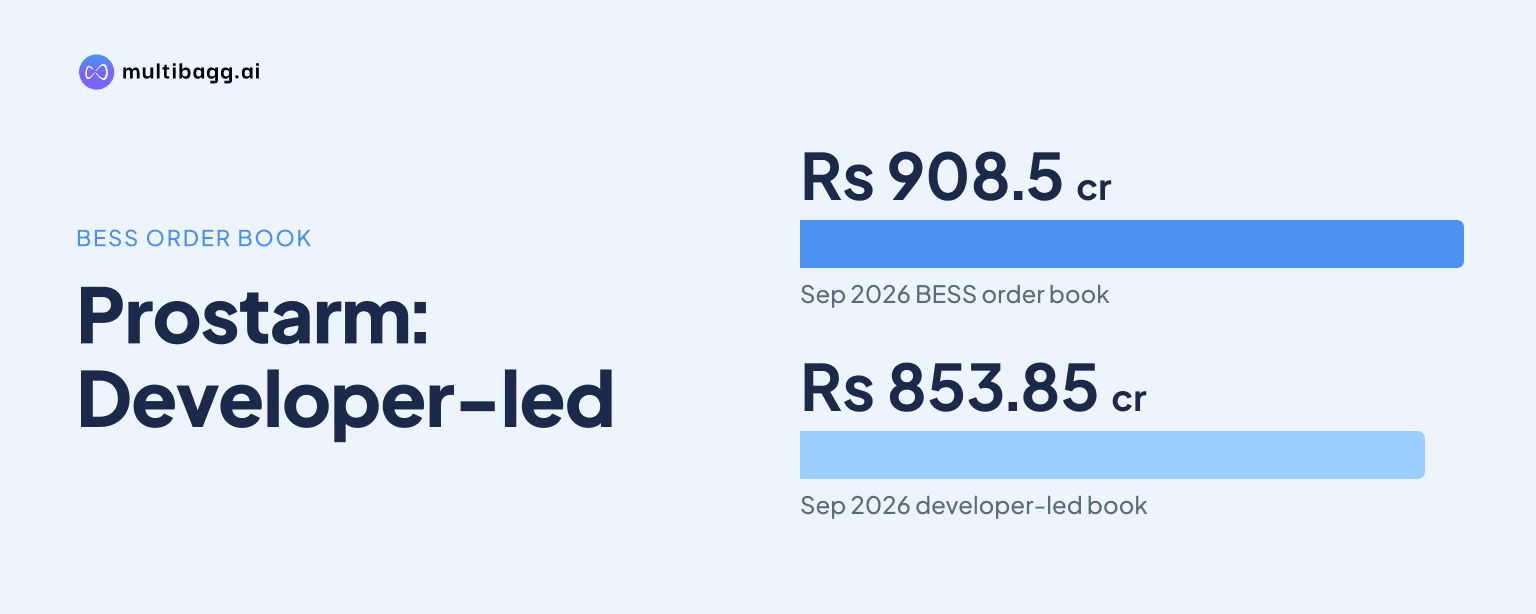
Prostarm reported a Rs 908.5 crore battery energy storage system (BESS) order book as of September 2026, of which Rs 853.848 crore was in BESS-developer projects and Rs 54.651 crore was in engineering, procurement and construction (EPC) work. The disclosed developer pipeline includes 420 megawatt-hours (MWh) under two 12-year contracts.
Know Prostarm Info Systems inside out
Results, valuation, peers and who's buying, in one view.
How large is Prostarm’s BESS order book?
Prostarm’s BESS order book stood at Rs 908.5 crore at September 2026, with the developer segment accounting for Rs 853.848 crore and BESS-EPC accounting for Rs 54.651 crore. The developer component represented about 94% of the reported BESS total, calculated from the two disclosed order-book figures.
The BESS-EPC component includes an 11 megawatt (MW), 22 MWh project for Adani Electricity, where Prostarm says supply has already been completed and execution remains under way. Prostarm also reports additional BESS orders totalling about 33 MWh from a portfolio of customers, although it does not state their order value, customer names or commissioning dates.
Which contracts support Prostarm’s BESS developer pipeline?
Prostarm’s disclosed developer pipeline comprises a 30 MW, 120 MWh Bihar State Power project under a build-own-operate-transfer (BOOT) model and a 150 MW, 300 MWh Karnataka Power Transmission Corp. (KPTCL) project under a build-own-operate (BOO) model. The two projects total 420 MWh and both have 12-year monthly rental contracts.
The Bihar State Power project is in progress and is expected to be commissioned in FY27–FY28, while the KPTCL project is in progress with commissioning expected in FY28. Prostarm does not disclose the individual order-book allocation, monthly rental amount, financing structure or transfer terms for either the 120 MWh Bihar project or the 300 MWh KPTCL project.
What changed in Prostarm’s BESS-EPC revenue?
Prostarm reported BESS-EPC revenue of Rs 36.4 crore in H1-FY27, compared with Rs 4.2 crore in FY26. The reported increase was Rs 32.2 crore, although H1-FY27 is a half-year period and FY26 is a full fiscal year, so the periods are not directly comparable.
The H1-FY27 revenue figure coincides with the execution sequence Prostarm identifies for BESS projects: equipment procurement, manufacturing, installation and commissioning. The Adani Electricity assignment is expected to be commissioned in FY27, while the company gives no FY27 revenue target for the approximately 33 MWh of additional BESS orders.
Got a follow-up? Ask IRIS
How does Prostarm plan to supply and execute BESS projects?
Prostarm describes a BESS value chain that starts with externally sourced cells and extends through module assembly, container-level integration, in-house power conversion systems (PCS), EPC, commissioning and operations and maintenance. Its Jhajjar facility has 1.2 gigawatt-hours (GWh) of assembly capacity, according to the presentation.
Prostarm says it is selective in utility-scale BESS because of aggressive pricing and margin pressure, with a focus on BESS projects from private players. It also identifies commercial and industrial installations of 50 kilowatt-hours (kWh) to 500 kWh as a strategic focus for peak shaving, demand-charge optimisation, backup power and solar or renewable-energy integration.
What BESS execution record does Prostarm disclose?
Prostarm cites the 11 MW, 22 MWh Adani Electricity project as a completed BESS supply assignment that remains under execution for FY27 commissioning. The company also says that the project is complemented by additional BESS orders of about 33 MWh, without identifying whether those orders are EPC, developer or commercial and industrial assignments.
The 1.2 GWh Jhajjar assembly capacity and in-house PCS capability are the operating features Prostarm highlights for greater local integration. The presentation also points to 40 GWh of advanced cell chemistry capacity awarded under India’s production-linked incentive scheme and 43.8 GWh of BESS capacity supported through viability-gap-funding schemes as sector conditions, rather than as Prostarm capacity or orders.
Conclusion
Prostarm’s reported BESS order book at September 2026 is principally a developer-project pipeline, with Rs 853.848 crore in that segment compared with Rs 54.651 crore in EPC. The disclosed Bihar and KPTCL projects account for 420 MWh of capacity and introduce 12-year monthly rental contracts alongside the 22 MWh Adani Electricity EPC assignment.
The disclosed milestones are Adani Electricity commissioning in FY27, Bihar commissioning in FY27–FY28 and KPTCL commissioning in FY28. Prostarm’s next disclosures on individual project values, rental economics, ownership conditions and progress through procurement, manufacturing, installation and commissioning would clarify how the Rs 908.5 crore BESS order book is executed.