










Prostarm expects Jhajjar BESS utilisation of 25%-30% in FY28
Key highlights
- Prostarm expects 25%-30% utilisation at its 1.2 GWh Jhajjar BESS plant in FY28.
- Management estimates about Rs 1,000 crore of annual Jhajjar revenue at 100% single-shift utilisation.
- Prostarm cited Rs 90 crore of current-year BESS business, including Rs 36 crore built and Rs 54 crore of new orders.
- Prostarm said peak Jhajjar utilisation could be reached gradually in about three years.
powered by IRIS
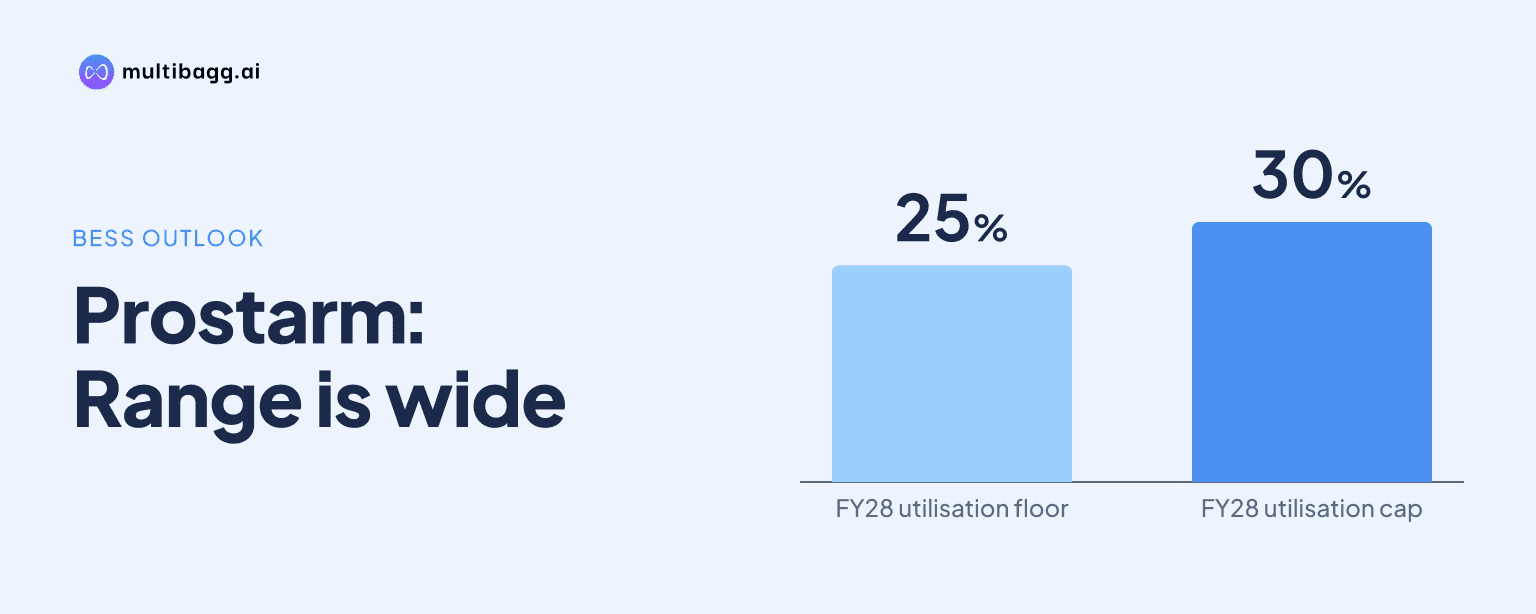
Prostarm expects its Jhajjar battery energy storage system (BESS) plant to run at 25%-30% utilisation in financial year 2028 (FY28), while management estimates about Rs 1,000 crore of annual revenue at 100% single-shift use. Management said the operational facility should scale gradually and could reach peak utilisation in about three years.
Know Prostarm Info Systems inside out
Results, valuation, peers and who's buying, in one view.
What utilisation does Prostarm expect at Jhajjar in FY28?
Prostarm expects 25%-30% utilisation at the Jhajjar BESS facility in FY28. Management gave that expectation in response to a question that specifically referred to FY28, describing the plant as being in a gradual scale-up phase rather than moving immediately to full production.
The Jhajjar facility has 1.2 gigawatt-hours (GWh) of BESS assembly capacity on a single shift, according to management. Prostarm said the capacity should begin contributing from the next financial year, while the facility can be expanded to 3 GWh if operated across three shifts.
Management expects the ramp to depend on orders executed from the facility. It said the plant’s credentials would develop through delivery of orders, and that the second year should show good growth as those credentials build. That leaves FY28 as an initial utilisation year, with no quarterly production or utilisation targets disclosed.
How much revenue could Prostarm generate from Jhajjar?
Prostarm estimates about Rs 1,000 crore of annual revenue from Jhajjar if the 1.2 GWh facility operates at 100% utilisation on a single shift. Management presented this as facility-level revenue potential, not as a committed FY28 sales forecast.
Applying the stated 25%-30% FY28 utilisation range to the Rs 1,000 crore full-capacity estimate indicates Rs 250 crore to Rs 300 crore of annualised revenue potential. This is a calculation based on management’s disclosed utilisation and capacity-revenue assumptions, rather than guidance issued separately by Prostarm.
The company cited Rs 90 crore of BESS business in the current financial year, comprising Rs 36 crore of BESS orders already built and Rs 54 crore of new orders for execution. That order position provides a smaller current base for a segment that management described as new to Prostarm.
Prostarm said it is focusing Jhajjar more on commercial and industrial (C&I) customers than utility projects, although some existing major orders are from the utility segment. Management cited BESS order values of Rs 5 crore, Rs 11 crore and Rs 29 crore, saying the segment has relatively large order tickets that can support the utilisation ramp.
Got a follow-up? Ask IRIS
How will Prostarm ramp the Jhajjar facility over three years?
Prostarm expects peak utilisation at Jhajjar in about three years, reached gradually. Management said the facility should show good growth in its second year, while maintaining that FY28 utilisation is expected at 25%-30%.
The production configuration contains an unresolved point. Management initially said the 1.2 GWh single-shift plant could scale to 3 GWh under three shifts, but later said two shifts could be operated if demand justified it. Prostarm did not provide a revenue estimate for two-shift operations, so the Rs 1,000 crore estimate remains tied to full utilisation on one shift.
Export business could affect the pace of the ramp, but it remains conditional on customer approval. Prostarm said it had sent an overseas BESS sample with about 16 kilowatts of storage capacity and could receive export volume if that sample is approved. Management did not identify the country or quantify a prospective export order.
Management also set a minimum expectation of 25% revenue growth for the next financial year and said BESS would be the majority contributor to incremental revenue. It said solar engineering, procurement and construction activity would remain selective, noting that the current year’s higher solar volume may not continue without another high-value order.
Will Jhajjar reduce Prostarm’s import dependence and support margins?
Prostarm said Jhajjar will reduce its dependence on third-party assembly, but lithium cells will continue to be imported unless the company pursues backward integration. The Jhajjar operation is an assembly plant: Prostarm will procure cells and complete BESS assembly in-house.
The company described a similar manufacturing approach at its Bakrol uninterruptible power supply (UPS) facility. Bakrol can produce about 3,000 single-phase UPS units daily and has estimated annual revenue potential of Rs 500 crore to Rs 600 crore, while imports are expected to continue with in-house value addition through assembly.
Management attributed current margin pressure partly to factory overheads that cannot yet be fully recovered while production ramps. It guided to an earnings before interest, tax, depreciation and amortisation (EBITDA) margin of 12%-13% for the next financial year, compared with its indication of above 11% for FY27.
The BESS ramp also requires inventory and working capital. Management said inventory had risen to about Rs 120 crore from roughly Rs 76 crore to Rs 77 crore, citing the BESS build-out, Bakrol’s start-up and supply-chain lead times. It said BESS delivery lead times exceed three months and total debt would rise to support inventory and the BESS facility.
Conclusion
Prostarm’s 25%-30% FY28 utilisation expectation positions Jhajjar as an early-stage BESS manufacturing ramp rather than a full-capacity operation. The gap between that level and the Rs 1,000 crore single-shift revenue estimate shows the scale management believes the facility could eventually support, while the Rs 90 crore current-year BESS order position indicates the segment’s starting base.
The next indicators are order execution from Jhajjar, progress in the 16-kilowatt export sample approval process and management’s ability to deliver its minimum 25% revenue-growth expectation. Investors should also watch whether C&I orders support a faster utilisation ramp, how the shift configuration is clarified, and whether imported cell costs and higher inventory affect margins and cash requirements.