










Prostarm cuts FY27 EBITDA margin view to above 11%
Key highlights
- Prostarm expects FY27 EBITDA margin above 11%, after the earlier 13%-14% indication cited on the November 12, 2026 call.
- Q2 FY27 revenue rose 82% year on year to Rs 120 crore, while EBITDA declined 17% to Rs 9 crore.
- H1 FY27 revenue increased 62% year on year to Rs 196 crore and EBITDA margin was 8.06%.
- Management targets about Rs 500 crore of FY27 revenue, supported by more than Rs 260 crore of remaining orders and channel sales.
powered by IRIS
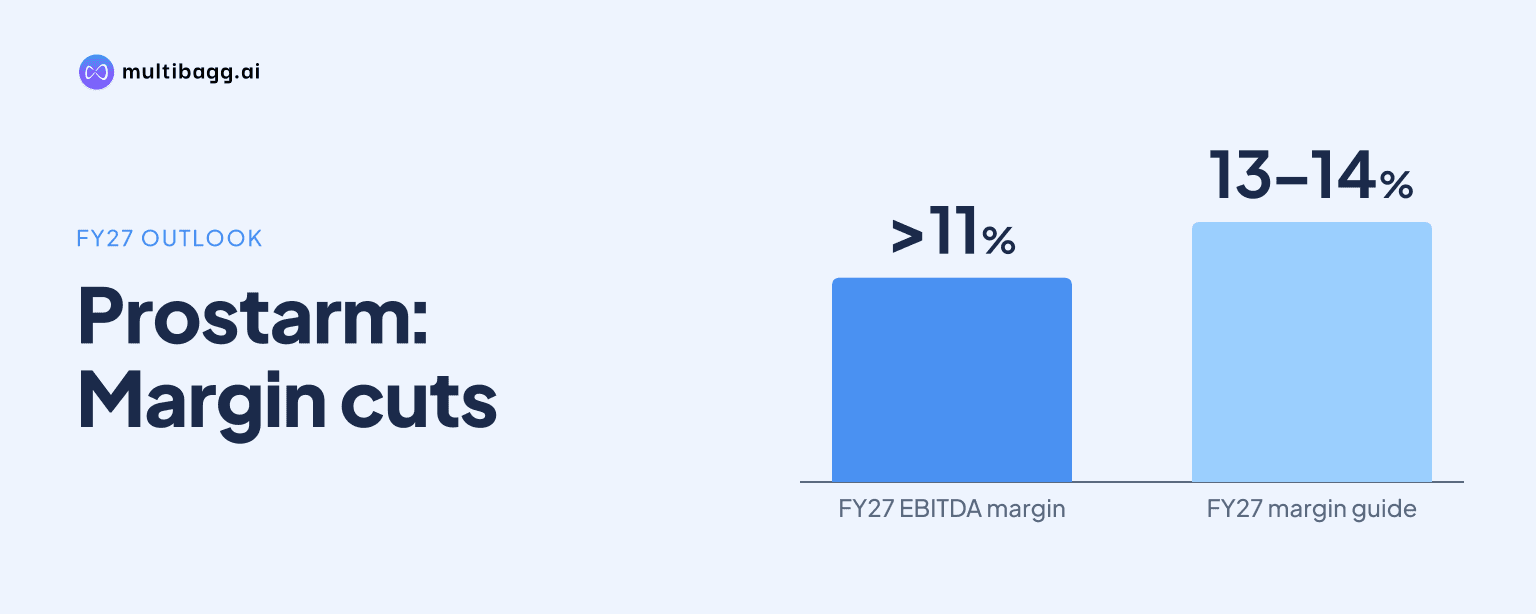
Prostarm Info Systems Limited expects FY27 earnings before interest, tax, depreciation and amortisation (EBITDA) margin to be above 11%, versus the earlier 13%-14% indication cited on its November 12, 2026 call, after Q2 FY27 margin reached 7.83% and revenue growth brought lower-margin third-party sales, higher freight, foreign-exchange and plant start-up costs.
Know Prostarm Info Systems inside out
Results, valuation, peers and who's buying, in one view.
Why did Prostarm lower its FY27 EBITDA-margin expectation?
Prostarm lowered its FY27 EBITDA-margin expectation to above 11% because H1 FY27 execution included relatively low-margin third-party power and other product sales, as well as lower-margin orders. An analyst referred to the earlier 13%-14% FY27 margin indication, and management responded that the full-year margin should be above 11% while it pursued about Rs 500 crore of revenue.
The company attributed the change to elevated input and freight costs, foreign-exchange fluctuations on fixed-price tariff-based contracts, higher employee costs and overheads from its new Jhajjar and Bakrol facilities. Management said freight costs had almost doubled from the previous financial year, although it expects some moderation during H2 FY27.
Project mix and billing timing also influenced the outcome. Prostarm said its project-led business has margins that vary by the type of order executed and the execution period. Management said it prioritised order continuity and billing in H1 FY27, including orders with lower margins, rather than treating the H1 margin as a structural level.
How did Prostarm's Q2 and H1 FY27 profit compare with revenue growth?
Prostarm's Q2 and H1 FY27 profit growth lagged revenue growth: Q2 revenue rose 82% year on year to Rs 120 crore while EBITDA fell 17% to Rs 9 crore, and H1 revenue rose 62% to Rs 196 crore while EBITDA increased 5% to Rs 16 crore. The figures show the cost and sales-mix impact was most pronounced in the September quarter.
Q2 EBITDA margin was 7.83%, below the H1 margin of 8.06%, even though Q2 revenue of Rs 120 crore represented more than half of H1 revenue of Rs 196 crore. Q2 PAT declined nearly 27% year on year to Rs 6 crore, whereas H1 PAT rose about 6% to Rs 11 crore.
Management expects an H2 FY27 improvement as market conditions settle, but did not provide a quarterly margin forecast. It also cautioned that freight-cost moderation may not be substantial, because some of the increase could persist even if rates ease from current levels.
Can Prostarm achieve about Rs 500 crore of FY27 revenue?
Prostarm said it is positioned to achieve about Rs 500 crore of FY27 revenue through remaining order execution and channel sales. Management cited more than Rs 260 crore of orders in hand for the rest of the year, separately describing this balance as Rs 266 crore, plus potential channel revenue of about Rs 25 crore to Rs 30 crore after H1 revenue of Rs 196 crore.
The target depends on execution, rather than on a separate FY27 contracted-order disclosure. As of September 30, 2026, Prostarm had an order book of about Rs 1,121 crore across 97 ongoing projects. Battery energy storage system (BESS), engineering, procurement and construction (EPC), and developer projects accounted for about Rs 909 crore, or 81%, of that order book.
Solar EPC represented Rs 178 crore, or about 16%, while manufactured power-solution products accounted for Rs 26 crore. Management also said it had executed Rs 36 crore of BESS orders during FY27 and received Rs 54 crore of new BESS orders for execution in the same year, positioning BESS for Rs 90 crore of revenue.
Got a follow-up? Ask IRIS
What role do the Jhajjar and Bakrol plants play in FY27 margins?
Prostarm's Jhajjar BESS facility and Bakrol uninterruptible power supply, or UPS, assembly facility added start-up overheads to FY27 results before their costs could be fully absorbed by output. Both facilities began operations on September 25, 2026, and management said the initial cost burden contributed to the current-year margin deviation.
The Jhajjar facility has BESS assembly capacity of 1.2 gigawatt-hours on a single shift and can be scaled to 3 gigawatt-hours with three shifts. The Bakrol facility expands UPS manufacturing across the 1 kilovolt-ampere to 600 kilovolt-ampere range, while Jhajjar will still require imported lithium cells unless Prostarm undertakes backward integration.
Management expects the facilities' capacity contribution to become more visible from FY28. It said FY28 revenue growth should be at least 25% and EBITDA margin should return to 12%-13%, subject to the mix of orders and facility ramp-up. Prostarm also sent a 16-kilowatt home-energy-storage sample to an overseas customer in October 2026, with export volumes dependent on approval.
How has Prostarm's working capital changed during expansion?
Prostarm reported a working-capital cycle of 192 days at H1 FY27, compared with 185 days in FY26, as inventory, government deposits and goods and services tax input credit increased. Management separately cited a cash-conversion cycle of about 172 days in FY26 and 189 days currently, indicating that it used different working-capital measures during the call.
Inventory rose to about Rs 120 crore from about Rs 76 crore to Rs 77 crore as the company prepared for BESS and Bakrol manufacturing. GST input credit stood at about Rs 18.5 crore to Rs 19 crore, while concentrated September billing of around Rs 86 crore of net revenue also affected working-capital movements.
Cash flow from operating activity was about negative Rs 17 crore at September 2026, improving from about negative Rs 49 crore at March 2026. Management said October collections of about Rs 73 crore to Rs 75 crore reduced debtors from Rs 257 crore at H1 FY27 to Rs 201 crore, and it expected further receipts from two major parties by December.
Conclusion
Prostarm's above-11% FY27 EBITDA-margin expectation reflects a trade-off between sales growth and profitability. Revenue rose 62% year on year to Rs 196 crore in H1 FY27, but EBITDA rose only 5% to Rs 16 crore as third-party sales mix, low-margin execution, freight, foreign exchange and new-facility overheads affected earnings.
The next developments to watch are H2 FY27 order execution against the Rs 500 crore revenue target, freight-cost movement and collections after debtors fell to Rs 201 crore in October 2026. Management's FY28 plan calls for at least 25% revenue growth and a 12%-13% EBITDA margin as Jhajjar and Bakrol scale, while export volumes depend on approval of the 16-kilowatt sample.