










Prostarm H1 revenue rises 62% as EBITDA margin falls 444 basis points
Key highlights
- Prostarm’s H1-FY27 revenue from operations increased 62.3% to Rs 196.1 crore.
- Prostarm’s H1-FY27 EBITDA margin declined 444 basis points to 8.06% from 12.50%.
- Prostarm’s Q2-FY27 revenue rose 82.1% to Rs 120 crore, while EBITDA declined 16.8% to Rs 9.4 crore.
- Prostarm’s working-capital days increased to 192 in H1-FY27 from 185 in FY26.
powered by IRIS
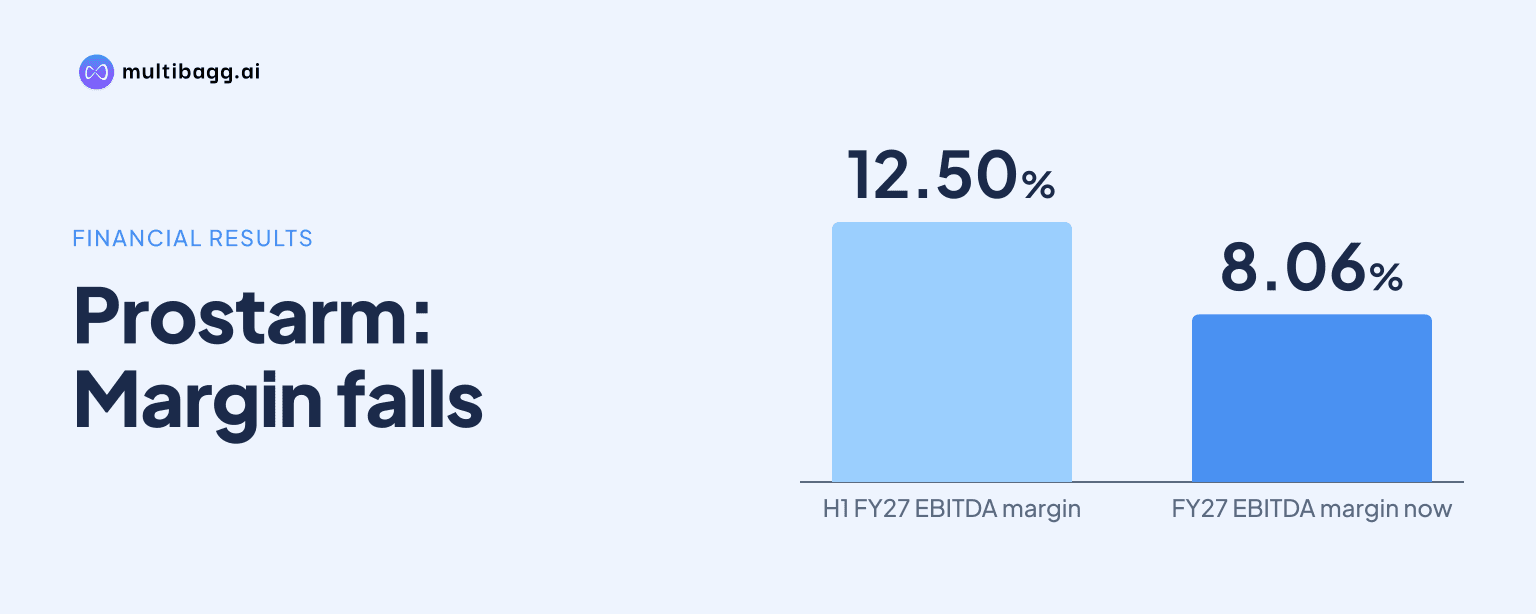
Prostarm Info Systems Limited reported H1-FY27 revenue from operations of Rs 196.1 crore, up 62.3% year on year, but EBITDA margin fell 444 basis points to 8.06% as lower-margin Q2 order execution and higher input, freight, foreign-exchange, employee and facility costs limited profit growth.
Know Prostarm Info Systems inside out
Results, valuation, peers and who's buying, in one view.
How did Prostarm’s H1-FY27 revenue and profit change?
Prostarm delivered higher revenue in H1-FY27, while EBITDA and profit after tax (PAT) rose at much slower rates. Revenue from operations increased from Rs 120.8 crore in H1-FY26 to Rs 196.1 crore in H1-FY27. Earnings before interest, tax, depreciation and amortisation (EBITDA) increased 4.6%, from Rs 15.1 crore to Rs 15.8 crore, while PAT rose 5.9%, from Rs 10.1 crore to Rs 10.7 crore.
The difference between sales and profit growth reflected expenses increasing faster than revenue. Total expenses rose 70.6% to Rs 180.3 crore in H1-FY27 from Rs 105.7 crore a year earlier. EBITDA margin declined to 8.06% from 12.50%, while PAT margin fell 290 basis points to 5.46% from 8.36%. Diluted earnings per share, which was not annualised, declined 4.3% to Rs 1.78 from Rs 1.86.
Other income rose 79.2% to Rs 4.3 crore in H1-FY27 from Rs 2.4 crore in H1-FY26, while finance cost increased 64.0% to Rs 4.1 crore from Rs 2.5 crore. Profit before tax increased 5.1% to Rs 14.3 crore. The increase in other income did not offset the rise in operating expenses, depreciation and finance cost during the half year.
Why did Prostarm’s EBITDA margin decline in H1-FY27?
Prostarm attributed the H1-FY27 margin moderation primarily to relatively lower-margin orders executed in Q2-FY27 and higher input, freight, foreign-exchange, employee and facility overhead costs. EBITDA margin was 8.06% in H1-FY27, compared with 12.50% in H1-FY26. Prostarm specifically linked higher overheads to its new Jhajjar and Bakrol facilities.
The quarterly figures show the pressure was most pronounced in Q2-FY27. Revenue from operations increased 82.1% year on year to Rs 120 crore from Rs 65.9 crore, but EBITDA declined 16.8% to Rs 9.4 crore from Rs 11.3 crore. Q2 EBITDA margin therefore declined 932 basis points to 7.83% from 17.15% a year earlier.
The sequential comparison also showed that higher sales did not restore quarterly margin. Q2 revenue was 57.9% above Q1-FY27 revenue of Rs 76 crore, while Q2 EBITDA was 44.6% above Rs 6.5 crore. EBITDA margin was 7.83% in Q2, down 72 basis points from 8.55% in Q1-FY27, and PAT margin declined to 5.08% from 6.05%.
The half-year outcome followed a decline in the reported EBITDA margin over the historical series. Prostarm reported EBITDA margins of 13.65% in FY24, 12.98% in FY25 and 12.00% in FY26, before reaching 8.06% in H1-FY27. PAT margin moved from 8.55% in FY26 to 5.46% in H1-FY27, alongside the latest period’s revenue growth.
Got a follow-up? Ask IRIS
What did Prostarm add through its new facilities and systems?
Prostarm commenced operations at a 1.2 gigawatt-hour Battery Energy Storage System, or BESS, manufacturing facility in Jhajjar, Haryana, and an uninterruptible power supply, or UPS, assembly facility in Bakrol, Gujarat, on September 25, 2026. Management said the facilities strengthen manufacturing capabilities and support future business growth, while new-facility overheads contributed to the H1-FY27 margin movement.
Prostarm also implemented SAP and Salesforce during Q2-FY27. The company said the systems are intended to improve business-process integration, operational visibility and customer relationship management. The presentation does not quantify the implementation cost or a financial benefit from the systems.
International activity began with the export of a sample Home Energy Storage System, or Home ESS, to an overseas customer in October 2026. Prostarm described the shipment as its first step toward exploring export opportunities. The disclosure does not state the sample’s value, identify the customer or provide an export-sales target, and the October shipment was outside the reported H1-FY27 period.
Property, plant and equipment increased to Rs 43.9 crore at H1-FY27 from Rs 16.1 crore at FY26, while capital work in progress declined to Rs 1.5 crore from Rs 20.8 crore. These movements occurred alongside the September 25 facility commencements. Prostarm did not allocate the balance-sheet changes between the Jhajjar and Bakrol locations.
How did Prostarm’s working capital and borrowings change?
Prostarm’s working-capital days increased to 192 days in H1-FY27 from 185 days in FY26. Management attributed the increase to inventory held for anticipated order execution and supply-chain continuity, expanding operations, higher government deposits from goods and services tax input credit, and supplier advances.
Inventories rose to Rs 122.3 crore at H1-FY27 from Rs 73.2 crore at FY26, an increase of Rs 49.1 crore. Trade receivables were Rs 257.7 crore, compared with Rs 254.6 crore at FY26. Prostarm said receivables remained elevated as of September 30, 2026, primarily because revenue was concentrated toward the end of the quarter.
Current borrowings increased to Rs 104.1 crore at H1-FY27 from Rs 83.3 crore at FY26, while trade payables rose to Rs 177.9 crore from Rs 146.3 crore. Cash and cash equivalents were Rs 80 lakh at H1-FY27, compared with Rs 1.2 crore at FY26. Net debt to equity, including lease liabilities, was 0.33 times in H1-FY27 versus 0.29 times in FY26.
Equity attributable to the parent company increased to Rs 298 crore at H1-FY27 from Rs 286.7 crore at FY26. Total assets rose to Rs 596.4 crore from Rs 537.4 crore, while current assets reached Rs 505.4 crore. The balance-sheet expansion coincided with higher inventory, receivables, borrowings and manufacturing assets during the half year.
Conclusion
Prostarm’s H1-FY27 results showed that revenue growth did not translate proportionately into earnings growth. Revenue increased 62.3% to Rs 196.1 crore, while expenses rose 70.6%, leaving EBITDA up 4.6% and reducing EBITDA margin to 8.06%. The Q2 comparison, in which revenue rose 82.1% while EBITDA declined 16.8%, identified lower-margin execution and higher costs as the immediate factors.
The next developments to watch are the operating contribution and overhead effects of the 1.2 gigawatt-hour Jhajjar BESS facility and Bakrol UPS facility, both of which began operations on September 25, 2026. Prostarm has also begun exploring exports through its October 2026 sample Home ESS shipment, while management’s cited need for inventory and supply continuity leaves working-capital movements relevant as anticipated orders are executed.