










Prostarm Says BESS Price Cuts Pressure Project Margins
Key highlights
- Prostarm said equity IRR on BESS developer projects remains above 12% to 13%.
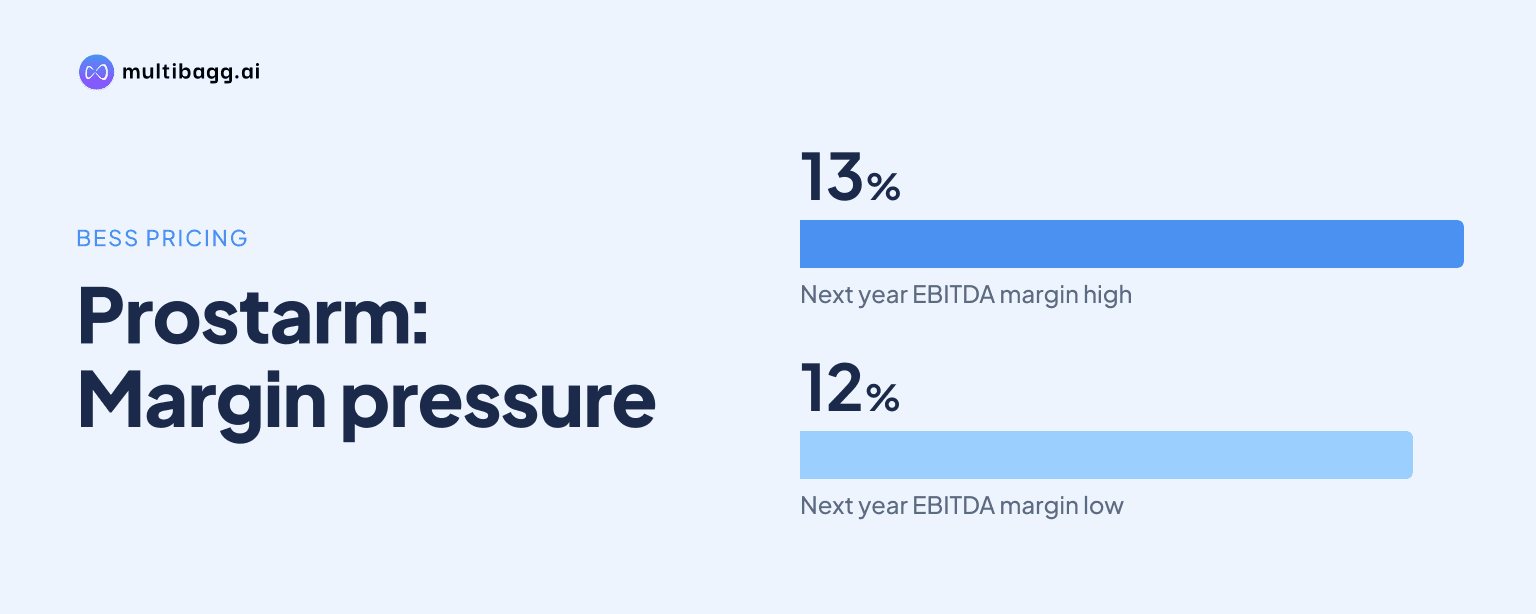
- Prostarm management guides for EBITDA margin of 12% to 13% next year.
- Prostarm management guides for PAT margin of 8.5% to 9% next year.
- Prostarm is discussing the sale of two BESS developer projects with about six or seven players.
powered by IRIS
Prostarm said battery energy storage system, or BESS, price cutting by new entrants and higher Chinese input costs are pressuring project margins, although management said equity internal rate of return, or IRR, on its developer projects remained above 12% to 13%. Prostarm is responding by prioritising manufacturing, original equipment manufacturer, or OEM, and solutions work over developer and broad engineering, procurement and construction, or EPC, exposure.
Know Prostarm Info Systems inside out
Results, valuation, peers and who's buying, in one view.
Why does Prostarm say BESS pricing is under pressure?
Prostarm says BESS pricing is under pressure because new and unknown entrants have reduced prices in a market management said has become more commodity-like than technical. Management said China had increased prices at the same time, creating a difficult cost-and-pricing combination for BESS suppliers and developers.
The pressure affects projects won over the past 15 to 16 months because procurement costs at execution can differ from assumptions at bidding. Management cited higher lithium and direct-current, or DC, block costs on developer projects, while dollar movements added another cost factor. It said recent moderation in the dollar offered some relief but did not say the wider cost pressure had ended.
Prostarm did not disclose a sector-wide measure of price cuts or Chinese cost increases. Instead, management said the two BESS developer projects would remain profitable, with equity IRR above 12% to 13%, but warned that the ultimate margin could decline because current costs differ substantially from the original project-cost assumptions.
How is Prostarm changing its BESS business model?
Prostarm is shifting toward a manufacturer, OEM and solution-provider model rather than retaining BESS developer projects or operating as a typical EPC contractor. Management said the Jhajjar facility requires working capital and that this model should need less leverage than carrying developer-project exposure. It contrasted this approach with EPC work, where management said revenue can be high while profit is limited.
Prostarm is discussing the sale of its two existing BESS developer projects with about six or seven industry players. Management said a transaction could occur in the current quarter, the next quarter or later, but did not provide a buyer, valuation or firm timetable. It said any sale would be profitable, although the margin will depend on negotiations and higher costs.
The company has also withdrawn from government bids valued up to Rs 5 crore. Management said it will target a limited number of larger tenders where fewer companies can qualify, seeking better commercial terms. Its direct-bidding focus is uninterruptible power supply, or UPS, BESS for commercial and industrial, or C&I, customers, and special applications rather than utility projects.
Which BESS markets does Prostarm want to serve?
Prostarm wants to pursue larger-ticket BESS opportunities while building C&I orders through partner channels. Management cited its smallest BESS order at Rs 5 crore, followed by orders of Rs 11 crore and Rs 29 crore. It said these order values make BESS average tickets larger than those in the C&I market.
By comparison, management put a typical C&I single order at Rs 40 lakh to Rs 50 lakh and said those orders can carry better margins. Prostarm has focused on private-sector bidding through partner channels for the past six months, with management expecting the effect to become visible in the next financial year. It said solar EPC will be undertaken only selectively where margins are suitable or the customer is private.
Management expects BESS to be the main growth driver next year, supported by the Jhajjar facility. It expects 25% to 30% utilisation next year and described one-shift capacity of Rs 1,000 crore, with two-shift operation possible if demand warrants it. Management said peak utilisation could take about three years, while the second year should benefit as the facility builds credentials through completed orders.
Got a follow-up? Ask IRIS
What margins and working-capital levels does Prostarm expect?
Prostarm management guides for an earnings before interest, tax, depreciation and amortisation, or EBITDA, margin of 12% to 13% next year and a profit after tax, or PAT, margin of 8.5% to 9%. Management said delivery depends on BESS volume, competitor behaviour, new capacity additions and broader external conditions.
Management said percentage PAT growth would be difficult in the current year because of costs, dollar movements in the first half and customer demand for minimum pricing. It nevertheless said absolute PAT would increase. When asked about a steady-state PAT margin after peak utilisation, management said it was too early to comment.
Working-capital requirements are expected to rise with BESS activity. Management said BESS delivery lead times exceed three months and advance payments are involved, making inventory necessary for servicing customers and executing orders. It said inventory days may decline as operations expand, but absolute inventory is likely to rise, and total debt will increase to support stock and the BESS facility.
Management cited Rs 97 crore of fixed deposits and Rs 105 crore of corresponding debt in discussing its leverage position. That comparison sits alongside its plan to use a working-capital-managed OEM model and its expectation that facility utilisation will reach 25% to 30% next year.
What could local content mean for Prostarm’s strategy?
Prostarm says local domestic content could become a differentiator if battery imports face restrictions similar to those management said had affected solar equipment, panels and raw materials. This is management’s expectation rather than a disclosed policy decision, target or timetable. Its case is that domestic manufacturing capability may create higher BESS volume for companies with product and production expertise.
The strategy remains exposed to the same variables that produced the current margin pressure: Chinese cost changes, competitor pricing and new capacity additions. Management said utility-sector conditions need more time to moderate, while its 8.5% to 9% PAT-margin outlook for next year depends on achieving sufficient BESS volume.
Conclusion
Prostarm’s message is that BESS demand and order values remain meaningful, but project economics are being squeezed by lower market pricing and higher input costs. The company is seeking to reduce developer and broad EPC exposure by focusing on selective tenders, private-sector partner channels, manufacturing and solutions work. The contrast between BESS orders of Rs 5 crore to Rs 29 crore and C&I tickets of Rs 40 lakh to Rs 50 lakh illustrates the different markets it is targeting.
The next issues to watch are the outcome and terms of talks with six or seven prospective buyers for the two developer projects, Jhajjar utilisation of 25% to 30% next year, and management’s delivery against its 12% to 13% EBITDA-margin and 8.5% to 9% PAT-margin guidance. Inventory and total debt are also expected to rise as Prostarm supports BESS delivery lead times of more than three months.