










Prostarm working-capital cycle reaches 192 days in H1 FY27
Key highlights
- Prostarm reported a 192-day working-capital cycle in H1 FY27, versus 185 days in FY26.
- Prostarm’s inventory rose to around Rs 120 crore from roughly Rs 76 crore to Rs 77 crore.
- Prostarm said receivables declined from Rs 257 crore at H1 FY27 to Rs 201 crore in October 2026.
- Prostarm said negative operating cash flow improved from around Rs 49 crore in March 2026 to around Rs 17 crore in September.
powered by IRIS
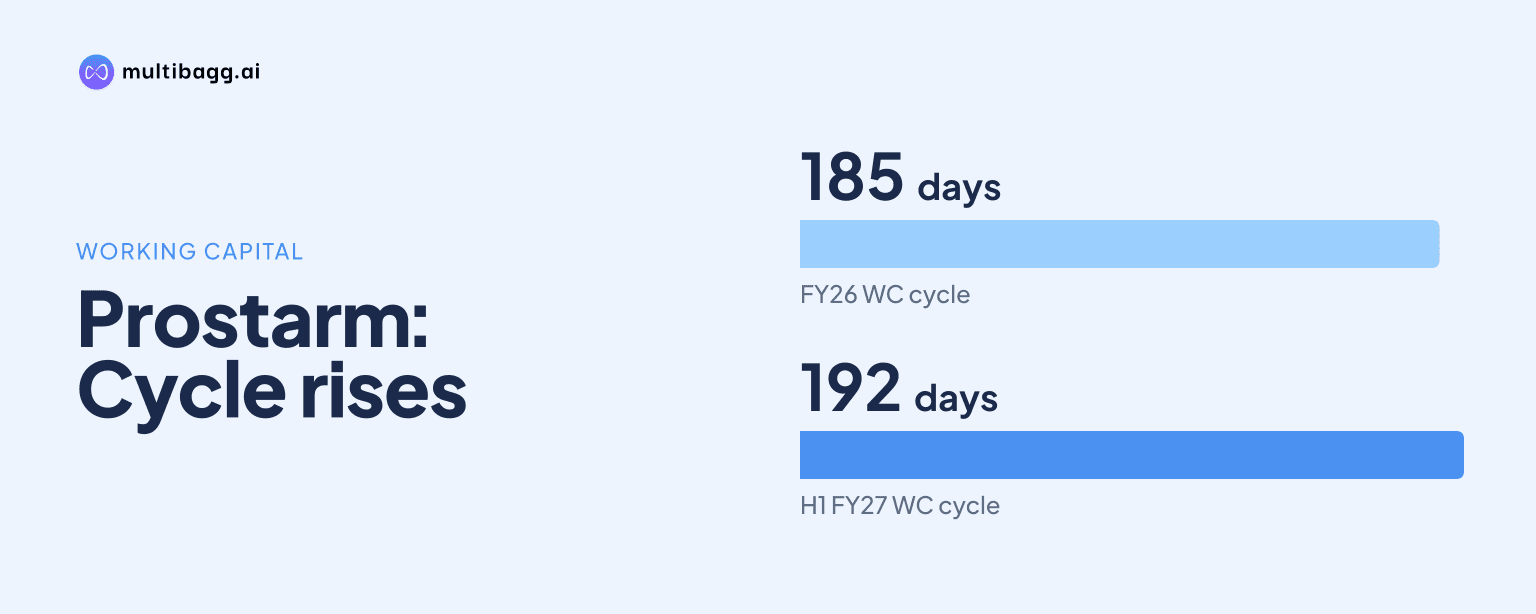
Prostarm’s working-capital cycle reached 192 days in H1 FY27, seven days above FY26’s 185 days, as inventory rose to about Rs 120 crore to support battery energy storage system, or BESS, orders and factory expansion. Management said Rs 73 crore of October 2026 collections subsequently reduced receivables from the September period-end level.
Know Prostarm Info Systems inside out
Results, valuation, peers and who's buying, in one view.
Why did Prostarm’s working-capital cycle rise in H1 FY27?
Prostarm said its working-capital cycle rose to 192 days in H1 FY27 from 185 days in FY26 because it carried higher inventory, government deposits related to goods and services tax, or GST, input credits, and supplier advances. The company said the inventory was intended to support order execution, supply-chain continuity and an expanding operating footprint.
The increase came alongside higher sales. Revenue from operations grew 62% year on year to Rs 196 crore in H1 FY27, while second-quarter revenue increased 82% to Rs 120 crore. Management attributed the growth to order execution, but said project-led operations can create uneven billing because revenue depends on the timing of individual project milestones.
In the question-and-answer session, management separately described the FY26 cash-conversion cycle as about 172 days and the current level as 189 days. Those figures differ from the 185-day FY26 and 192-day H1 FY27 working-capital-cycle figures in the formal financial commentary. The transcript does not explain the differing calculations, so the formal 192-day disclosure is the stated H1 FY27 working-capital measure.
How much inventory is Prostarm holding for BESS expansion?
Prostarm said inventory had increased to around Rs 120 crore from roughly Rs 76 crore to Rs 77 crore earlier, an increase of about Rs 43 crore to Rs 44 crore. Management described the increase as a deliberate build for future orders, BESS activity and the gradual start of manufacturing at the Bakrol facility.
BESS, engineering, procurement and construction, or EPC, and developer projects represented about Rs 909 crore, or nearly 81%, of Prostarm’s order book. Solar EPC contracts accounted for Rs 178 crore, or around 16%, while manufactured power-solution products represented Rs 26 crore. Management also said it received additional BESS orders totalling 33 megawatt-hours from customers including Adani Electricity, Bihar State Power and Karnataka Power Transmission Corporation.
The inventory plan is tied to manufacturing capacity and supply lead times. Prostarm said its Jhajjar BESS assembly plant has capacity of 1.2 gigawatt-hours on a single shift, scalable to 3 gigawatt-hours across three shifts. Cells would continue to be imported unless the company undertakes backward integration, while in-house assembly is expected by management to reduce third-party dependence.
Bakrol is intended to add factory-based assembly for single-phase uninterruptible power supply products. Management said the facility can produce around 3,000 units a day and could generate Rs 500 crore to Rs 600 crore of annual revenue at capacity. The stated facilities plan explains why materials may be held ahead of related billing and collections.
Got a follow-up? Ask IRIS
What changed in Prostarm’s receivables after September 2026?
Prostarm said receivables declined to Rs 201 crore in October 2026 from Rs 257 crore at H1 FY27 after post-period-end collections. Management first referred to about Rs 75 crore of October collections and then specified Rs 73 crore for the month. The transcript does not reconcile the two collection figures.
Management said a concentrated September billing cycle had raised the period-end position. It reported around Rs 86 crore of net revenue in September alone, which it described as roughly Rs 87 crore of gross billing and more than Rs 90 crore of billed value. Such a single-month concentration can increase receivables and reported working-capital days at a reporting date before cash is received.
Management put receivable days at around 178 days after excluding one single billing, but did not provide a comparable FY26 receivable-days measure. It also said further large collections from two major parties were expected by December, without quantifying the expected amounts. Separately, management said it had Rs 266 crore of order book left for the financial year, plus potential channel revenue of Rs 25 crore to Rs 30 crore, which could create further billing-related timing effects.
Has Prostarm’s operating cash flow improved despite higher inventory?
Prostarm said negative operating cash flow improved to around Rs 17 crore at the end of September from around Rs 49 crore negative at the end of March 2026. The movement represents an improvement of about Rs 32 crore, although operating cash flow remained negative despite the 62% increase in first-half revenue.
Management attributed the remaining cash-flow pressure to capital expenditure and inventory maintenance. It said it was trying to achieve a very positive operating cash-flow outcome by the end of FY27, but did not provide a numerical target or a planned inventory reduction. That statement was management’s objective rather than formal cash-flow guidance.
Profit growth also lagged revenue growth in H1 FY27. Earnings before interest, taxes, depreciation and amortisation, or EBITDA, rose 5% year on year to Rs 16 crore, with an 8.06% margin, while profit after tax, or PAT, increased about 6% to Rs 11 crore, with a 5.46% margin. Management cited low-margin third-party product sales and orders, higher freight and input costs, foreign-exchange effects, employee costs, and Jhajjar and Bakrol overheads.
For FY27, management said Prostarm was positioned to book around Rs 500 crore of revenue and would try to keep EBITDA margin above 11%, compared with 7.83% in the second quarter. It also said PAT should grow in absolute terms. These outlook statements depend on execution, collections, order mix and costs, including freight costs that management said had nearly doubled from the prior financial year.
Conclusion
Prostarm’s longer reported working-capital cycle reflects a higher inventory commitment, GST input-credit balances and supplier advances during a period of rapid revenue growth and factory expansion. The Rs 120 crore inventory level is linked to BESS and manufacturing plans, while the reduction in receivables to Rs 201 crore in October indicates cash collection after the H1 FY27 reporting date.
The next items to watch are whether the two expected major collections arrive by December and whether fresh late-year billing offsets the receivables reduction. Management is targeting at least 25% revenue growth in FY28, expects BESS to be the principal growth driver, and expects BESS capacity utilisation of about 25% to 30% next year, all of which could continue to shape inventory and cash requirements.