










Purple United Sales EBOs reach 38% of revenue in H1 FY27
Key highlights
- Purple United Sales derived approximately 38% of H1 FY27 revenue from EBOs, versus 35% from distribution.
- Purple United Sales added 17 EBOs in H1 FY27, reaching 126 stores across 21 states and union territories.
- Stores with a vintage of at least 18 months delivered 20% same-store sales growth in H1 FY27.
- Revenue from operations rose 103.6% year on year to Rs 123.7 crore in H1 FY27.
powered by IRIS
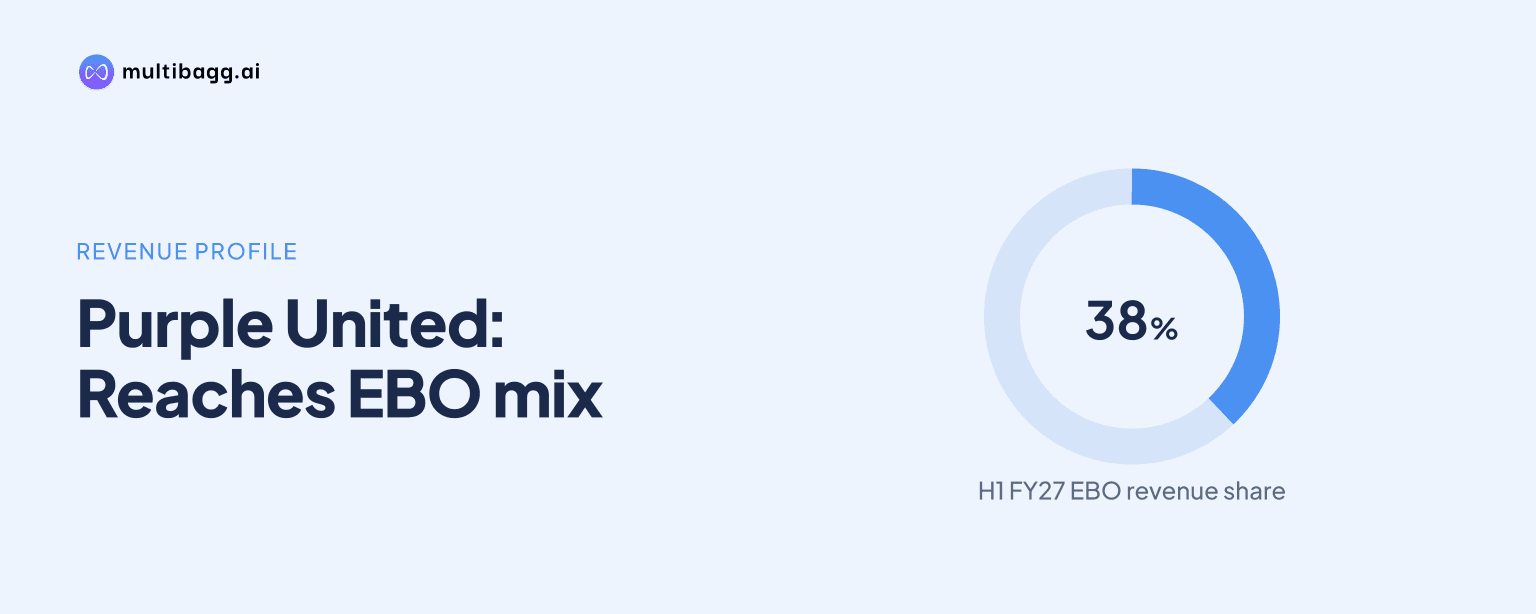
Purple United Sales Limited generated approximately 38% of H1 FY27 revenue through exclusive brand outlets, making EBOs its largest reported channel ahead of distribution at 35%. The company added 17 EBOs during the half year ended September 30, 2026, taking its network to 126 stores, while management targets an approximately 50% EBO revenue mix over the medium term.
Know Purple United Sales inside out
Results, valuation, peers and who's buying, in one view.
How much revenue came from EBOs in H1 FY27?
Purple United Sales received approximately 38% of H1 FY27 revenue from exclusive brand outlets (EBOs), compared with 35% from distribution, 21% from key accounts and 5% from online channels. EBOs exceeded distribution by about 3 percentage points in the half year ended September 30, 2026, making exclusive retail the largest disclosed revenue channel.
Management aims to increase EBOs to about 50% of revenue over the medium term and raise e-commerce to about 10% to 12%. Purple United Sales did not provide a target contribution for distribution or key accounts. Management said EBOs offer greater control over merchandising, product assortment and customer experience, as well as direct purchasing insights that can support inventory allocation.
The stated targets form part of Purple United Sales’ move from a predominantly distribution-led business toward an integrated omnichannel platform. The company serves children aged 0 to 14 years through its own brands in apparel, footwear and accessories. Its asset-light, partner-led manufacturing model is intended to preserve sourcing flexibility while capital is directed towards brand development, product innovation and retail expansion.
How is Purple United Sales expanding its EBO network?
Purple United Sales added 17 EBOs during H1 FY27, taking its network to 126 stores across 21 states and union territories and approximately 2 lakh square feet of retail area. The network comprised 99 high-street stores and 27 mall stores at the end of the period, with high-street outlets accounting for most locations.
Management’s FY27 aspiration is to scale the EBO network to 180 to 190 stores, implying a further 54 to 64 stores from the 126 reported in H1 FY27. This is a management target rather than a reported outcome. The company said its cluster-led approach is intended to deepen presence in established markets and generate operating efficiencies from a larger local store base.
Revenue from operations rose 103.6% year on year to Rs 123.7 crore in H1 FY27 from Rs 60.7 crore in H1 FY26. Management attributed the increase to retail-network expansion and a higher contribution from existing stores, indicating that the strategy depends on both new openings and productivity at locations opened in previous periods.
Are existing Purple United Sales stores becoming more productive?
Purple United Sales reported 20% same-store sales growth in H1 FY27 for stores with a vintage of 18 months or more. The measure indicates that growth was not solely from new locations because it tracks sales at stores that had operated for at least 18 months.
Management also said stores with a vintage of more than two years had EBITDA of around 20%. It said approximately 80 stores were above its expectations, while around 35 to 40 were below expectations, without giving a full mature-versus-immature store count. Management expects the latter group to contribute positively to EBITDA in the next year, supported by winter and festive demand.
Seasonality is central to this outlook. Management said H1 normally contributes about 35% to 40% of annual sales, while festive and winter demand is concentrated in H2. It also said average selling prices have historically been approximately 40% higher in the second half than in the first half, supported by festive and winter merchandise; blended average selling price was Rs 814 in FY27.
Got a follow-up? Ask IRIS
What financial trade-offs accompany the retail shift?
Purple United Sales’ earnings before interest, tax, depreciation and amortisation (EBITDA) increased 88.6% to Rs 23.7 crore in H1 FY27 from Rs 12.6 crore a year earlier, but EBITDA margin declined to 19.2% from 20.7%, a contraction of 153 basis points. Management attributed the margin movement to higher expansion-related operating expenses.
Employee expenses increased by approximately 81% year on year as Purple United Sales hired senior personnel, an e-commerce specialist and support team, and store-level teams. Management said these investments affected near-term operating margins but were needed to support a larger retail and omnichannel operation.
Profit after tax increased 60.1% to Rs 8.1 crore from Rs 5.1 crore, while profit-after-tax margin was 6.5% in H1 FY27. Finance costs rose 150.6% year on year to Rs 9.6 crore as short-term borrowings supported seasonal working-capital requirements. Management said this included a one-time Rs 1.5 crore processing charge paid to banks and institutions that it does not expect to recur in H2 FY27.
Inventory holding days to sales fell to 152 from 156, while overall working capital improved to 206 days from 256 days. Short-term borrowings nevertheless rose to Rs 138.2 crore as of September 2026 from Rs 83.9 crore as of March 2026. Management said its approximately Rs 48 crore fundraise should moderate reliance on short-term borrowings and gradually normalise finance costs during H2 FY27.
What is Purple United Sales targeting for FY27?
Purple United Sales aspires to deliver approximately 70% to 75% year-on-year revenue growth in FY27, supported by the full-year contribution of stores opened in FY26, continued retail expansion and improved mature-store productivity. The aspiration follows H1 FY27 revenue growth of 103.6%, though management noted that the first half normally accounts for only 35% to 40% of annual sales.
Management expects H2 FY27 to benefit from its seasonally higher average selling price for festive and winter merchandise, while gross margin was broadly stable with a marginal year-on-year improvement in H1. Purple United Sales also plans to report results quarterly going forward, despite its SME-listed requirement to report only half-yearly results.
Conclusion
Purple United Sales shifted its reported revenue mix towards EBOs, which supplied approximately 38% of H1 FY27 revenue and exceeded distribution’s 35% share. The shift was supported by 17 new outlets, a 126-store network and 20% same-store sales growth at stores operating for at least 18 months. Higher staffing, store and financing costs, however, coincided with a 153-basis-point EBITDA-margin decline.
The next disclosures to watch are progress towards management’s FY27 target of 180 to 190 EBOs, its aspiration for approximately 70% to 75% revenue growth, and the expected moderation in short-term financing following the approximately Rs 48 crore fundraise. H2 FY27 is also the key seasonal period because management says it typically contributes 60% to 65% of annual sales and has average selling prices about 40% higher than H1.