










Purple United borrowings rise to Rs 138.2 crore in H1 FY27
Key highlights
- Purple United’s short-term borrowings rose to Rs 138.2 crore in H1 FY27 from Rs 83.9 crore in March 2026.
- Finance costs increased 150.6% year on year to Rs 9.6 crore in H1 FY27, including a non-recurring Rs 1.5 crore bank charge.
- Purple United reported working capital of 206 days, down from 256 days, while inventory days fell to 152 from 156.
- Purple United raised about Rs 48 crore and said it hopes to lower its average interest rate by 50 to 75 basis points in H2 FY27.
powered by IRIS
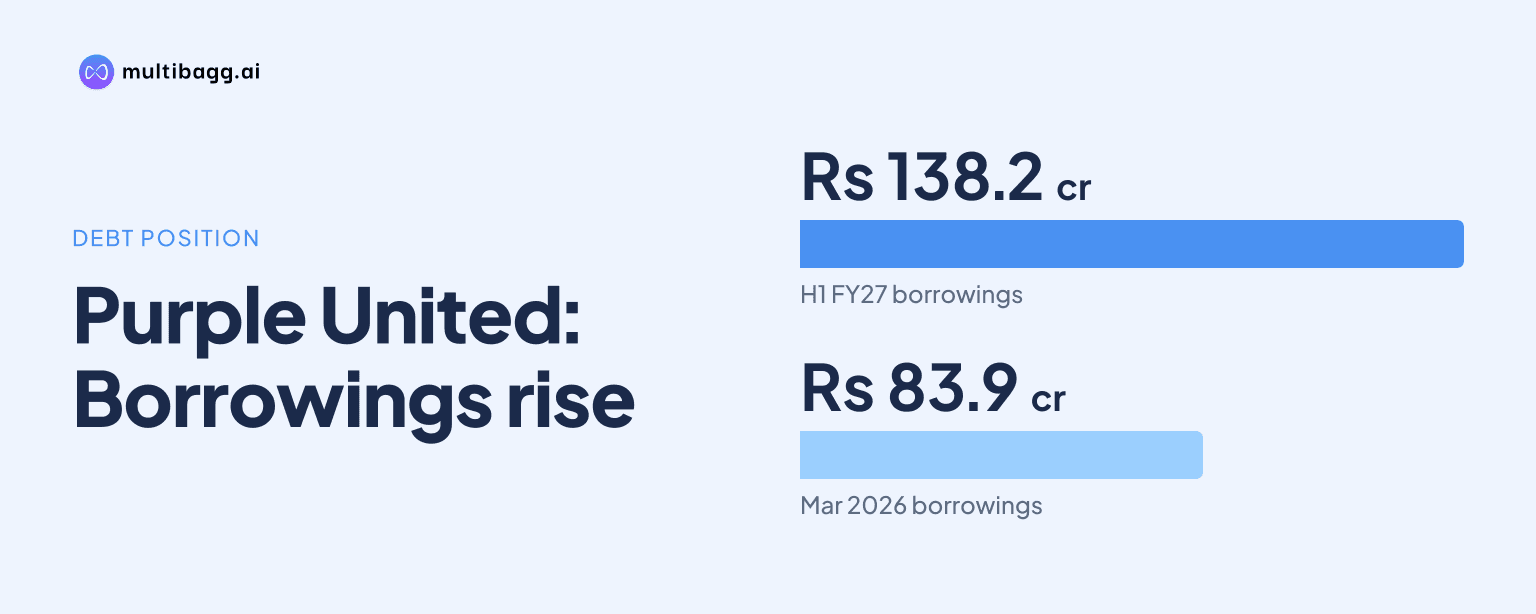
Purple United Sales ended H1 FY27 with short-term borrowings of Rs 138.2 crore, up from Rs 83.9 crore in March 2026, as seasonal inventory funding, supplier and store-capex advances, and delayed fundraise proceeds increased temporary financing needs. Finance costs consequently rose 150.6% year on year to Rs 9.6 crore.
Know Purple United Sales inside out
Results, valuation, peers and who's buying, in one view.
Why did Purple United’s short-term borrowings increase?
Purple United’s short-term borrowings increased by Rs 54.3 crore to Rs 138.2 crore in H1 FY27 because management cited working-capital needs ahead of the festive season and the delayed receipt of preferential-fundraise proceeds. The borrowing increase occurred as the company added 17 exclusive brand outlets, or EBOs, in H1 FY27, taking its network to 126 stores across 21 states and union territories.
Management said negative operating cash flow primarily resulted from advances paid to suppliers. These included advances to capital-expenditure, or CapEx, vendors constructing stores and to inventory suppliers preparing merchandise for the next season. Management said these advances support vendors’ ability to deliver products on time during Purple United’s growth phase.
An analyst referred to operating cash flow of around negative Rs 11.7 crore and other current assets rising from about Rs 51 crore in March to Rs 78 crore in September. Management also identified accumulated input tax credit, or ITC, on services and inventory as part of the asset balance, saying the credits cannot be used immediately but remain available across its operations in 21 states.
Did Purple United improve its working-capital cycle?
Purple United improved its reported overall working-capital cycle to 206 days from 256 days despite the rise in short-term borrowings to Rs 138.2 crore. Inventory holding days to sales also fell to 152 days from 156 days, indicating that management reported better cycle measures while funding seasonal stock, supplier advances and store construction.
The timing of cash requirements is linked to Purple United’s sales seasonality. Management said H1 typically contributes 35% to 40% of annual revenue, while H2 contributes about 60% to 65%. It also said average selling prices have historically been around 40% higher in H2 than in H1, supported by festive and winter merchandise, while gross margin has remained broadly stable with marginal year-on-year improvement.
Revenue from operations increased 103.6% year on year to Rs 123.7 crore in H1 FY27 from Rs 60.7 crore in H1 FY26. Earnings before interest, tax, depreciation and amortisation, or EBITDA, rose 88.6% to Rs 23.7 crore from Rs 12.6 crore, but EBITDA margin declined by 153 basis points to 19.2% from 20.7% as operating expenses increased with the retail expansion.
Got a follow-up? Ask IRIS
What caused Purple United’s finance costs to rise?
Purple United’s finance costs rose 150.6% year on year to Rs 9.6 crore in H1 FY27, primarily because of higher short-term borrowing for working-capital requirements. An analyst noted that finance cost represented about 8% of revenue in H1 FY27, compared with around 6% in H1 FY26, while management also cited expanding retail-related banking costs.
The H1 FY27 finance-cost figure included a non-recurring Rs 1.5 crore annual charge paid to banks and institutions. Management described it mainly as processing fees associated with newly onboarded banking relationships, said it was charged to the profit and loss account in H1, and said it would not recur in H2. It added that processing charges on renewals are normally much lower.
Expansion-related operating costs also affected profitability in H1 FY27. Management said employee expense increased about 81% year on year after it hired senior personnel, an e-commerce specialist and support team, and store-level employees. An analyst noted that other expenses increased from around 24% to 27% of revenue, while management identified salary and store costs as significant components.
Management said most operating costs remain broadly unchanged between the two halves, while H2 brings the larger share of annual revenue. It added that stores operating for six to eight months are near or below EBITDA breakeven, and said the higher H2 sales base could improve fixed-cost absorption as festive-season demand increases.
Can Purple United reduce borrowing costs in H2 FY27?
Purple United expects reliance on short-term borrowings to moderate following a fundraise of about Rs 48 crore, which management said should support a gradual normalisation of finance costs during H2 FY27. Management said the funds would support expansion and reduce use of banking facilities, but did not disclose a target short-term borrowing balance for the end of H2.
Management said Purple United’s average interest rate was around 10.1% at the time of the call. It said the company had received a State Bank of India sanction at an interest rate of about 9.25%, and that it hoped to reduce the average rate by at least 50 to 75 basis points in H2 through banking consolidation and other finance-department actions.
The banking-consolidation plan also aims to reduce cash-collateral percentages offered to banks, which management said could free additional funds. The stated objective is to move interest costs from double-digit to single-digit levels, but this is a management objective rather than reported H2 FY27 performance.
Funding capacity remains tied to store expansion. Management said 190 to 200 stores were feasible with visibility from the recent fundraise and banking tie-up, compared with 130 stores at the time of the call. It said organic additions of three to five stores a month could be funded through internal accruals and working capital, whereas an expansion pace of seven to 10 stores a month could require additional capital.
Conclusion
Purple United’s H1 FY27 debt increase reflects the cash demands of a fast-growing retail network rather than a reported worsening in its working-capital days. Revenue more than doubled to Rs 123.7 crore and the working-capital cycle shortened to 206 days, but supplier advances, store-capex advances, unavailable ITC and seasonal inventory requirements lifted short-term borrowing to Rs 138.2 crore and finance cost to Rs 9.6 crore.
The next update to watch is whether H2, which management expects to contribute 60% to 65% of annual revenue, converts higher seasonal selling prices and the Rs 48 crore fundraise into lower banking use. Purple United said it will begin reporting quarterly results despite its SME listing requirement for half-yearly reporting, and management said it expects greater clarity on next financial year’s store-opening plan after the December quarter.