










Radiowalla Says Client Funding Keeps Screen Expansion Asset-Light
Key highlights
- Radiowalla said clients generally fund radio and screen devices through upfront installation charges or higher rentals.
- Radiowalla said exceptional investments in screens are recovered within 12 to 15 months.
- Screen-content management generates about Rs 400 to Rs 2,000 per screen per month, versus typical in-store-radio revenue of Rs 300 to Rs 400 per store per month.
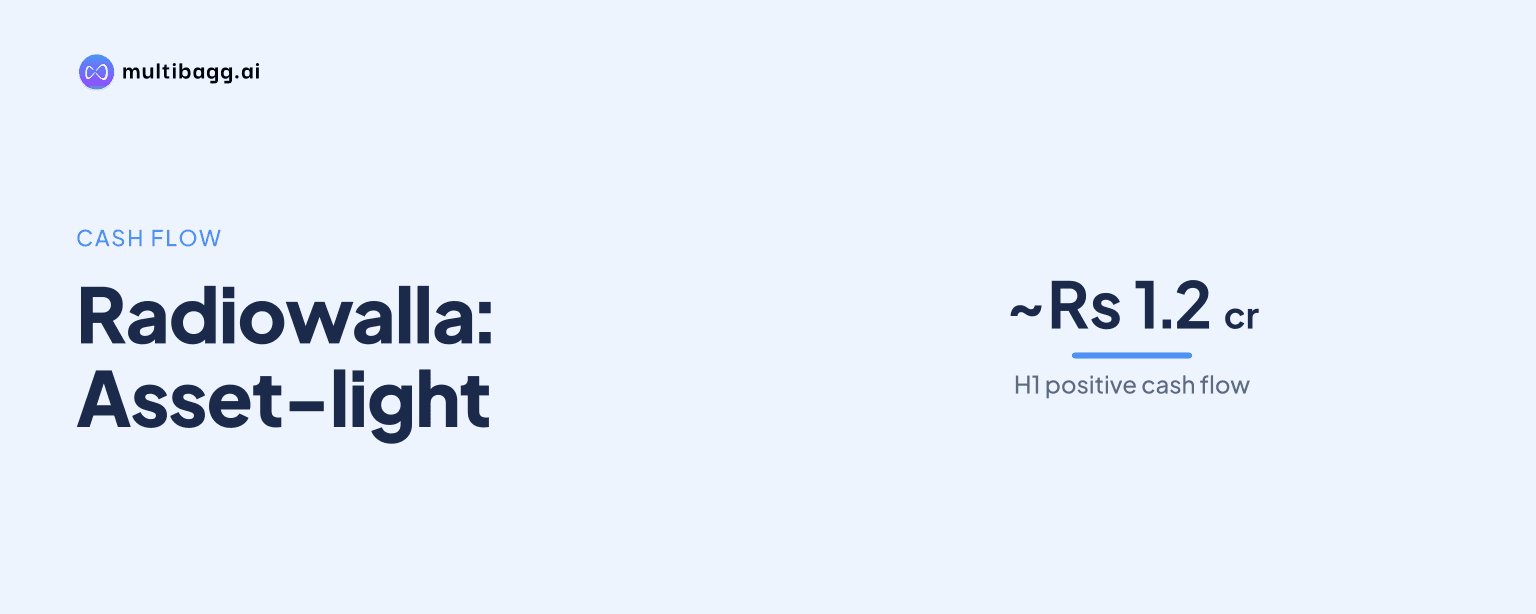
- Radiowalla reported almost Rs 1.2 crore of positive first-half cash flow after previously negative cash flow.
powered by IRIS
Radiowalla Network Limited said on November 9, 2026 that clients generally fund screen devices, while any exceptional screen investment is recovered within 12 to 15 months. The company said its visual-content model focuses on managing content across client-owned displays, limiting routine capital spending on screen hardware.
Know Radiowalla Network inside out
Results, valuation, peers and who's buying, in one view.
How does Radiowalla fund devices for stores and screens?
Radiowalla said its investment in in-store-radio equipment is practically zero per store because clients typically pay for devices that need to be deployed. Management said the same principle generally applies to screen-content management: customers commonly pay for screen devices either through an upfront installation amount or a higher rental that includes the device cost.
The arrangement makes Radiowalla primarily a service provider rather than an equipment owner in most installations. Management said on November 9 that clients often already own screens but need one provider to manage content across different display sizes and locations. Radiowalla therefore sells centrally managed visual content rather than routinely purchasing and installing the underlying screens.
What happens when Radiowalla funds a screen?
Radiowalla said it only sometimes invests in screens at a client’s request, and management said such investment is recovered within 12 to 15 months. The company did not disclose the number of exceptional projects requiring its investment or the rupee value of hardware spending on those projects.
Management described visual content management as a software-as-a-service model in which Radiowalla manages material shown on client screens. That model can create recurring service revenue without requiring ownership of a client’s full display network. Management’s view that capital expenditure is not high rests on client-funded hardware in normal deployments and the stated 12-to-15-month recovery period in exceptions.
How does screen revenue compare with in-store radio revenue?
Radiowalla said in-store radio typically generates Rs 300 to Rs 400 per store per month, although revenue can approach Rs 1,000 for smaller clients with fewer stores and broader deliverables. Screen-content management has a higher stated range, starting at about Rs 400 to Rs 500 per screen per month and rising to Rs 2,000 depending on content work, screen specifications and deliverables.
The comparison indicates that screen management can produce more revenue per unit than the typical in-store-radio range, although management did not provide a single average rate. It said pricing differs with store count, screen type, content requirements and deliverables. The potentially higher screen revenue is paired with customer-funded equipment in most cases, rather than a matching increase in Radiowalla hardware spending.
Got a follow-up? Ask IRIS
How does the model increase revenue from existing clients?
Radiowalla said it has a presence across more than 35,000 locations and is seeking to lift average revenue per user, or ARPU, from existing customers. Management cited annual price increases of 5% to 7% for some clients, alongside add-on services including fragrance and screen-content management. Account managers identify those opportunities through daily or weekly client interactions covering digital-content and fragrance requirements.
For screen management, Radiowalla’s proposition targets customers that have displays but lack a single provider able to manage varied screen formats and locations. An existing in-store-radio relationship can therefore provide a route to sell visual-content services. Management cited a corporate-radio customer that subsequently added screen-content management, describing the move from audio to screens as an upsell.
Radiowalla also said its initial fragrance customers were existing clients and that it had deployed more than 100 diffusers by the call date. Management planned another 400 to 500 diffuser deployments over the following three to four months, estimating monthly oil revenue of Rs 700 to Rs 2,000 per diffuser and a 15% to 20% margin. Fragrance is separate from screen management, but both offerings reflect the strategy of selling additional services to established accounts.
What does the model mean for cash flow and expansion?
Management said first-half cash flow improved from negative territory to almost Rs 1.2 crore positive. It attributed the change partly to better collections and advance annual billing for clients below a certain annual-revenue threshold, instead of monthly billing followed by collection activity. Radiowalla said receivables typically operate on a 60-day cycle, making collections its principal working-capital consideration.
Client-paid devices are relevant to that cash-flow approach because routine radio and screen hardware deployments do not generally require Radiowalla to commit cash. Management nevertheless said it was investing in technology and certain media devices, which had increased depreciation. Those investments were distinct from the normal model in which clients fund installation equipment upfront or through increased rental.
Management said Radiowalla opened a Dubai subsidiary in January and funded its initial set-up, but said it had made no continuous additional funding after that. The Dubai operation had started generating revenue, according to management. The company also has a step-down subsidiary in Canada, where it said no costs were being incurred as of November 9; management said a North American operating focus would depend on client wins over the next six to 12 months.
Conclusion
Radiowalla’s model combines service revenue from in-store radio and visual-content management with limited normal exposure to device purchases. Screen-content management’s stated Rs 400 to Rs 2,000 monthly revenue range per screen is above the typical Rs 300 to Rs 400 range per in-store-radio store, while client payment for equipment and a 12-to-15-month recovery period for exceptions shape the capital requirement behind that expansion.
The next measure to watch is conversion of existing relationships into screen-management, fragrance and corporate contracts while collections remain disciplined. Management reported 5% to 7% price increases for some clients and plans to focus internationally on the Middle East and Africa; it said any greater North American activity remains conditional on winning business within six to 12 months.