










Radiowalla targets 400-500 fragrance diffusers in four months
Key highlights
- Radiowalla has deployed more than 100 fragrance diffusers and targets another 400 to 500 within three to four months.
- Management estimates Rs 700 to Rs 2,000 of monthly oil revenue from each fragrance diffuser.
- Radiowalla cited a fragrance margin of 15% to 20% before cost of goods sold.
- Management said first-half cash flow improved from negative to almost Rs 1.2 crore positive.
powered by IRIS
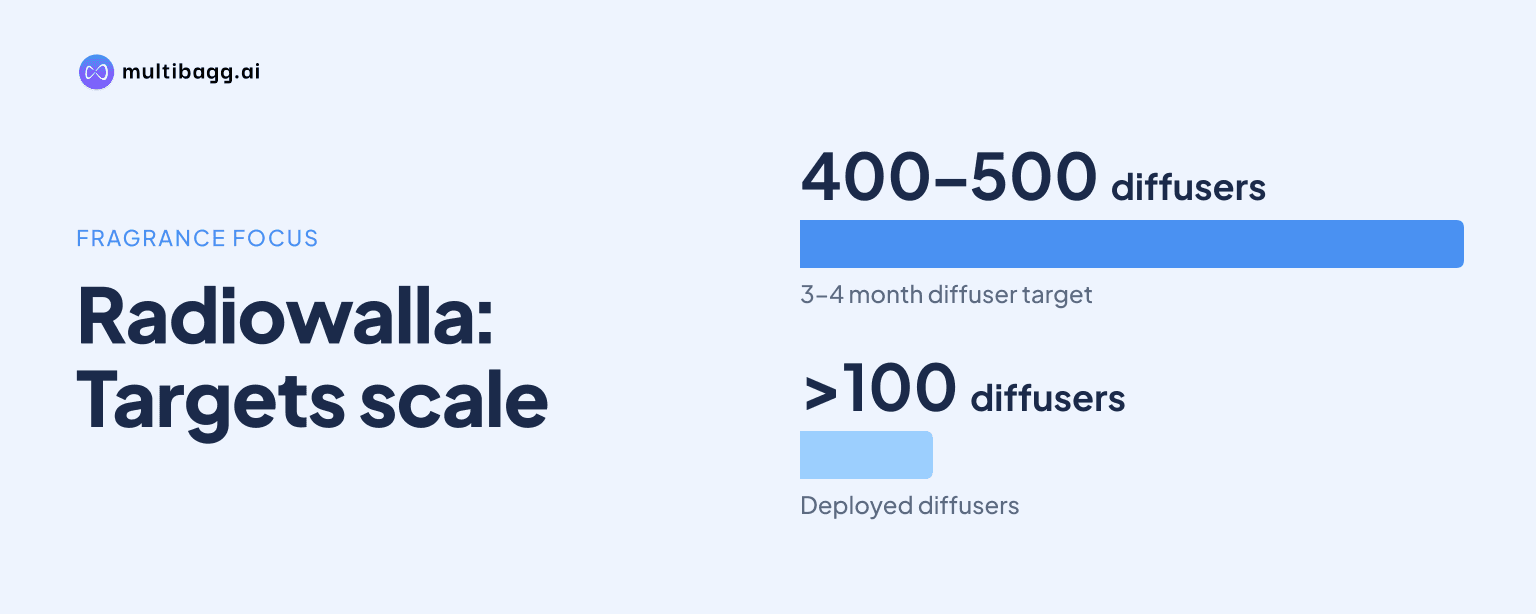
Radiowalla Network Limited has deployed more than 100 fragrance diffusers and targets another 400 to 500 over the next three to four months, with management estimating Rs 700 to Rs 2,000 of monthly revenue from oil consumed by each unit. The new retail service is initially being sold to existing clients.
Know Radiowalla Network inside out
Results, valuation, peers and who's buying, in one view.
How many fragrance diffusers is Radiowalla planning to add?
Radiowalla plans to deploy another 400 to 500 fragrance diffusers within the next three to four months after installing more than 100 units. Management disclosed the rollout at its November 9, 2026 call and said the fragrance service arose from requests by customers seeking several retail services through one vendor.
If the planned installations are completed, the disclosed diffuser base would exceed 500 units. Management did not identify customers, provide a dated installation schedule or disclose orders for the additional units, but said the initial fragrance customers were existing clients. The proposed rollout is therefore a cross-sell effort across Radiowalla’s established retail relationships rather than a disclosed new-client acquisition programme.
Radiowalla said its account managers engage with larger clients daily or weekly and use these discussions to identify requirements, including fragrance arrangements. Management said it can set up pilots at client locations, but conversions take time. That makes the 400-to-500-unit plan dependent on client decisions as well as the timing of existing supplier contracts.
What revenue and margin does Radiowalla expect from fragrance?
Radiowalla estimates each fragrance diffuser will generate Rs 700 to Rs 2,000 a month from the oil consumed, with a margin of 15% to 20% before cost of goods sold. Management described the economics as recurring consumable revenue rather than a one-time sale of the diffuser device.
Using management’s disclosed ranges, 400 additional units would produce Rs 2.80 lakh in monthly revenue at Rs 700 per unit, while 500 units would produce Rs 10 lakh at Rs 2,000 per unit. These are arithmetic illustrations, not company guidance. Actual revenue will depend on installations and oil consumption, neither of which was quantified for the initial base of more than 100 diffusers.
The fragrance range starts above the Rs 300 to Rs 400 monthly figure management cited for a typical larger in-store radio client. It also overlaps with the Rs 400 to Rs 2,000 range for screen content management. The services have different cost structures, however: management did not disclose fragrance installation costs, oil procurement costs, contract lengths or renewal rates.
Got a follow-up? Ask IRIS
Why is Radiowalla selling fragrance to existing clients first?
Radiowalla is targeting current clients first because management expects cross-selling to increase average revenue per user, or ARPU, without the usual customer-acquisition effort. Management said existing relationships help the company reach decision-makers, understand incumbent vendor-contract timing and learn the price points customers may consider.
Management said customer-acquisition cost, or CAC, was “practically nil” to the extent fragrance is sold to current customers. That is a management characterisation rather than a reported financial calculation. During the call, a question referred to Radiowalla’s presence across more than 35,000, and management described this existing network as a platform for services that can be added in retail and hospitality environments.
The fragrance offering accompanies annual price discussions for existing services. Management said it had secured year-on-year price increases of 5% to 7% from some clients and remained in negotiation with others. It described price increases as difficult, so a new service such as fragrance offers another mechanism to lift revenue from a store without depending only on new locations.
Radiowalla’s subscription margins provide context but are not directly comparable with fragrance. Management said in-store radio has a margin above 40%, corporate radio is around 45%, and content management is slightly below 40% and moving towards that level. The 15% to 20% fragrance figure is before cost of goods sold, unlike the margin descriptions for subscription services.
How does the diffuser rollout fit Radiowalla’s growth and cash-flow plan?
Radiowalla presents fragrance as a retail brand extension alongside subscription growth, advertising and cost management. Management said revenue had grown around 7% year on year, while subscription businesses, advertising improvement and cost rationalisation contributed to higher earnings before interest, tax, depreciation and amortisation, or EBITDA.
Management said it rationalised payroll after process improvements, while expecting to hire junior sales staff in new markets at salaries below Rs 1 lakh. It also reported a Rs 20 lakh first-half impact from tax deducted at source, or TDS, on overseas revenue, plus a Rs 10 lakh provision for doubtful debts based on receivables ageing. Management said EBITDA improved despite these items and employee stock-option costs.
Cash flow improved from negative to almost Rs 1.2 crore positive in the first half, according to management, which cited collections and annual advance billing for lower-revenue clients. It said receivables typically follow a 60-day cycle. These collection measures are separate from fragrance, but they show that management is seeking to limit cash tied up in receivables while adding service lines.
Advertising remained in an investment stage, management said, although it expects margins to improve as advertising locations increase in the second half. Management also said marketing costs for partnerships with Campaign India, Exchange4media and industry associations were included in reported results and had not been present in the previous year. Fragrance is positioned separately as an offering to existing retail clients.
Conclusion
Radiowalla’s fragrance initiative is a specific cross-selling plan: more than 100 diffusers are deployed, 400 to 500 more are targeted in three to four months, and management estimates Rs 700 to Rs 2,000 in monthly oil revenue per unit. The service could add recurring retail revenue, but its margin measure before cost of goods sold should not be compared directly with subscription-business margins above 40%.
The next measure to watch is whether client pilots convert into the planned installations and whether oil usage supports management’s monthly revenue range. Management also said its FY27 focus includes top-line growth, gross margin, EBITDA and cash flow, while Dubai decisions may gain clarity after the music-licensing policy that began on December 1.