










Radiowalla returns to profit as H1 EBITDA margin hits 8%
Key highlights
- Radiowalla reported H1 FY27 revenue of Rs 10.79 crore, up 7% year on year.
- Radiowalla’s EBITDA margin rose to 8% in H1 FY27 from negative 1% in H2 FY26.
- Radiowalla returned to PAT of Rs 21 lakh in H1 FY27.
- Radiowalla had deployed more than 100 fragrance diffusers and plans another 400 to 500 over three to four months.
powered by IRIS
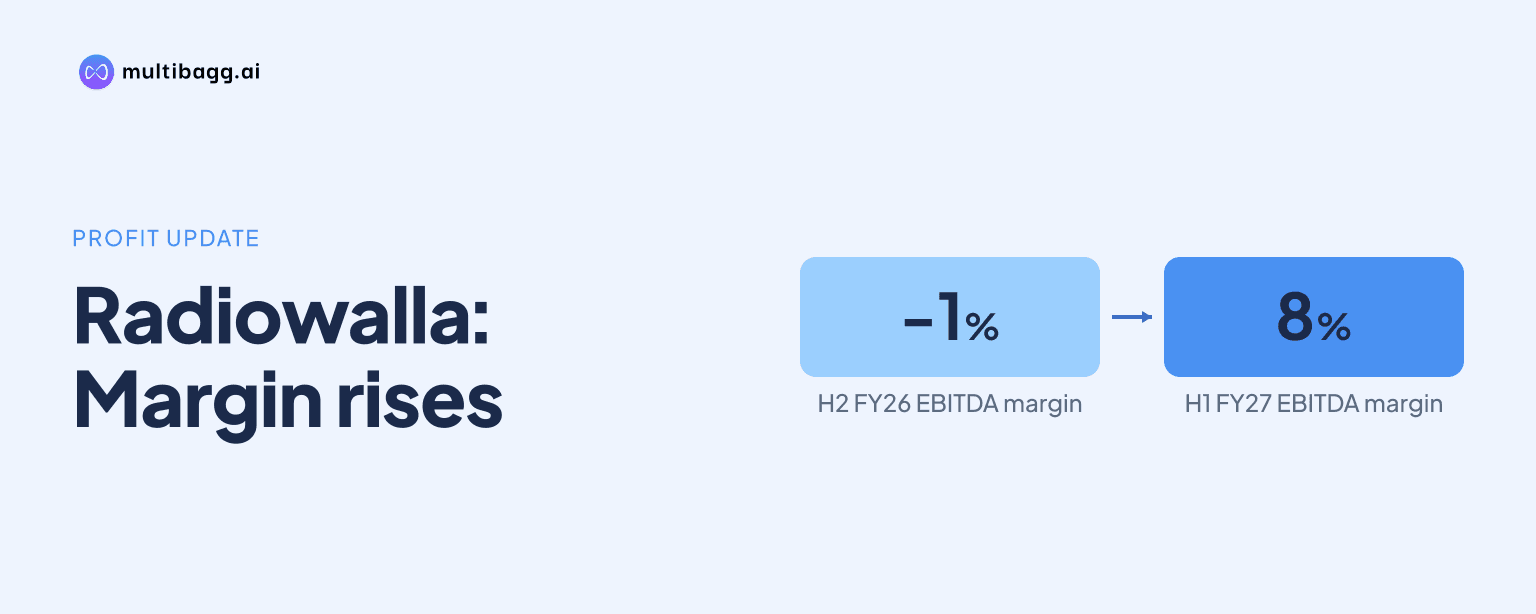
Radiowalla Network Limited returned to a Rs 21 lakh profit in H1 FY27 as its earnings before interest, tax, depreciation and amortisation (EBITDA) margin rose to 8% from negative 1% in H2 FY26, supported by higher-margin subscriptions, payroll rationalisation and artificial-intelligence-led workflow changes.
Know Radiowalla Network inside out
Results, valuation, peers and who's buying, in one view.
How did Radiowalla’s H1 FY27 profitability change?
Radiowalla reported revenue from operations of Rs 10.79 crore in H1 FY27, up 7% from Rs 10.06 crore in H1 FY26 and 5% from H2 FY26. EBITDA reached Rs 81.58 lakh, compared with Rs 74 lakh in H1 FY26, while the margin improved from 7% a year earlier and negative 1% in H2 FY26.
Radiowalla also recorded profit after tax (PAT) of Rs 21 lakh in H1 FY27, reversing the loss reported in the preceding half. Management said H2 FY26 had been affected by a substantial decline in advertising revenue, which it described as an aberration, while revenue and margins improved again in advertising during H1 FY27.
Reported H1 FY27 earnings included a Rs 20 lakh withholding-tax charge on overseas revenue and a Rs 10 lakh provision for doubtful debts based on receivable ageing. Management said the doubtful-debt item was a provision under its policy rather than a realised loss, and also said employee stock-option costs were included in the result.
What drove Radiowalla’s EBITDA margin recovery?
Radiowalla attributed the 8% EBITDA margin to subscription-business economics, resource use and cost optimisation. Management said in-store radio generates margins above 40%, corporate radio generates about 45%, and visual content management is below 40% but moving towards that level.
The higher-margin subscription services include in-store music, corporate radio and visual content management, whereas advertising remains in an investment stage. Management said advertising revenue and margins had improved, but subscriptions were the principal factor lifting the overall margin profile in H1 FY27.
Payroll rationalisation was another contributor. Management said certain fixed-cost employees were let go after process improvements reduced manpower needs, while new junior sales hires in newer markets would be paid below Rs 1 lakh a month. It did not disclose the number of roles affected or the total payroll saving.
Radiowalla also said artificial intelligence (AI) is being used for music content, non-music content and content curation. Management linked AI integration in workflows to cost rationalisation, saying costs had largely remained flat or declined even as H1 FY27 revenue increased to Rs 10.79 crore.
Is advertising still limiting Radiowalla’s growth?
Advertising is still a recovery opportunity rather than the main source of Radiowalla’s H1 FY27 margin improvement. Management said the prior-half advertising decline had pushed H2 FY26 EBITDA margin to negative 1%, while H1 FY27 saw improvement in both advertising revenue and advertising margin.
Radiowalla can sell audio advertising in more than 5,000 stores and owns 15 digital hoardings across Gujarat and Uttar Pradesh. In the audio model, participating retailers allow third-party advertisements in their outlets, with part of the revenue shared with the retail chain providing the inventory.
Management said it had engaged media agencies and conducted roadshows over the past year to build awareness of retail media. It is also engaging chief marketing officers, agencies, Campaign India, Exchange4Media, retail associations and the Federation of Hotel and Restaurant Associations of India to develop the category.
The 7% H1 FY27 revenue increase was therefore lower than the change in profitability. Management said it had seen an improving business trajectory after September and expected better advertising margins as scale rises in the second half, but gave no numerical FY27 revenue, EBITDA or PAT target.
Got a follow-up? Ask IRIS
How is Radiowalla increasing revenue from existing clients?
Radiowalla is pursuing price increases, cross-selling and product additions across more than 35,000 locations. Management said it had secured annual price increases of 5% to 7% from some clients, though it described negotiations with customers as difficult.
The company added about 100 brands and 3,000 stores in the first half, and said it serves more than 700 retail brands. Its corporate-radio service reaches more than 50,000 daily users in India, Mexico and Brazil in seven languages, while its visual-content-management service operates on more than 1,200 screens.
Radiowalla is also piloting a smart amplifier in about 100 stores. The device changes audio volume using real-time footfall data and reduces store-level control of volume; management said it would decide how to scale the product after three months, with advertising its primary intended use.
Management said the company is also moving smaller clients below a specified annual-revenue threshold to advance annual billing. It said receivables typically run on a 60-day cycle and that better collections and advance billing helped lift first-half cash flow to nearly Rs 1.2 crore positive from negative cash flow.
What can fragrance add to Radiowalla’s business?
Radiowalla launched its fragrance solution in September and had begun servicing and billing a few clients by the November 9, 2026 earnings call. Management said the product resulted from client requests to buy multiple in-store services from one supplier.
Management estimated recurring monthly revenue of Rs 700 to Rs 2,000 per diffuser from fragrance-oil consumption. More than 100 diffusers had been deployed, and management planned another 400 to 500 installations over the following three to four months, subject to client conversion and deployment.
The fragrance business is expected to deliver a margin of 15% to 20%, excluding cost of goods sold, according to management. Initial customers are existing clients, which management said reduces the effort of reaching relevant decision-makers and supports higher average revenue per user (ARPU).
Fragrance is a separate recurring-revenue mechanism from the core subscription offerings because billing depends on oil consumed at each installed diffuser. Management positioned the service as a cross-selling opportunity for retail and hospitality clients alongside audio, visual content and advertising solutions.
Conclusion
Radiowalla’s H1 FY27 return to profit reflected subscription margins and cost actions more than a complete advertising recovery. Revenue rose 7% year on year to Rs 10.79 crore, while EBITDA margin rose from negative 1% in H2 FY26 to 8% and PAT reached Rs 21 lakh despite the Rs 20 lakh overseas-tax charge and Rs 10 lakh doubtful-debt provision.
The next measures to watch are advertising monetisation across more than 5,000 eligible stores, the decision after the three-month smart-amplifier pilot in about 100 stores, and fragrance deployment against management’s plan for another 400 to 500 diffusers in three to four months. Management also plans to continue subscription growth, cross-selling, advance billing and operating-efficiency measures without issuing numerical FY27 guidance.