










Radiowalla returns to profit as half-year EBITDA margin reaches 8%
Key highlights
- Radiowalla reported profit after tax of Rs 21.1 lakh in HY Sep-26, reversing a Rs 19.2 lakh loss in HY Mar-26.
- Revenue from operations rose 5% sequentially to Rs 10.7931 crore and increased 7% year on year.
- EBITDA improved from a Rs 10.38 lakh loss to Rs 81.58 lakh, lifting the EBITDA margin from negative 1% to 8%.
- Cash flow from operations was positive at Rs 1.27 crore in HY Sep-26, compared with negative Rs 75.8 lakh in the same period last year.
powered by IRIS
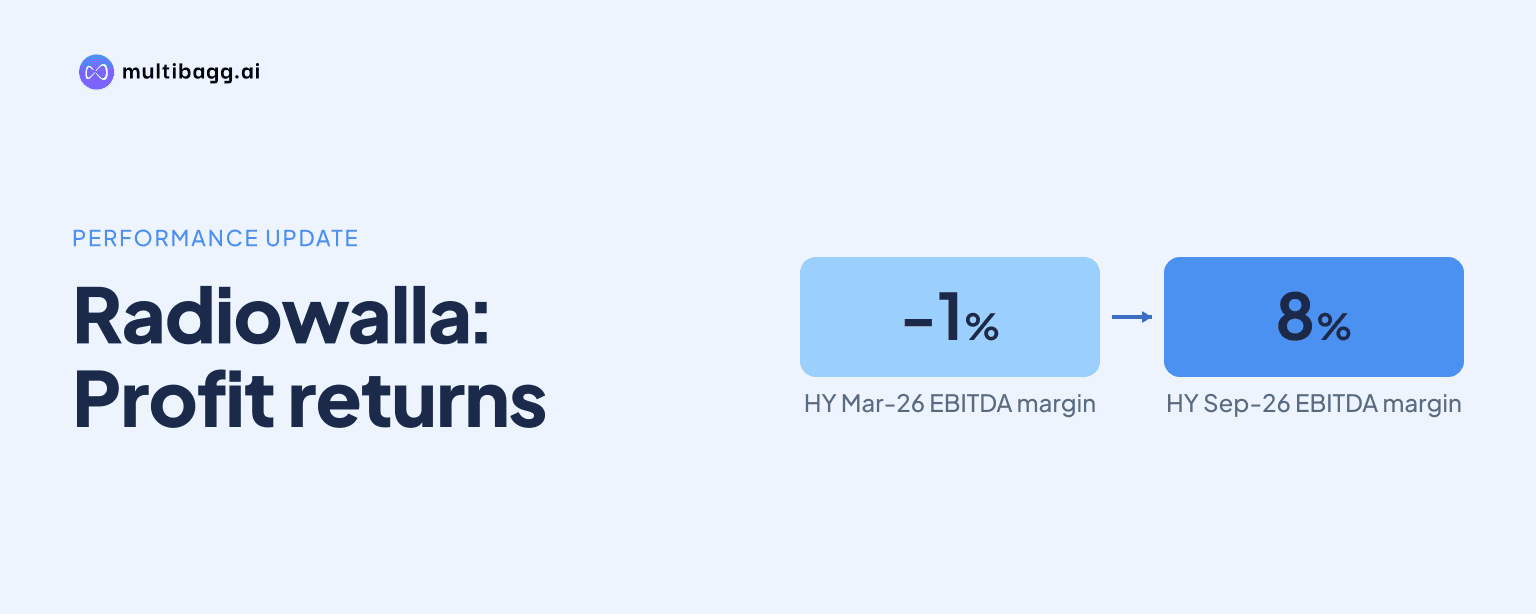
Radiowalla Network Limited returned to profit in the half year ended September 2026, reporting profit after tax of Rs 21.1 lakh after a Rs 19.2 lakh loss in the preceding six months. Radiowalla’s earnings before interest, tax, depreciation and amortisation (EBITDA) reached Rs 81.58 lakh, and its EBITDA margin rose to 8% from negative 1%.
Know Radiowalla Network inside out
Results, valuation, peers and who's buying, in one view.
What changed in Radiowalla’s half-year financial performance?
Radiowalla moved from a sequential operating loss to EBITDA of Rs 81.58 lakh in HY Sep-26, while revenue from operations increased 5% to Rs 10.7931 crore from Rs 10.3144 crore in HY Mar-26. EBITDA had been a loss of Rs 10.38 lakh in the preceding six months, making the reported sequential EBITDA improvement 920%.
Revenue also rose 7% from Rs 10.065 crore in HY Sep-25. EBITDA was Rs 74.47 lakh in the corresponding prior-year half, so the latest result was 10% higher year on year even though the margin increase was narrower, at 8% in HY Sep-26 versus 7% in HY Sep-25.
The 8% EBITDA margin also exceeded the 3% margin reported for the full year ended March 2026. The comparison between HY Sep-26 and FY Mar-26 is not like for like because the former covers six months and the latter covers 12 months, but it places the latest half-year margin above the prior full-year outcome.
How did cost reductions support Radiowalla’s EBITDA recovery?
Radiowalla said its sequential EBITDA improvement was supported by a 5.32% reduction in the cost of goods and services and a 10.29% reduction in employee benefit expenses. Those reductions occurred despite the 5% increase in revenue between HY Mar-26 and HY Sep-26, according to management.
Management also reported a 14% sequential decline in direct costs, attributing the reduction to improved resource utilisation and the integration of artificial intelligence, or AI, in backend workflows. The stated mechanism was that lower direct costs, alongside higher revenue, increased margins during the half year ended September 2026.
The scale of the operating change exceeded the increase in sales. Revenue rose by Rs 47.87 lakh from HY Mar-26 to HY Sep-26, while EBITDA improved by Rs 91.96 lakh, moving from a Rs 10.38 lakh loss to Rs 81.58 lakh of profit. The presentation does not provide absolute direct-cost or employee-benefit expense figures, only the percentage reductions.
Did Radiowalla return to reported profit and generate operating cash flow?
Radiowalla returned to reported profit in HY Sep-26, recording profit before tax and exceptional or extraordinary items of Rs 24.7 lakh, compared with a Rs 35.4 lakh loss in HY Mar-26. That sequential movement followed the increase in EBITDA to Rs 81.58 lakh, although EBITDA excludes depreciation and amortisation.
Profit after tax, or PAT, was Rs 21.1 lakh in HY Sep-26, compared with a Rs 19.2 lakh loss in the preceding six months. Basic and diluted earnings per share, or EPS, were each Rs 0.3; Radiowalla compared this with negative EPS of Rs 0.25 in the preceding year.
Cash flow from operations was positive at Rs 1.27 crore, compared with negative Rs 75.8 lakh in the same period last year. This is a year-on-year comparison, whereas the PAT reversal compares HY Sep-26 with HY Mar-26, so the cash-flow and profit measures have different reference periods.
Got a follow-up? Ask IRIS
Which Radiowalla business lines improved their margins?
Radiowalla’s In-Store Radio service reported a 42% gross margin, up from 33% in the prior year, while VCMS reported 36%, up from 21%. The 15-percentage-point gain in VCMS was the largest disclosed improvement across the three subscription-service categories.
Corporate Radio recorded a 45% gross margin, compared with 46% in the prior year. It remained the highest-margin subscription category disclosed by Radiowalla, although its margin declined by 1 percentage point while In-Store Radio and VCMS improved.
Advertising remained loss-making at the gross-margin level, but its margin improved to negative 14% from negative 23% in the prior year. Management said it was expanding marketing and technology efforts and was confident of turning around the advertising unit in the second half of financial year 2027, or H2 FY27.
What expenses limited Radiowalla’s profit conversion?
Radiowalla’s EBITDA increase did not flow fully through to pre-tax profit because depreciation and amortisation rose to Rs 70.4 lakh in HY Sep-26 from Rs 47.3 lakh in HY Mar-26. Management linked the increase to capital expenditure for In-Store Radio and continuing technical improvements to its delivery platform.
Other expenses increased to Rs 145.9 lakh from Rs 97.3 lakh sequentially. Management identified about Rs 15 lakh of travel costs for international business development and domestic industry events, along with a one-time withholding-tax charge of about Rs 20 lakh that was not claimable because of insufficient profit in earlier years.
The new Fragrance business unit for retail clients was launched during the period, but Radiowalla said revenue from that vertical would start flowing in H2. The presentation does not disclose a revenue target for Fragrance, its margin profile, or the capital required to build the unit.
Conclusion
Radiowalla’s HY Sep-26 result combines 5% sequential revenue growth with a reversal from a Rs 10.38 lakh EBITDA loss to Rs 81.58 lakh of EBITDA, lifting the margin from negative 1% to 8%. Lower cost of goods and services, employee-benefit expenses and direct costs were the mechanisms management identified, while PAT turned to Rs 21.1 lakh.
The next disclosed point to watch is management’s H2 FY27 plan to turn around advertising, whose gross margin remained negative 14% despite improving from negative 23%. Revenue from the newly launched Fragrance retail unit is also expected to begin in H2, while depreciation and amortisation of Rs 70.4 lakh will remain relevant to how much EBITDA converts into reported profit.