










Rainbow targets over 5,000 beds by FY32 expansion plan
Key highlights
- Rainbow Children’s Hospital currently has 2,685 capacity beds across 26 hospitals in six states and 11 cities.
- Named projects are expected to add 1,190 beds by FY30, taking total capacity to 3,875 beds.
- The largest scheduled project is the 325-bed Gurugram Sector 44 facility in FY28-29.
- Approximately 1,125 additional beds remain under discussion for FY28-FY32, with no project-level capacities or completion dates disclosed.
powered by IRIS
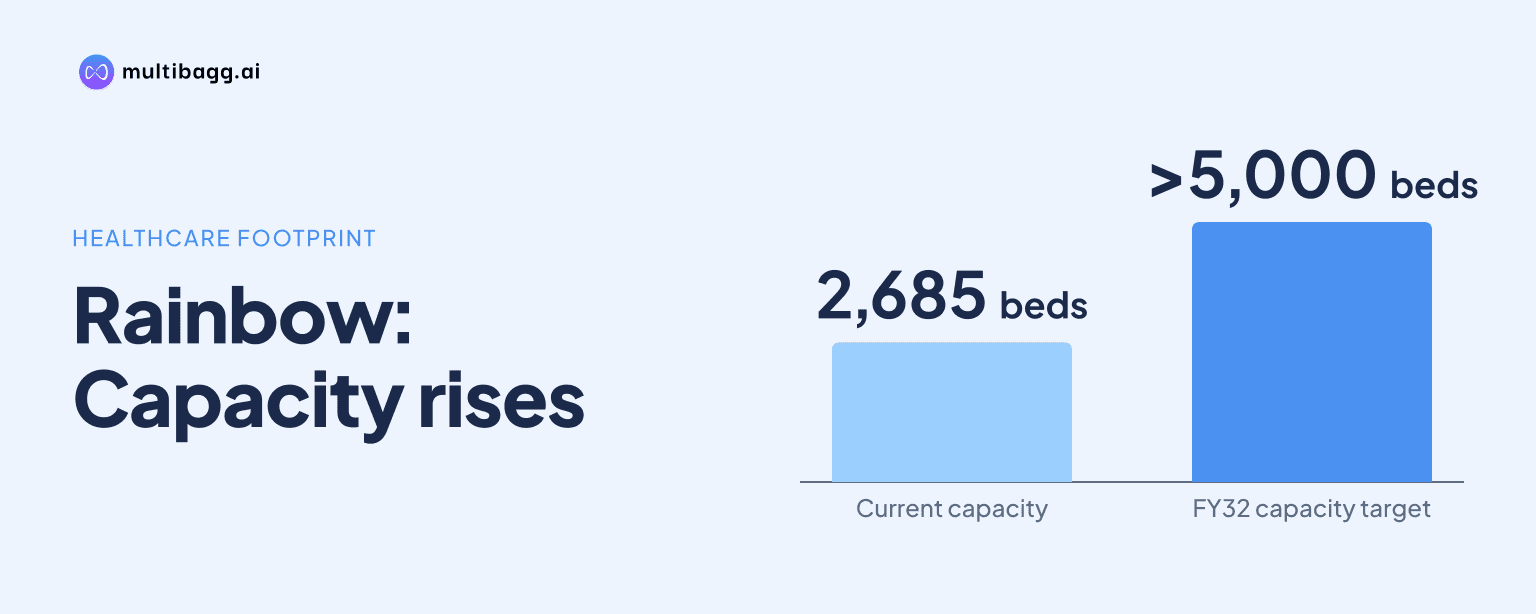
Rainbow Children’s Hospital has set an indicative path to more than 5,000 capacity beds by FY32, from 2,685 currently. Rainbow’s named projects add 1,190 beds through FY30, taking capacity to 3,875, while approximately 1,125 further beds remain under discussion for the FY28-to-FY32 period.
Know Rainbow Childrens Medicare inside out
Results, valuation, peers and who's buying, in one view.
How many beds does Rainbow plan to add by FY32?
Rainbow plans to add approximately 2,315 beds to its current 2,685-bed capacity to exceed 5,000 beds by FY32. The presentation divides the increase into 1,190 beds from projects scheduled through FY30 and about 1,125 further beds under discussion between FY28 and FY32.
The FY30 target of 3,875 beds is 1,190 beds above the current base, while the FY32 target would be about 2,315 beds higher. Capacity beds mean the total bed count on the last day of the relevant period, including operational beds and non-census beds such as day-care, emergency, pre-operative and post-operative beds.
The FY30 total is supported by projects assigned to financial years, whereas the additional approximately 1,125 beds have no individual capacities or completion dates in the presentation. Rainbow describes the project timelines as indicative, so the FY32 figure is a stated plan rather than completed capacity.
Where are Rainbow’s current 2,685 beds located?
Rainbow’s largest current bed base is in Telangana, at 1,040 beds, followed by Bengaluru with 592 beds and Andhra Pradesh with 479 beds. Telangana accounts for 1,040 of the 2,685 beds, and its figure includes the acquisition of Prashanthi Hospital in Warangal.
Bengaluru and Andhra Pradesh together account for 1,071 beds, compared with 270 beds in Tamil Nadu, 154 beds in the National Capital Region and 150 beds in the North East. The National Capital Region figure includes beds at Madhukar in New Delhi, where Rainbow provides medical services.
Rainbow reports 26 hospitals across six states and 11 cities, alongside more than 1,100 doctors. That doctor count includes full-time residents and Diplomate of National Board personnel, while the network listing also identifies clinics and in vitro fertilisation locations in addition to hospitals.
Got a follow-up? Ask IRIS
Which Rainbow projects are scheduled before FY30?
Rainbow’s scheduled additions begin with 25 beds in Indore in FY26-27, followed by 385 beds in FY27-28. The FY27-28 additions comprise 30 beds at Nellore Phase 2, 125 beds at Gurugram Sector 56, 130 beds in Coimbatore and 100 beds in Mumbai.
The 25-bed Indore operation is described as Rainbow’s current arrangement, with an independent facility of approximately 100 beds likely to be commissioned by the end of FY29. The timetable therefore includes another 75 Indore beds in FY28-29, taking the listed Indore contribution to approximately 100 beds.
Rainbow’s largest scheduled annual addition is 630 beds in FY28-29. This consists of 325 beds at Gurugram Sector 44, 150 beds in Pune, 80 beds in Seegehalli, Bengaluru, and 75 further beds in Indore, compared with 385 beds scheduled in FY27-28.
Gurugram has 450 beds in the named pipeline when the 125-bed Sector 56 project and 325-bed Sector 44 project are combined. The final scheduled addition is 150 beds in Amaravati, Andhra Pradesh, in FY29-30, which brings the named additions across the four financial years to 1,190 beds.
Coimbatore is expected to be commissioned in the second half of FY27-28, according to the presentation. Rainbow says its Mumbai hospital is likely to commence in the first quarter of FY28, distinguishing both projects from the FY28-FY32 additions that remain under discussion.
What remains undecided in Rainbow’s FY32 expansion plan?
Approximately 1,125 beds required for Rainbow’s path from 3,875 beds in FY30 to more than 5,000 in FY32 are under discussion. This is separate from the 1,190 beds in projects assigned to FY26-27 through FY29-30, and it means the latter portion of the expansion has not been allocated project by project.
Rainbow lists Hyderabad, Lucknow, Noida, Jaipur, Bhuvaneshwar, Raipur, Chandigarh, Mumbai and Ludhiana as locations for projects under discussion. The presentation gives no bed count, commissioning date or individual status for these nine locations.
Mumbai appears in both parts of the plan. Rainbow has a named 100-bed Mumbai hospital likely to commence in the first quarter of FY28, while Mumbai is also among the cities listed for further projects under discussion, without a disclosed capacity for that additional opportunity.
The timetable shows 1,190 scheduled beds against approximately 1,125 beds under discussion, making the two components similar in scale. The presentation does not state which of the nine discussion-stage cities will account for the approximately 1,125 beds or whether every listed location will proceed by FY32.
Conclusion
Rainbow’s expansion plan has a defined first phase and a less specified second phase. Named projects would add 1,190 beds by FY30, led by the 325-bed Gurugram Sector 44 project and 150-bed additions in Pune and Amaravati, while the longer-term target depends on a separate group of approximately 1,125 beds under discussion.
The next disclosed milestones are the 25-bed Indore operation in FY26-27, Coimbatore’s expected commissioning in the second half of FY27-28 and the likely first-quarter FY28 start for Mumbai. The key unresolved matter is whether Rainbow converts the nine discussion-stage locations into projects with defined capacities and completion dates before FY32.