










Rainbow Children’s Hospital reports 2.9-kg infant transplant
Key highlights
- Rainbow Children’s Hospital reported a living-donor liver transplant for a six-week-old infant weighing 2.9 kg.
- The infant received a 62-gram liver graft donated by the mother after GALD caused severe liver failure.
- The infant spent 3 weeks in intensive care and 1 additional week in hospital before discharge with a well-functioning liver.
- Rainbow Children’s Medicare operates 26 hospitals, 6 clinics and 2 fertility clinics across 11 cities, with 2,685 beds.
powered by IRIS
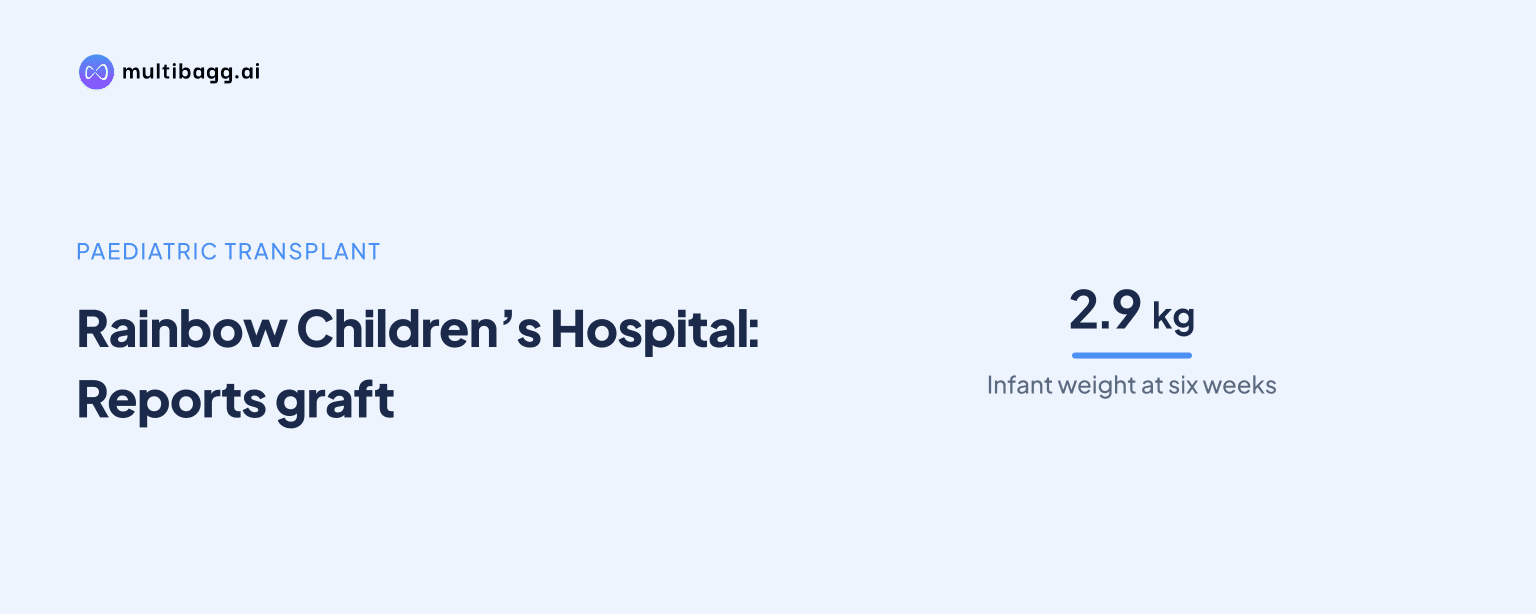
Rainbow Children’s Hospital reported performing a living-donor liver transplant on a six-week-old infant weighing 2.9 kg at Banjara Hills. The baby received a 62-gram graft from the mother after jaundice progressed to severe liver failure and intravenous immunoglobulin plus two exchange transfusions did not halt deterioration.
Know Rainbow Childrens Medicare inside out
Results, valuation, peers and who's buying, in one view.
What transplant did Rainbow perform for the 2.9-kg infant?
Rainbow performed a living-donor liver transplant for a six-week-old baby weighing 2.9 kg, using a 62-gram graft donated by the mother. Its presentation headline called the patient South India’s youngest baby to successfully receive a liver transplant, while the Indian Chronicle material reproduced on the page described the case as what Rainbow termed South India’s smallest paediatric liver transplant.
The procedure took place at Rainbow Children’s Hospital, Banjara Hills, according to the presentation. The Indian Chronicle material carries an October 8, 2026 dispatch date and an October 9, 2026 masthead date, but Rainbow did not disclose the operation date, its duration, or the infant’s identity. The source identifies a single clinical case rather than a programme-wide transplant volume.
The maternal graft was reduced to fit the 2.9-kg infant, according to the accompanying report. Rainbow said tiny blood vessels and limited abdominal space made vessel connections and safe graft placement particularly difficult. These constraints are central to the hospital’s account of the operation, alongside the 62-gram graft size and the infant’s age of six weeks.
Why did the infant need a liver transplant?
The infant needed transplantation after jaundice beginning in the first week of life progressed to severe liver failure by the third week. Rainbow said investigations revealed Gestational Alloimmune Liver Disease, or GALD, a rare condition; the accompanying report said clinicians reached that conclusion after ruling out infections, metabolic disorders and genetic causes.
Initial treatment did not arrest the deterioration. Rainbow reported using intravenous immunoglobulin and two exchange transfusions before proceeding to transplantation because the baby’s life was at risk. The disclosed clinical sequence moved from jaundice in week one to severe liver failure in week three and transplant by six weeks of age.
Rainbow did not provide liver-function test results, donor-assessment information, or a comparison with other GALD cases. It did disclose the treatment mechanism: a maternal living-donor graft was used after immunoglobulin and two exchange transfusions failed to stop disease progression. Dr. Prashant Bachina said early diagnosis and timely transplantation can be crucial in rapidly progressive liver failure.
What complications followed Rainbow’s infant transplant?
Rainbow reported a complicated post-operative course involving pulmonary complications and an intestinal obstruction that required an additional surgery. The infant spent three weeks in the intensive care unit, or ICU, on parenteral nutrition, meaning nutrition provided intravenously, and was discharged after another week in hospital with a well-functioning liver.
The reproduced Indian Chronicle report gives further detail, saying severe lung problems required high-frequency ventilation, inhaled nitric oxide and bronchoscopy. It also reported infections involving antibiotic-resistant bacteria. The recovery therefore involved respiratory support, infection management and nutritional treatment as well as the 62-gram graft procedure.
The newspaper account said a leak near an intestinal surgical join led to a second operation and a temporary stoma. Oral feeding was gradually restarted after prolonged intravenous nutrition, and the child was eventually discharged without oxygen and taking full feeds. Rainbow’s main presentation reports the same four-week hospital course as three ICU weeks plus another week of stay, but gives no later outcome data.
Got a follow-up? Ask IRIS
Which clinical teams did Rainbow say were involved?
Rainbow said the 2.9-kg transplant involved specialists in hepatology, transplant surgery, anaesthesia, neonatal care, intensive care, paediatric surgery, radiology, nutrition, physiotherapy, infection control and transplant nursing. Dr. Mettu Srinivas Reddy said the procedure required meticulous planning, surgical precision and close teamwork, reflecting the small blood vessels, limited space and post-operative complications described in the case.
The presentation links the case to Rainbow’s paediatric quaternary-care services, which include organ transplantation. Rainbow Children’s Medicare Limited said it operates 26 hospitals, six clinics and two dedicated fertility clinics across 11 cities, with 2,685 beds in total. That capacity includes 130 beds at Madhukar Hospital, where Rainbow provides medical services.
Rainbow describes a hub-and-spoke model in which hub hospitals provide outpatient and inpatient care focused on tertiary and quaternary services, while spokes provide paediatric and obstetric emergency care, outpatient services, obstetrics and level 3 neonatal intensive care. The company said the model is operational in Hyderabad and gaining traction in Bengaluru, giving the Banjara Hills case a Hyderabad-based clinical setting.
What does Rainbow’s disclosure establish about this case?
Rainbow’s disclosure establishes that it reported completing a living-donor transplant for a six-week-old, 2.9-kg infant with GALD and discharging the child with a well-functioning liver after three ICU weeks and another week of hospital stay. It also documents the 62-gram maternal graft, two unsuccessful exchange transfusions and a recovery involving pulmonary and intestinal complications.
The supplied material does not independently substantiate the descriptions of South India’s youngest baby or smallest paediatric transplant. It provides no benchmark population, registry comparison or defined geographic dataset. Rainbow’s statement that the procedure demonstrates its capacity for highly complex neonatal transplantation is the hospital’s assessment of this one case and its multidisciplinary care process.
The case is not an operating or financial performance measure. Rainbow disclosed no transplant programme volumes, waiting-list data, survival rates, transplant revenue or long-term graft-function results. The evidence instead concerns one clinical milestone, reported in October 2026, involving a 2.9-kg recipient and a 62-gram maternal graft.
How does this case fit Rainbow’s expansion plans?
Rainbow said its hub-and-spoke approach is operational in Hyderabad and is gaining traction in Bengaluru, while it intends to replicate the model in Chennai and the National Capital Region. The company subsequently intends to expand into tier-2 cities in southern India. Those plans concern service-network development, not a disclosed target for liver-transplant procedures.
The company also said its doctors work exclusively on a full-time retainer basis and in teams with 24/7 commitment, particularly for paediatric emergency, neonatal and intensive-care services. In this case, the three-week ICU stay, respiratory treatment and additional intestinal surgery illustrate the range of care Rainbow says its team-based model is designed to support.
Conclusion
Rainbow reported that a six-week-old infant weighing 2.9 kg received a 62-gram maternal liver graft after GALD progressed despite intravenous immunoglobulin and two exchange transfusions. The disclosed outcome, discharge after three ICU weeks and another hospital week with a functioning liver, combines a technically constrained transplant with a recovery requiring respiratory, nutritional and intestinal surgical care.
What to watch next is whether Rainbow discloses longer-term graft function, infection status, feeding progress or developmental follow-up, none of which appears in the October 2026 material. At the network level, management’s stated next steps are replication of its hub-and-spoke model in Chennai and the National Capital Region, followed by intended expansion into tier-2 cities in southern India.