










Rainbow emerging hospitals report 54% H1 discharge growth
Key highlights
- Rainbow’s emerging hospitals recorded 16,052 inpatient discharges in H1 FY27, up 54% from 10,391 in H1 FY26.
- Operational beds in the emerging-hospital cluster increased 29% to 476, while total capacity remained 635 beds.
- Emerging-hospital occupancy rose to 43.1% in H1 FY27 from 38.9%, even as average length of stay fell 8% to 2.34 days.
- The emerging cluster contributed 22% of Rainbow’s H1 FY27 revenue and represented 25% of group beds.
powered by IRIS
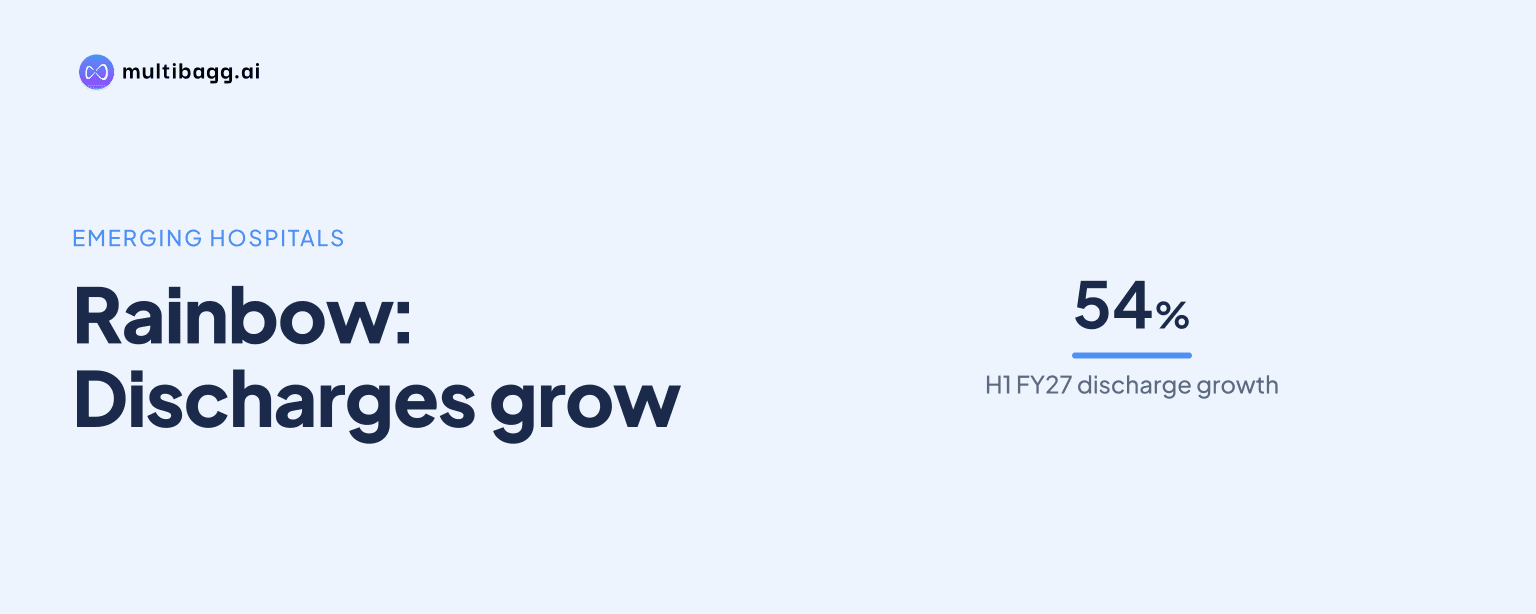
Rainbow Children's Hospital reported 16,052 inpatient discharges from its emerging-hospital cluster in H1 FY27, up 54% from 10,391 a year earlier. Rainbow increased operational beds by 29% to 476 while capacity stayed at 635, and occupancy rose 4.2 percentage points to 43.1% from 38.9%.
Know Rainbow Childrens Medicare inside out
Results, valuation, peers and who's buying, in one view.
What does Rainbow classify as an emerging hospital?
Rainbow defines emerging hospitals as facilities that are two to five years after commencing operations, covering hospitals opened between 1 April 2021 and 31 March 2024. The H1 FY27 cluster comprised seven hospitals: OMR, Financial District, Himayat Nagar, Sarjapur, Anna Nagar, Warangal and Guwahati.
Rainbow reported that the emerging cluster accounted for 25% of group beds and 22% of group revenue in H1 FY27. The group separately classified 14 hospitals as mature, meaning more than five years old, and five hospitals as new, meaning zero to two years old; it also disclosed that Guwahati commenced operations on 1 September 2025.
How fast did Rainbow emerging-hospital discharges grow?
Rainbow's emerging hospitals increased inpatient, or IP, discharges by 54% to 16,052 in H1 FY27 from 10,391 in H1 FY26. That outpaced the 4% rise at mature hospitals, where discharges reached 40,723, and the 21% increase in group IP discharges to 59,592.
The H1 result included 8,845 emerging-hospital discharges in Q2 FY27, up 32% from 6,697 in Q2 FY26 and above 7,207 in Q1 FY27. The sequential increase means Q2 contributed more than half of the 16,052 H1 discharges, alongside the year-on-year comparison.
Rainbow's mature network operated 1,202 beds in both H1 FY27 and H1 FY26, while its emerging network added 106 operational beds. Discharges at the emerging cluster therefore expanded faster despite the mature group remaining the larger network, with 40,723 H1 FY27 discharges compared with 16,052 at emerging hospitals.
Did occupancy rise while Rainbow opened more beds?
Rainbow's emerging-hospital occupancy increased to 43.1% in H1 FY27 from 38.9% in H1 FY26 as operational beds rose to 476 from 370. Capacity was unchanged at 635 beds, so the reported expansion reflected a higher proportion of existing capacity being brought into operation.
The emerging cluster remained below mature-hospital occupancy of 49.6% and group occupancy of 45.3% in H1 FY27. However, mature-hospital occupancy rose from 48.6%, whereas group occupancy declined from 46.3% as group operational beds increased 20% to 1,886 from 1,572.
Rainbow also reported emerging-hospital occupancy of 47.2% in Q2 FY27, compared with 44.7% in Q2 FY26 and 38.9% in Q1 FY27. Operational beds were 476 in both Q2 FY27 and Q1 FY27, indicating that the quarter-on-quarter occupancy increase occurred without a change in the reported operated-bed count.
Got a follow-up? Ask IRIS
What happened to revenue per bed and length of stay?
Rainbow reported average revenue per occupied bed, or ARPOB, of Rs 59,770 for emerging hospitals in H1 FY27, 10% above Rs 54,105 in H1 FY26. Mature-hospital ARPOB was Rs 68,962, up 13% from Rs 61,299, on an unchanged 1,202 operational beds.
Rainbow's emerging-hospital average length of stay, or ALOS, declined to 2.34 days from 2.54 days, an 8% reduction. Q2 FY27 ALOS was also 2.34 days, versus 2.58 days in Q2 FY26, while Q2 discharges increased 32% to 8,845.
In the H1 FY27 maturity-wise comparison, Rainbow reported 43% occupancy, 24% earnings before interest, tax, depreciation and amortisation, or EBITDA, and ARPOB rounded to Rs 60,000 for emerging hospitals. Mature hospitals reported 50% occupancy, 27% EBITDA and ARPOB rounded to Rs 69,000, while new hospitals reported 25% occupancy and negative 22% EBITDA, all on a pre-Ind AS 116 basis.
How does the emerging cluster compare with Rainbow's wider results?
Rainbow's emerging hospitals generated 22% of group revenue from 25% of group beds in H1 FY27. Mature hospitals accounted for 73% of revenue and 64% of beds, while new hospitals represented 4% of revenue and 11% of beds, placing the emerging cohort between the established and newest networks.
Rainbow reported consolidated revenue from operations of Rs 101.80 crore in H1 FY27, up 27.6% from Rs 79.77 crore in H1 FY26. EBITDA after Ind AS 116 and excluding other income increased 20.6% to Rs 30.46 crore, while profit for the year increased 13.1% to Rs 14.64 crore; the presentation did not disclose rupee revenue or profit for the emerging cluster.
Rainbow's group outpatient consultations increased 21% to 9,17,704 in H1 FY27 and deliveries increased 22% to 10,629. Its specialty mix changed to 64% paediatrics, 31% women care and 5% in-vitro fertilisation from 66%, 30% and 3%, respectively, in H1 FY26.
What do Q2 results show about Rainbow's hospital ramp-up?
Rainbow's Q2 FY27 data show emerging-hospital activity above both Q1 FY27 and Q2 FY26 levels: discharges were 8,845, occupancy was 47.2% and ARPOB was Rs 59,096. The cluster had 635 capacity beds and 476 operational beds in Q2 FY27, compared with 419 operational beds in Q2 FY26.
Rainbow reported a 26% pre-Ind AS 116 EBITDA margin for emerging hospitals in Q2 FY27, against 28% for mature hospitals and negative 16% for new hospitals. Group revenue in that quarter was Rs 54.80 crore, up 23% year on year, while EBITDA after Ind AS 116 increased 14% to Rs 17 crore.
Conclusion
Rainbow's H1 FY27 operating data show that its emerging cohort added activity faster than its mature network, with 54% discharge growth, a 4.2-percentage-point occupancy increase and 106 additional operational beds. The cluster nevertheless remained below the mature network on occupancy, ARPOB and revenue share, while representing 22% of group revenue.
The next measure to watch is whether Rainbow can increase utilisation beyond Q2 FY27 occupancy of 47.2% while operating more of the cluster's 635-bed capacity. The presentation reported 476 operational beds in both Q1 and Q2 FY27 and disclosed no timetable for further operationalisation.