










Rainbow Children's Medicare Limited ARPOB Grew 15%, Above 6%-8% Range
Key highlights
- Rainbow reported 15% year-on-year ARPOB growth in Q2 FY27, above management’s broad 6%-8% range.
- Management said fertility contributed around 5% of revenue alongside obstetrics growth and improved case mix.
- Rainbow’s Q2 FY27 operating revenue rose 23.2% year on year to Rs 548 crore.
- Mature-hospital occupancy was 54%, versus management’s stated maximum achievable level of around 60%.
powered by IRIS
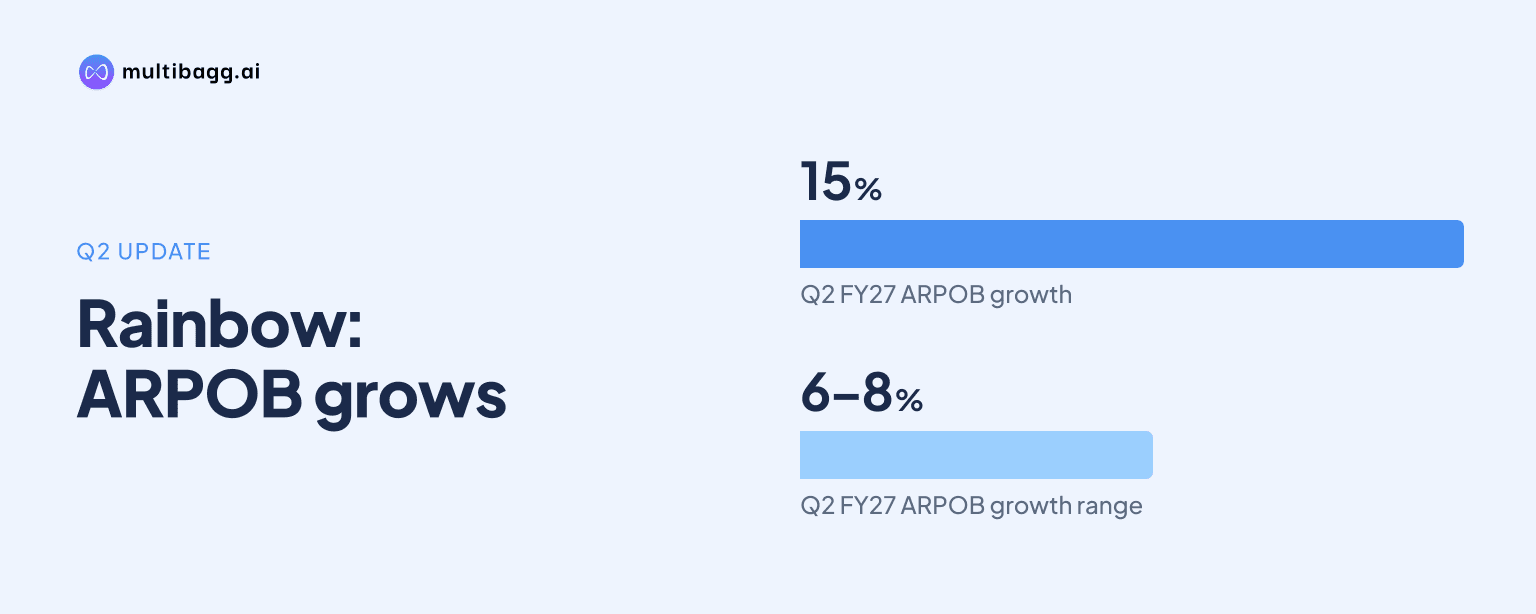
Rainbow Children's Medicare Limited reported 15% year-on-year average revenue per occupied bed, or ARPOB, growth in Q2 FY27, above management’s normal 6%-8% range, as obstetrics expanded, fertility contributed around 5% of revenue, case mix improved and average length of stay declined.
Know Rainbow Childrens Medicare inside out
Results, valuation, peers and who's buying, in one view.
What drove Rainbow’s 15% ARPOB growth in Q2 FY27?
Rainbow’s 15% ARPOB growth in Q2 FY27 was driven by significant obstetrics growth, fertility’s additional revenue contribution of around 5%, improved case mix and a significant reduction in average length of stay, or ALOS, management said. Dr. Ramesh Kancharla identified these as the principal factors behind the quarterly result rather than attributing ARPOB growth solely to price increases.
The operating indicators also showed higher activity in Q2 FY27. Patient consultations rose 19% year on year, deliveries increased 20%, and inpatient discharges grew 15%. Operating revenue rose 23.2% year on year to Rs 548 crore, while the company did not disclose the absolute ARPOB amount.
The faster 20% increase in deliveries than the 15% increase in inpatient discharges coincided with management’s description of stronger obstetrics contribution. Management also said lower ALOS contributed to ARPOB, while consultations, deliveries and discharges measure activity across both the outpatient and inpatient parts of Rainbow’s women’s and children’s hospital network.
Is Rainbow’s 15% ARPOB growth a new normal?
No, Rainbow said its usual ARPOB growth expectation is around 7%-8%, and management agreed that ARPOB and average revenue per patient, or ARPP, should broadly grow in a 6%-8% range. The 15% Q2 FY27 outcome reflected a favourable period for case mix, obstetrics and fertility revenue rather than a revised recurring target.
ARPP measures year-on-year inpatient revenue per patient, whereas ARPOB also reflects occupied-bed use and ALOS. Management said ARPP growth can remain relatively stable because insurance negotiations may take up to one year to appear in reported figures; its three-year average ARPP growth was around 6%-7%.
Rainbow did not say that ARPP should replace ARPOB as the preferred operating metric. It said both should be viewed alongside the significant outpatient component of children’s and women’s hospitals, where outpatient consultations grew 21% in the first half of FY27.
How are obstetrics and fertility affecting Rainbow’s revenue mix?
Obstetrics and fertility were material drivers of Rainbow’s Q2 FY27 revenue intensity, with fertility adding around 5% of revenue, according to management. The company’s fertility or in vitro fertilisation, or IVF, business is mainly an in-house model: growth in obstetrics outpatient department, or OPD, consultations is intended to create fertility patient conversions when treatment is required.
Rainbow said its existing IVF business has broadly grown in line with obstetrics OPDs. It has also started two to three standalone fertility centres and expects those centres, together with digital-led marketing, to provide an additional channel of growth as they become established.
The H1 FY27 activity figures support the expansion in maternal-care services. Deliveries increased 22% year on year, compared with 21% growth in outpatient consultations and 21% growth in inpatient discharges. Management did not disclose separate earnings before interest, tax, depreciation and amortisation, or EBITDA, margins for paediatric care, women and child care, and fertility.
Got a follow-up? Ask IRIS
Is Rainbow becoming less reliant on seasonal disease volumes?
Rainbow said Q2 FY27 performance was largely driven by underlying paediatric and maternal-care business rather than usual seasonal volumes. Management said the delayed monsoon affected occupancy and that the company had seen little of its normal seasonal business over the last three quarters.
Mature-hospital occupancy was 54%, below management’s stated maximum achievable level of around 60%. Management said seasonality can still provide an additional occupancy and revenue benefit, but it cited Q2 operating revenue of Rs 548 crore, up 23.2%, as evidence that the quarter delivered growth without much seasonal support.
The company did not quantify the revenue share attributable to seasonal illness, obstetrics, fertility or paediatric care. Its statement therefore supports the view that non-seasonal underlying businesses drove the recent period, but not a numerical division of the Rs 548 crore quarterly revenue among those sources.
What could determine Rainbow’s next ARPOB outcome?
Rainbow’s next ARPOB movement will depend on case mix, obstetrics and fertility contribution, ALOS and utilisation, based on management’s Q2 FY27 comments. A recovery in seasonal volumes could add occupancy and revenue, while fertility is expected to grow alongside obstetrics OPDs and the two to three standalone centres.
Capacity additions are another consideration because new hospitals require time to mature. Management said most new hospitals should achieve EBITDA break-even within two years, including those in new geographies; it cited first-year positive EBITDA for hospitals in an existing Hyderabad cluster, 12-15 months in Bengaluru and 15-18 months in Chennai.
Management gave no timetable for group occupancy to reach the 60% mature-hospital level. It said doctor recruitment, community engagement, patient-acquisition efforts, a revamped call centre and technology upgrades are intended to improve volumes progressively, while marketing expense was a little over 2% of revenue and a new website and patient app are planned in the next few months.
Conclusion
Rainbow’s 15% Q2 FY27 ARPOB growth was above management’s indicated 6%-8% range because specialty mix and operating factors aligned: obstetrics expanded, fertility contributed around 5% of revenue, case mix improved and ALOS fell. The comparison with ARPP’s 6%-7% three-year average indicates management does not treat the quarterly ARPOB result as its normal growth rate.
The next disclosed markers are whether deliveries and fertility conversion continue to rise, whether mature-hospital occupancy moves from 54% toward 60%, and whether expansion projects remain on schedule. Management said projects are generally delivered within plus or minus one quarter of planned timing, while Chennai, previously delayed by about six months for re-approvals, was back on track.