










Rainbow says new hospitals have 16% EBITDA loss before break-even
Key highlights
- Rainbow's current new-hospital cohort reported an EBITDA margin of around negative 16%.
- Most hospitals are expected to reach EBITDA break-even within two years, according to management.
- Rainbow said Hyderabad additions can generate positive EBITDA in the first year, versus 12-15 months in Bengaluru.
- Rainbow expects to add approximately 2,300 beds over the next three years.
powered by IRIS
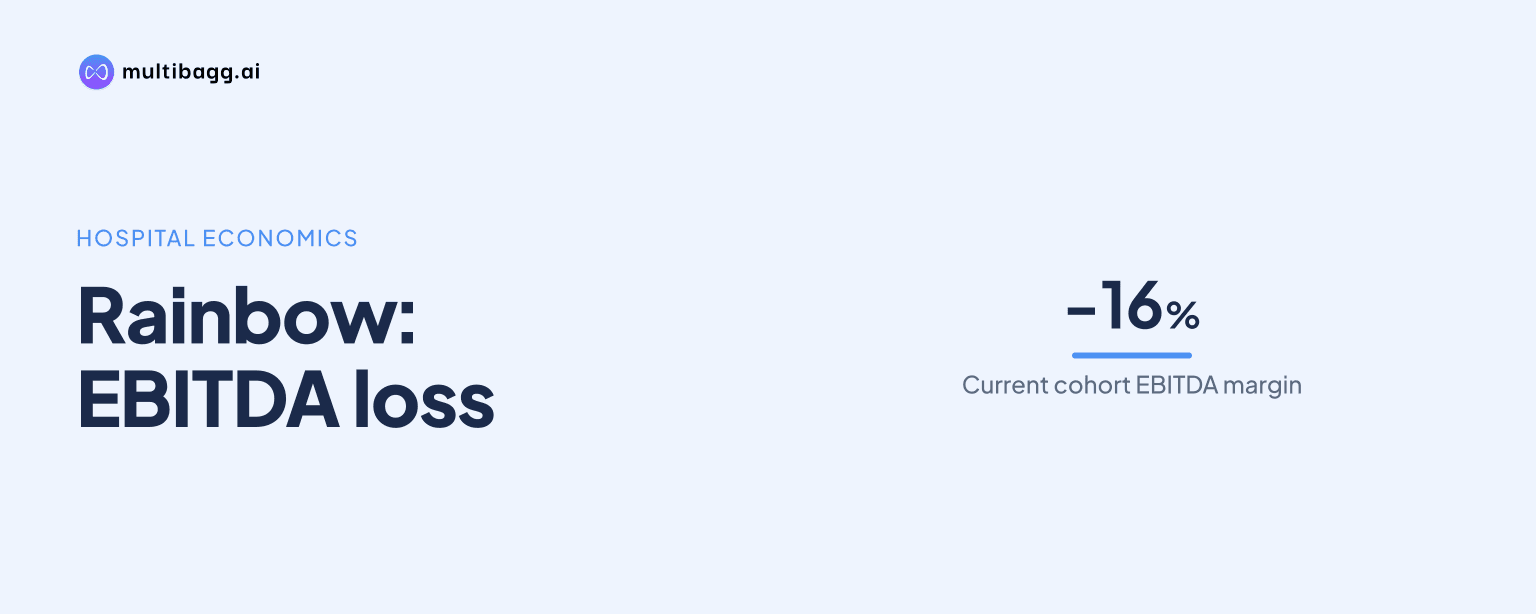
Rainbow Children's Medicare Limited said on its November 2, 2026 call that its current new-hospital cohort had an EBITDA margin of around negative 16%, because most sites had opened only six to eight months earlier, while management expects most hospitals, including those in new geographies, to reach EBITDA break-even within two years.
Know Rainbow Childrens Medicare inside out
Results, valuation, peers and who's buying, in one view.
How long do Rainbow hospitals take to break even?
Rainbow expects most new hospitals to achieve EBITDA break-even within two years, although management said the precise timing depends on the location and how each facility is developed. EBITDA means earnings before interest, taxes, depreciation and amortisation. Management separated hospitals into mature facilities operating for more than five years, emerging hospitals, and new hospitals, saying the categories help show the different stages of their operating ramp-up.
The two-year expectation is not a uniform forecast for every location. Dr. Ramesh Kancharla said a new hospital opened within an established cluster such as Hyderabad would almost certainly generate positive EBITDA in its first year. By contrast, management expects a hospital in a new geography to need more time to build patient volumes, doctor teams and referral links before it reaches the same milestone.
Rainbow's disclosed timelines show the difference between existing and newer markets:
Why is Rainbow's new-hospital cohort loss-making?
Rainbow's new-hospital category is loss-making because its facilities have largely been operating for only six to eight months, leaving initial operating costs ahead of their full revenue ramp. Management reported an EBITDA margin of around negative 16% for this category, while also describing its revenue numbers as encouraging. The figure reflects the initial operating phase for this group of recently opened hospitals.
The company said the composition of the new-hospital group can materially affect the reported loss. If Rainbow had commissioned a couple of hospitals in an established market such as Hyderabad, management said the category's performance could have been better. That comment indicates that the aggregate negative 16% margin is influenced by both hospital age and the geography of recently opened sites, not just by the number of hospitals in the group.
Management contrasted this start-up phase with emerging hospitals, which it said are already delivering healthy EBITDA performance. Hospitals move from the new category into the emerging category after their initial operating years, and management expects this group to increasingly contribute to EBITDA as the network expands. Rainbow did not disclose separate EBITDA margins for mature and emerging hospitals in the supplied call transcript, so the size of the gap versus the negative 16% new-hospital margin cannot be calculated from the disclosure.
Got a follow-up? Ask IRIS
How does Rainbow's expansion model affect ramp-up economics?
Rainbow's model can shorten the path to profitability when a hospital is added to an existing local network, as management's first-year positive EBITDA expectation for Hyderabad illustrates. The company said it has six hospitals in the Hyderabad and Bengaluru hub-and-spoke network, with a seventh under development. Under this model, complex cases can be referred within the network and hospitals can benefit from established brand recognition and operating synergies.
In Bengaluru, management's 12-15-month break-even indication is shorter than the 15-18 months stated for Chennai. The difference shows that the company does not apply one city-wide timetable to every expansion. Chennai had also experienced an earlier delay of approximately six months because of re-approvals and related requirements, although management said the project was back on track.
Rainbow is also building its operating capabilities around demand generation. Marketing expense is now a little over 2% of revenue, and management said it has increased its marketing focus during the year through community engagement, loyalty cards, corporate outreach and digital channels. The company said its patient digital footprint rose substantially over the last three quarters, but it did not quantify the increase or link it to a specific new-hospital margin outcome.
What does Rainbow's 2,300-bed plan mean for margins?
Rainbow expects to add approximately 2,300 beds over the next three years, which means newly commissioned facilities will remain a visible part of the consolidated business during the expansion period. Management said hospital ageing is particularly important in children's healthcare, because the new category reflects initial investment and operating losses while emerging hospitals demonstrate how the next group is ramping revenue and EBITDA.
This planned addition creates a moving cohort effect: even when older new hospitals progress toward break-even, later openings may enter the same category with their own early-stage losses. Management explicitly said performance will depend on how many hospitals are commissioned and where they are established. Therefore, the negative 16% reported for the current cohort should not be treated as a fixed margin assumption for all future openings.
The expansion is planned to extend beyond existing southern clusters. Management said its North India strategy would develop over three to five years and that it currently has two hospitals in Delhi NCR. It also said it intends to build a hub hospital and then spoke hospitals across NCR and other parts of North India, but it did not provide a project-level break-even forecast for the two Delhi NCR hospitals.
Conclusion
Rainbow's disclosure provides a direct measure of the cost of its current expansion phase: hospitals opened in the past six to eight months are producing an EBITDA margin of around negative 16%, while established-cluster additions can reach positive EBITDA in their first year. The reported difference between Hyderabad, Bengaluru and Chennai also shows why location, hospital age and network density matter when assessing the economics of new capacity.
The next item to watch is the pace and location of the approximately 2,300 beds Rainbow expects to add over three years. Management plans to provide more specific guidance for the Delhi NCR hub hospital around three to six months before operations begin, while its stated objective remains to bring those hospitals to EBITDA break-even within two years.