










Ramkrishna Forgings seeks approval for semiconductor expansion
Key highlights
- Ramkrishna Forgings is seeking shareholder approval to expand its MOA into semiconductor, defence, aerospace, space, drone and related technology activities.
- The proposed expansion has no disclosed investment amount, customer, product launch date, revenue target or identified project.
- Ramkrishna Forgings plans an additional Rs 56.76 crore investment in RTRWL, which is developing a rail-wheel plant with planned annual capacity of around 2,28,000 wheels.
- Subir Chakraborty and Anurag Vohra were appointed as independent directors on 30 October 2026 for five-year terms, subject to shareholder approval.
powered by IRIS
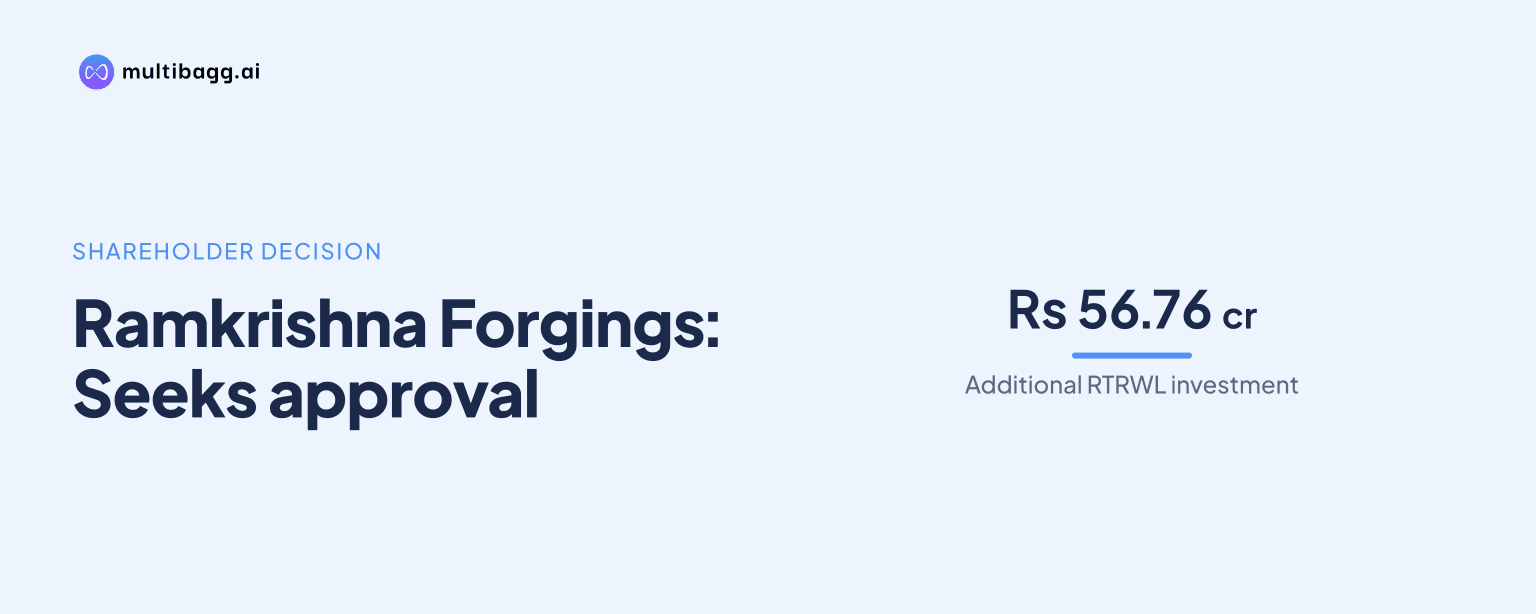
Ramkrishna Forgings Limited (Ramkrishna Forgings) is seeking shareholder approval to expand its legal business objects into semiconductors, defence, aerospace, drones and related technologies. The proposed Memorandum of Association amendment would permit activities ranging from design and manufacturing to testing, servicing and trading, through the company, subsidiaries, alliances or joint ventures.
Know Ramkrishna Forgings inside out
Results, valuation, peers and who's buying, in one view.
Why is Ramkrishna Forgings changing its business objects?
Ramkrishna Forgings is seeking the amendment because it is exploring a move into products, systems and solutions for semiconductor, aerospace, drone, defence and related technology applications. Its 30 October 2026 disclosure says a new clause in its Memorandum of Association (MOA) is required to enable diversification into these activities, either directly or through subsidiaries.
The proposal is an enabling corporate action rather than an announcement of a completed operating launch. Ramkrishna Forgings has stated that shareholder approval is required to alter the MOA, but it has not disclosed an investment amount, customer, product launch date, revenue target or identified project for the proposed semiconductor and defence-linked businesses.
What activities would the proposed clause allow?
Ramkrishna Forgings would be permitted to undertake a broad set of activities under proposed new sub-clause 9 of the MOA. These include designing, developing, manufacturing, operating, simulating, engineering, integrating, testing, commissioning, validating, fabricating, forging, installing, repairing, refurbishing, upgrading, importing, exporting, distributing and trading engineering and technological products.
The proposed clause names products and systems for commercial, industrial, agricultural, civil, defence and space applications. Its scope includes cameras, armaments, tools, machines, components and equipment, and covers mechanical, optical, electrical, electronic and software technologies used in semiconductor, defence, space, aerospace and allied industries.
The amendment would also allow Ramkrishna Forgings to operate in India or abroad through contracts, partnerships, strategic alliances, joint ventures and other arrangements. The text permits technical, financial and operational assistance arrangements, including profit or loss sharing, but the 30 October 2026 filing does not name a prospective partner or acquisition in the newly proposed sectors.
Which defence and drone systems are covered?
Ramkrishna Forgings has proposed authority to deal in defence systems including rocket and missile applications, electronic warfare and surveillance, battle tanks and armoured vehicles, land systems, arms and ammunition, naval systems, and space research and exploration. The clause also extends to associated equipment, components and engineering systems rather than limiting the company to a single defence product category.
The unmanned-system coverage includes unmanned aerial vehicles (UAVs), unmanned aircraft systems (UASs), small unmanned aerial vehicles, route patrolling vehicles, remotely piloted aircraft, unmanned water vehicles and unmanned ground vehicles. It further includes counter-UAV systems, drones and drone controllers, with the proposed activities covering production, assembly, repair, hire, rental, distribution and servicing.
The filing does not state that Ramkrishna Forgings has begun manufacturing any of the named defence or drone systems. Instead, the proposed wording would give it the legal capacity to design, engineer, test, commission and supply such systems if shareholders approve the MOA change.
Got a follow-up? Ask IRIS
How does this proposal compare with the rail-wheel venture?
Ramkrishna Forgings’ proposed technology-object expansion differs from its separately disclosed investment in Ramkrishna Titagarh Rail Wheels Limited (RTRWL). Ramkrishna Forgings holds 51% of RTRWL and is the lead partner of the consortium, while Titagarh Rail Systems Limited holds the remaining 49% stake. RTRWL was incorporated on 9 June 2023 and had yet to commence commercial production as of 31 March 2026.
Unlike the objects amendment, which contains no disclosed financial commitment, the RTRWL transaction includes a stated cash investment. Ramkrishna Forgings plans to make an additional Rs 56.76 crore investment in RTRWL in one or more tranches. The filing classifies the investment as a related-party transaction, except in the case of a rights issue, with Ramkrishna Forgings interested to the extent of its shareholding.
RTRWL is setting up a forged-wheel manufacturing plant at Puduvoyal Village in Tiruvallur district, Chennai, Tamil Nadu. The project has an estimated total cost of Rs 2,181.41 crore across two phases and planned annual forging capacity of around 2,28,000 wheels. Phase 1 is intended to establish the complete plant and its full forging capacity, while Phase 2 is planned to increase machining capacity.
Ramkrishna Forgings described the RTRWL facility as Asia’s second-largest forged-wheel manufacturing plant. The filing says no governmental or regulatory approvals are required for the disclosed additional investment, while completion will occur in one or more tranches rather than by a specified date.
What board changes were disclosed with the proposal?
Ramkrishna Forgings’ board approved the appointments of Subir Chakraborty and Anurag Vohra as non-executive independent directors at its meeting on 30 October 2026. Both appointments took effect immediately on that date, run for five consecutive years and remain subject to shareholder approval; neither director is liable to retire by rotation.
Chakraborty’s profile cites more than four decades of experience, including more than two-and-a-half decades at Exide Industries Ltd, where he served as managing director and chief executive officer from 2021 to 2024. Vohra’s profile cites more than three decades across automotive, commercial vehicles, electric mobility and industrial businesses, including his most recent role as chief operating officer at TI Clean Mobility Private Limited.
The disclosure says neither Chakraborty nor Vohra has an inter se relationship with other directors or key managerial personnel of Ramkrishna Forgings. It also says neither is debarred from holding office as a director by an order of the Securities and Exchange Board of India or another statutory authority, but it does not link either appointment specifically to the proposed new business objects.
Conclusion
Ramkrishna Forgings is asking shareholders to authorise a major widening of its legal operating remit, spanning semiconductor, aerospace, defence, space and unmanned-system activities. The proposed clause is broader than the identified RTRWL rail-wheel project because it covers numerous products, technologies and operating arrangements, but it does not disclose a capital commitment, commercial partner or timetable for the new sectors.
The next disclosed milestone is shareholder approval of the MOA amendment, which Ramkrishna Forgings says is necessary to enter the proposed businesses. Separately, the company has said RTRWL’s additional Rs 56.76 crore investment will be made in one or more tranches, while the two-phase rail-wheel project is planned to reach around 2,28,000 wheels of annual forging capacity.