










Redington working-capital build drives Rs 2,571.17 crore outflow
Key highlights
- Redington used Rs 2,571.17 crore in consolidated operating activities in the half year ended September 30, 2026.
- Trade receivables and inventories used Rs 4,229.41 crore and Rs 3,672.84 crore of cash, respectively.
- Consolidated current borrowings rose to Rs 5,992.40 crore at September 30, 2026, from Rs 2,637.45 crore at March 31, 2026.
- Half-year consolidated profit increased to Rs 876 crore from Rs 583.18 crore a year earlier.
powered by IRIS
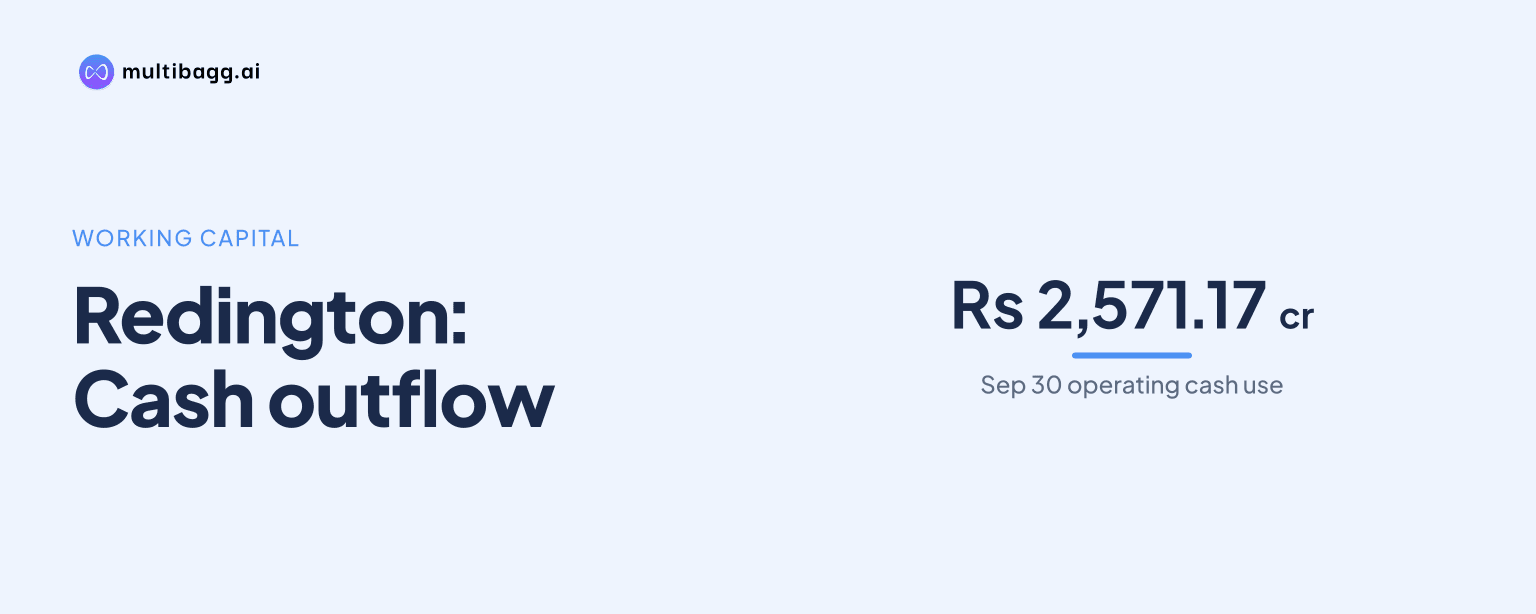
Redington Limited recorded negative consolidated operating cash flow of Rs 2,571.17 crore in the half year ended September 30, 2026, compared with cash generation of Rs 737.48 crore a year earlier, as receivables and inventories absorbed Rs 7,902.25 crore. Consolidated profit nevertheless rose to Rs 876 crore from Rs 583.18 crore.
Know Redington inside out
Results, valuation, peers and who's buying, in one view.
Why did Redington’s operating cash flow turn negative?
Redington’s operating cash flow turned negative because its Rs 1,905.77 crore operating profit before working-capital changes was outweighed by movements in receivables, inventory and other assets. Trade receivables used Rs 4,229.41 crore of cash and inventories used Rs 3,672.84 crore in the half year ended September 30, 2026, while other assets used another Rs 48.81 crore.
Those uses were partly offset by a Rs 2,960.63 crore increase in trade payables, a Rs 569.82 crore rise in other liabilities and a Rs 28.26 crore increase in provisions. Cash used in operations before tax was therefore Rs 2,486.58 crore, compared with cash generated of Rs 944.24 crore in the half year ended September 30, 2025. Net tax paid of Rs 84.59 crore brought the operating cash outflow to Rs 2,571.17 crore.
How much did Redington’s receivables and inventories increase?
Redington reported consolidated trade receivables of Rs 25,511.43 crore at September 30, 2026, up from Rs 21,569.46 crore at March 31, 2026. Consolidated inventories rose to Rs 11,843.55 crore from Rs 8,170.70 crore over the same period. The balance-sheet increases were Rs 3,941.97 crore for receivables and Rs 3,672.85 crore for inventories.
The cash-flow statement recorded a Rs 4,229.41 crore cash use for trade receivables and a Rs 3,672.84 crore use for inventories, identifying both working-capital lines as the main drivers of the outflow. Consolidated current assets rose to Rs 40,014.18 crore at September 30 from Rs 32,528.54 crore at March 31, while current liabilities increased to Rs 30,135.90 crore from Rs 23,016.59 crore.
This balance-sheet expansion accompanied higher sales. Revenue from operations reached Rs 77,869.38 crore for the half year ended September 30, 2026, compared with Rs 55,027.60 crore in the corresponding prior-year half. The filing does not provide a separate explanation for the relationship between the revenue increase and the receivables or inventory build.
Did higher profit and revenue offset Redington’s cash use?
Redington’s higher profit and revenue did not offset the cash absorbed by working capital during the reported half year. Consolidated profit rose to Rs 876 crore from Rs 583.18 crore, while revenue from operations increased by Rs 22,841.78 crore to Rs 77,869.38 crore. Operating profit before working-capital changes increased by Rs 734.26 crore to Rs 1,905.77 crore.
Both reported segments increased revenue. SISA, meaning Singapore, India and South Asia, reported half-year revenue of Rs 46,758.39 crore, compared with Rs 28,478.96 crore a year earlier. ROW, meaning Rest of the World, reported Rs 31,138.98 crore, up from Rs 26,575.17 crore. SISA’s Rs 18,279.43 crore increase exceeded ROW’s Rs 4,563.81 crore increase.
The combined Rs 7,902.25 crore cash use from receivables and inventories exceeded the Rs 3,558.71 crore combined increase in trade payables, other liabilities and provisions. Redington’s finance costs rose to Rs 217.46 crore from Rs 208.05 crore, while profit before tax increased to Rs 1,234.68 crore from Rs 764.09 crore. The half-year result also included an Rs 80.33 crore exceptional item in ROW.
Got a follow-up? Ask IRIS
How did Redington finance the working-capital requirement?
Redington generated Rs 2,357.06 crore from financing activities in the half year ended September 30, 2026, compared with a Rs 866.18 crore financing cash outflow in the prior-year half. Proceeds from short-term borrowings were Rs 19,275.55 crore, while repayments were Rs 16,166.55 crore, producing a net Rs 3,109 crore inflow from these borrowing movements.
That short-term borrowing inflow was reduced by Rs 469.06 crore of dividends paid, Rs 187.13 crore of finance costs paid and Rs 96.84 crore of lease-liability payments. Investing activities used Rs 80.95 crore, including Rs 110.29 crore spent on property, plant and equipment. Net cash and cash equivalents decreased by Rs 295.06 crore before a Rs 59.23 crore foreign-currency translation effect.
The cash-flow statement reported closing cash and cash equivalents of Rs 679.50 crore, compared with Rs 1,257.82 crore at September 30, 2025. Its balance-sheet reconciliation showed Rs 1,119.87 crore of cash and cash equivalents at September 30, 2026, less Rs 440.37 crore of bank overdrafts and cash-credit facilities used for cash-management purposes.
What changed in Redington’s borrowings and liquidity position?
Redington’s consolidated current borrowings rose to Rs 5,992.40 crore at September 30, 2026, from Rs 2,637.45 crore at March 31, 2026, an increase of Rs 3,354.95 crore. The higher closing borrowing balance followed the Rs 3,109 crore net inflow from short-term borrowings shown in the half-year cash-flow statement.
Consolidated trade payables increased to Rs 20,984.45 crore at September 30 from Rs 18,039.13 crore at March 31. The September figure included Rs 20,896.26 crore due to creditors other than micro and small enterprises and Rs 88.19 crore due to micro and small enterprises. Consolidated total assets rose to Rs 41,583.17 crore from Rs 33,838.94 crore in the same six-month period.
Redington’s cash and cash equivalents on the consolidated balance sheet increased modestly to Rs 1,119.87 crore from Rs 1,109.76 crore at March 31. The filing separately reported the movement after deducting overdrafts and cash-credit facilities, so the balance-sheet cash figure and cash-flow closing figure are not directly equivalent measures.
Conclusion
Redington’s first-half filing shows that higher sales and profit were accompanied by a reversal in operating cash generation. Revenue increased to Rs 77,869.38 crore and profit rose to Rs 876 crore, but the Rs 4,229.41 crore receivables cash use and Rs 3,672.84 crore inventory cash use resulted in a Rs 2,571.17 crore consolidated operating cash outflow. Financing inflows and higher current borrowings supplied immediate funding.
The next disclosed matter to watch is Redington’s continuing assessment of the evolving Middle East situation and its plan to mitigate prospective risks to its global footprint. Management said operations were adapting dynamically and it did not currently foresee a material adverse effect. The September results also included an Rs 80.33 crore impairment of other intangible assets at Redington Gulf FZE related to Arena Bilgisayar Sanayi Ve Ticaret A.S in Turkey.