










Remus+ targets 200-plus B2C launches from 600-product pipeline
Key highlights
- Remus+ targets more than 200 B2C launches from more than 600 products in development.
- Remus+ reported 955 registered products in H1-FY27, compared with 903 in 2026.
- Remus+ plans more than 2,100 new product filings alongside its B2C programme.
- Remus+ says its regulatory team of more than 30 professionals submits more than 50 dossiers monthly.
powered by IRIS
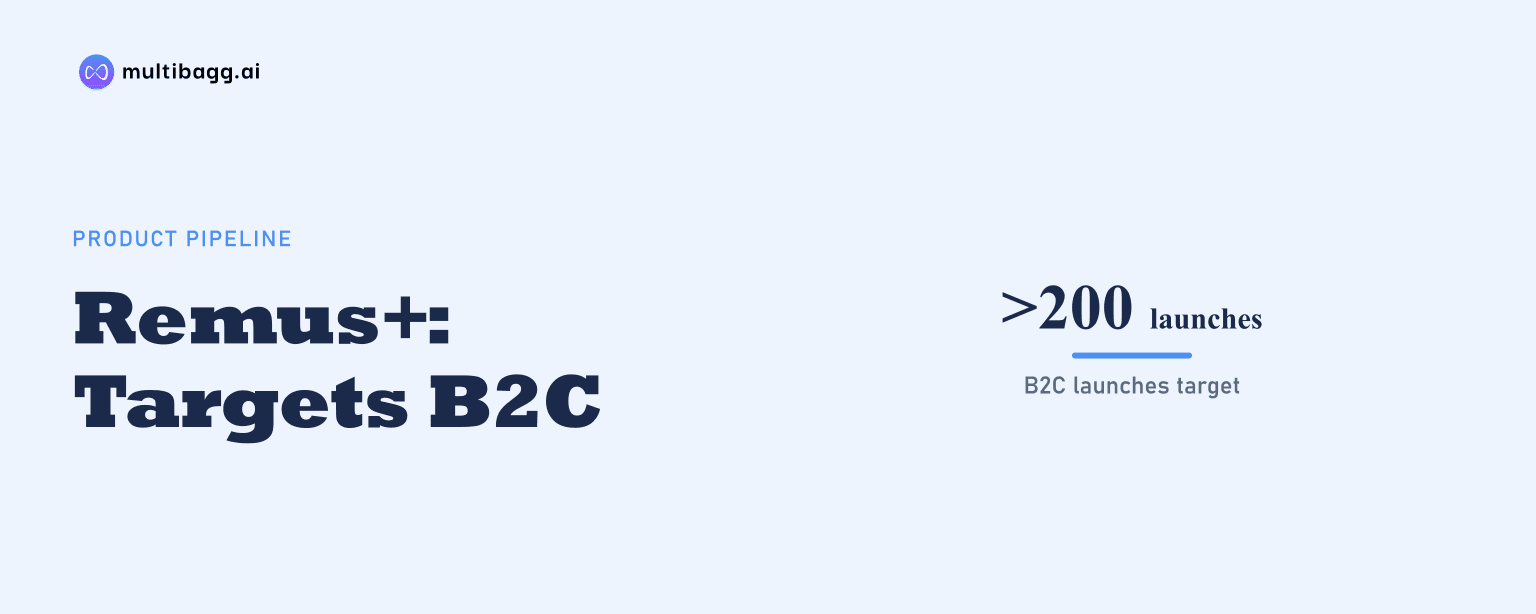
Remus+ is targeting 200-plus business-to-consumer (B2C) product launches from a 600-plus-product development pipeline, alongside 2,100-plus new product filings. The plan builds on the Relius brand, operated through subsidiaries in Bolivia and Guatemala, and a base of 955 registered products as of H1-FY27.
Know Remus Pharmaceuticals inside out
Results, valuation, peers and who's buying, in one view.
What is Remus+ planning for its B2C business?
Remus+ is targeting more than 200 B2C product launches from more than 600 products in development, while planning more than 2,100 new product filings. The presentation does not provide a deadline for the launch or filing targets, nor does it disclose how many of the 600-plus products have already received registration in individual markets.
The B2C model is based on direct-to-consumer (D2C) and pharmacy channels, rather than relying only on the partner marketing and distribution networks described for B2B operations. Remus+ says it will build D2C and pharmacy networks and train a field force for ethical, doctor-driven promotion as part of the launch programme.
Management describes the B2C model as capturing the full value chain, with higher per-unit margins, premium pricing and differentiation in commoditised markets. These are management's stated commercial objectives, not reported financial results: the presentation does not disclose B2C revenue, sales volumes, operating margins, marketing expenditure or a country-by-country launch schedule.
How does the Relius brand support Remus+ B2C plan?
Relius is Remus+'s brand platform for B2C operations through subsidiaries in Bolivia and Guatemala. The presentation identifies brand registration and trademarking as a key strength, alongside the stated aim of building a regional market presence through owned brands.
The listed Relius range includes Sacubitril and Valsartan tablets in 50 milligram (mg), 100 mg and 200 mg strengths; Iopromide injections in 300 mg iodine per millilitre and 370 mg iodine per millilitre; and Heparin Injection 25,000 international units. The examples show that the branded range includes tablets and injectables rather than a single dosage category.
Other listed Relius products include Rivaroxaban tablets in 10 mg, 15 mg and 20 mg strengths, Apixaban tablets in 2.5 mg and 5 mg strengths, and Iron Sucrose Injection 20 mg per millilitre. Remus+ does not state how many products are currently marketed under Relius, how many of the planned 200-plus launches will use the brand, or whether the Bolivia and Guatemala portfolios are the same.
How large is Remus+ registration and product base?
Remus+ reported 955 registered products in H1-FY27, compared with 903 in 2026, 875 in 2025, 594 in 2024 and 436 in 2023. The H1-FY27 figure was 52 above the 2026 total and 519 above the 2023 total, indicating that registrations rose across the periods shown.
The integrated product snapshot lists 1,227 tablet stock-keeping units (SKUs), 692 injectables, 253 hard-gel and soft-gel capsules, 117 syrups and oral suspensions, 69 ointments, creams and gels, 47 other products, and 38 inhalers or nebulisers. Remus+ notes that these counts include registered products, filed products and products under filing, so they are not solely a measure of approved products.
Cardiovascular drugs account for 20% of therapeutic registrations, the largest disclosed category. Central nervous system drugs and the “other” category each represent 14%, followed by antidiabetic products at 11%, analgesics at 10% and antibacterial products at 7%; the Relius examples include cardiovascular products such as Sacubitril and Valsartan, Rivaroxaban and Apixaban.
Got a follow-up? Ask IRIS
How will Remus+ support product registrations and launches?
Remus+ says its regulatory affairs team of more than 30 professionals submits more than 50 dossiers each month. A dossier is the technical file submitted to health authorities for marketing authorisation, and the company links its regulatory process to eventual supply through B2B, B2C or institutional channels after approval.
The disclosed process has seven stages: market and product identification, technical feasibility and partner alignment, formulation development, dossier compilation, regulatory review, submission to health authorities and commercial-launch readiness. Remus+ says formulation development includes pilot batches, laboratory testing and process validation under World Health Organization and International Council for Harmonisation norms.
Remus+ also cites more than 900 approved products and more than 850 ready dossiers for registration across major geographies. Its team is described as supporting compliance with guidelines in more than 35 rest-of-world markets and more than seven semi-regulated and regulated markets, although the presentation gives no approval timetable or filed-dossier conversion rate.
Where does Remus+ plan to expand market reach?
Remus+ identifies Bosnia, Ethiopia, Algeria, Kosovo, Mexico and Tanzania as planned new-market entries. It also plans to increase its developed-market presence through organic expansion and acquisitions, while accelerating registrations in semi-regulated and emerging markets; no timing, acquisition budget or expected sales contribution is disclosed.
The B2B presentation identifies Bolivia, Guatemala, the Dominican Republic, Ecuador and Myanmar as top-country growth markets. Myanmar is shown at 337 in H1-FY27 versus 202 in 2026, while Bolivia is shown at 352 versus 440 and Guatemala at 331 versus 392; the presentation does not define the unit for these figures, so they cannot be treated as revenue or sales volume.
Remus+ describes B2B as an end-to-end regulatory and commercial model using partners' marketing and distribution networks, with no inventory or promotional spend under that model. The B2C plan adds Relius branding, D2C and pharmacy distribution, plus field-force training, meaning the proposed consumer expansion sits alongside rather than replaces the partner-led B2B approach.
Conclusion
Remus+ is seeking a larger consumer-facing role through Relius, with 200-plus targeted B2C launches from a 600-plus-product pipeline and 2,100-plus planned filings. Its 955 registered products in H1-FY27, 850-plus ready dossiers and regulatory team submitting 50-plus dossiers monthly provide the disclosed operating base for that plan, while B2B remains dependent on partner distribution networks.
The next disclosed milestones to watch are progress in converting the 600-plus development products into launches, the pace of the 2,100-plus planned filings, and construction of D2C, pharmacy and field-force capabilities. Remus+ has also named Bosnia, Ethiopia, Algeria, Kosovo, Mexico and Tanzania for new-market entry, but has not provided dates, investment levels, country-level launch targets or B2C financial targets.