










Remus sees 1.5-to-3-year break-even for new subsidiaries
Key highlights
- Remus expects Chile, Guatemala and Dominican Republic subsidiaries to break even within 1.5 to 3 years.
- Guatemala has about 60 product registrations ready, according to management.
- The Dominican Republic has 18 approved products and 55 additional product filings.
- Chile is expected to take around 4 to 6 months to become operational after compliance work.
powered by IRIS
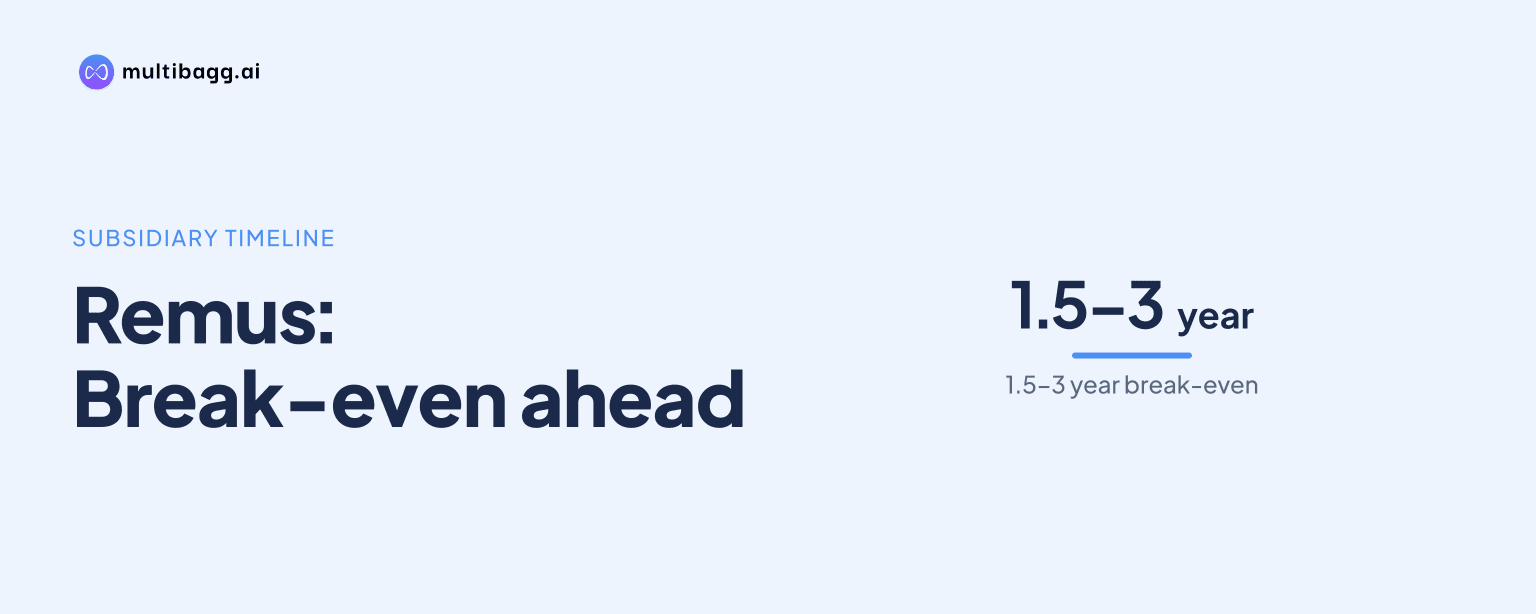
Remus Pharmaceuticals Limited expects its new subsidiaries in Chile, Guatemala and the Dominican Republic to reach break-even in 1.5 to 3 years, because it enters countries with products already registered rather than spending an initial 1.5 to 2 years waiting for approvals while absorbing operating costs.
Know Remus Pharmaceuticals inside out
Results, valuation, peers and who's buying, in one view.
When does Remus expect new subsidiaries to break even?
Remus expects break-even at its newer country subsidiaries to occur within 1.5 to 3 years, although management said the result will vary with each country's geography and market conditions. Management described 1,000 to 1,200 days, or roughly 3 to 3.5 years, as a broad pharmaceutical-subsidiary benchmark, while citing Bolivia as an operation that broke even in 1.5 years.
The 1.5-to-3-year range is management's operational expectation, not a country-specific financial forecast. The company said its approach differs from a conventional start-up because it seeks product registrations before establishing a local entity, avoiding a 1.5-to-2-year period in which a subsidiary may incur operating expenses without sales while registrations are pending.
Management did not disclose revenue, earnings before interest, tax, depreciation and amortisation, or EBITDA, targets for Chile, Guatemala or the Dominican Republic. It said only that break-even will depend on the individual country, while the registered-product model is intended to allow commercial activity to start when local operating expenditure begins.
Why does Remus register products before opening local operations?
Remus registers products before opening subsidiaries so it can begin commercial activity as it starts local spending, instead of waiting for regulatory approvals after incorporation. Management described this as having its products ready before launch, with registrations providing the basis for sales while the subsidiary builds its operating presence.
Chile illustrates the timing difference in this model. Management said the new Chile subsidiary should take around 4 to 6 months to become operational after completing required compliance work, but products are already registered during that period. That means the company expects business to start as it incurs operating expenses, rather than after a further registration cycle.
The approach does not eliminate country-specific regulatory constraints. Management said not every product can be filed in Chile because each product must meet the country's regulatory requirements before it can obtain approval. It therefore described the Chile portfolio as one selected for local suitability rather than a full transfer of all products sold elsewhere.
How ready are Remus's Guatemala and Dominican Republic operations?
Remus has about 60 registrations ready in Guatemala, while the Dominican Republic has 18 approved products and 55 products filed. Management said Guatemala is moving towards ethical marketing, which it described as business-to-consumer, or B2C, activity, while the Dominican Republic subsidiary is hiring a country manager.
The disclosed positions differ across the three markets. Guatemala has the largest stated ready registration base at about 60 products, whereas the Dominican Republic has 18 approvals plus 55 filings that may expand its available portfolio. For Chile, Remus disclosed the 4-to-6-month compliance timetable and existing registrations but did not give a product count.
The Dominican Republic operation also has an identified staffing step that was not specified for Chile. Management said it was hiring a country manager to take care of the Dominican Republic business, while describing Guatemala as ready to move from registrations into ethical marketing. These different stages are why management did not provide one break-even date for all three subsidiaries.
Got a follow-up? Ask IRIS
Why is Remus shifting Chile from partners to a subsidiary?
Remus is shifting Chile from a partner-led model to its own subsidiary because management sees the market as strategically important and highly competitive. The company said it previously served Chile through partners, but is now forming a local operation after building a portfolio that can meet Chile's product-specific registration requirements.
Management pointed to subsidiaries, product registrations and tender participation by companies including Dr. Reddy's, Alkem, Alembic and Emcure in Chile. Those comments were a description of the market structure rather than a comparison of revenue, market share or profitability. Remus did not disclose its Chile sales through partners or the expected sales contribution after direct operations begin.
The direct model is intended to give Remus its own commercial platform after the 4-to-6-month set-up process. Management said Chile's competition is intense, but did not quantify the incremental cost of replacing partners, the number of employees planned, or the margin difference between partner sales and direct sales.
How does portfolio acquisition support Remus's Latin American expansion?
Remus is considering product-portfolio acquisitions to gain immediate commercial products in Latin American markets where fresh filings can take 2 to 3 years. Management said it was discussing possible acquisitions in Mexico and Chile and was assessing opportunities involving 5 to 10 products in Mexico, Chile, Brazil or Colombia.
The company said it prefers product, brand and portfolio acquisitions over hard-asset acquisitions. Remus described its model as asset-light and said it works with more than 37 contract manufacturing organisations and contract development and manufacturing organisations, or CDMOs, rather than focusing on building manufacturing plants.
Management did not announce a completed acquisition, price, closing timeline or identified seller. It said an acquired established portfolio could provide immediate business, whereas filing new products in Mexico, Colombia or Brazil may take 2 to 3 years. That mechanism is consistent with the subsidiary strategy of reducing the interval between market entry and commercial sales.
Remus is also registering semaglutide products in multiple Latin American markets, but management said commercialisation depends on patent expiry even where registrations have been secured. It also said tirzepatide is being registered, with patents beginning to expire in emerging markets in 2029, though it did not identify launch countries or revenue expectations.
Conclusion
Remus is seeking to shorten the typical loss-making phase of international expansion by combining pre-registered products with local subsidiaries. Guatemala's roughly 60 ready registrations, the Dominican Republic's 18 approvals and 55 filings, and Chile's existing registered products underpin management's 1.5-to-3-year break-even expectation, compared with its broader 3-to-3.5-year benchmark.
The next milestones are Chile's stated 4-to-6-month compliance and operating set-up, further Dominican Republic approvals from its 55 filings, and any disclosed portfolio acquisition in Mexico, Chile, Brazil or Colombia. Management has not provided country-level revenue, cost or EBITDA targets, so the pace of product commercialisation remains the key unresolved measure.