










Remus+ registrations reach 955 as H1-FY27 portfolio expands
Key highlights
- Remus+ reported 955 registered products in H1-FY27, compared with 903 in 2026.
- Tablets were Remus+'s largest listed category at 1,227 SKUs, ahead of 692 injectables.
- Bolivia recorded 440 in 2026 and 352 in H1-FY27 in the top-country table, with no unit stated.
- Cardiovascular drugs represented 20% of Remus+ therapeutic-wise registrations.
powered by IRIS
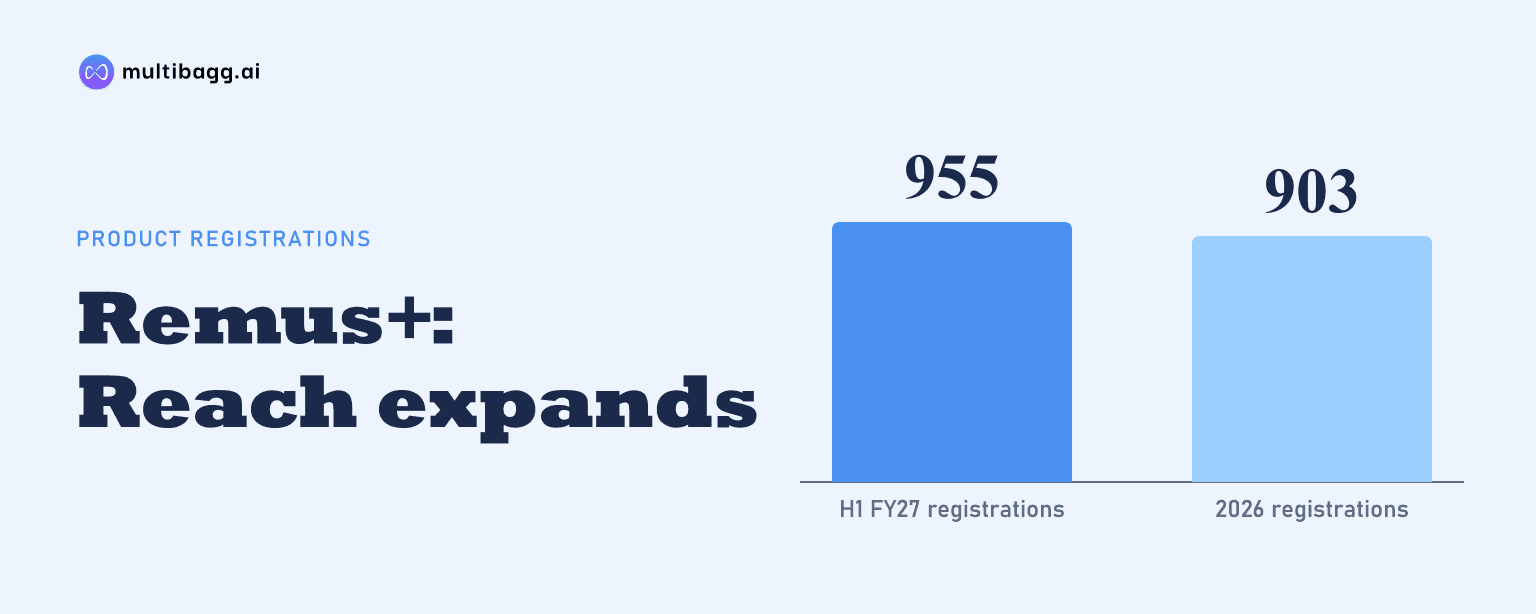
Remus+ reported 955 registered products in H1-FY27, up by 52 from 903 in 2026, while its broader product pipeline included 1,227 tablet SKUs. The presentation supports participation in government and institutional tenders, but it does not disclose a Bolivia award for 24 products, a Venezuela tender, contract values or delivery schedules.
Know Remus Pharmaceuticals inside out
Results, valuation, peers and who's buying, in one view.
How quickly has Remus+ increased registered products?
Remus+ increased registered products to 955 in H1-FY27 from 903 in 2026, following 875 in 2025, 594 in 2024 and 436 in 2023. The latest reported total is 519 higher than the 2023 figure, although H1-FY27 is a partial-year period and the presentation gives no full-year FY27 registration target.
The 52-product rise from 2026 to H1-FY27 exceeded the 28-product increase between 2025 and 2026. Remus+ links registrations to a seven-step pathway that starts with market and product identification and ends with commercial launch readiness after a dossier is submitted to local health authorities.
Remus+ says its regulatory affairs function has more than 30 professionals and submits more than 50 dossiers each month. The process includes country-specific compliance checks, gap analysis and responses to regulator queries, while the presentation distinguishes a filed dossier from a marketing authorization that has been granted.
Did Remus+ disclose a Bolivia tender award?
Remus+ did not disclose a Bolivia tender award for 24 products, a contract amount or a Venezuela government tender in the supplied presentation. It says the B2B segment participates in large government and institutional tenders, but does not identify tender customers, awarded products, bid dates or outcomes.
Bolivia had the highest figure in the company's top-country table, at 440 in 2026 and 352 in H1-FY27, ahead of Guatemala at 392 and 331. The presentation does not state the unit or define these country figures as revenue, orders, volumes or tender sales, so they cannot be treated as contract revenue.
Myanmar was the only listed country where the H1-FY27 figure of 337 exceeded the 2026 figure of 202. Bolivia, Guatemala, the Dominican Republic and Ecuador each had lower H1-FY27 figures than in 2026, but a half-year period is not comparable directly with a full-year period and Remus+ gives no explanation for the movements.
How do Remus+ B2B and B2C channels differ?
Remus+ describes B2B as supplying finished products to global distributors under the distributors' brands and registrations, while its direct-to-consumer export route supplies Relius subsidiaries. The Relius brand operates through subsidiaries in Bolivia and Guatemala, using direct-to-consumer and pharmacy channels for last-mile distribution.
The B2B model uses third-party partners' marketing and distribution networks and is described by Remus+ as requiring no inventory or promotional spending. Its listed B2B formulations include amlodipine, valsartan and hydrochlorothiazide tablets at 5 milligrams, 160 milligrams and 12.5 milligrams, plus eltrombopag 25 milligram tablets and palbociclib 125 milligram capsules.
The B2C product list includes Sacubitril & Valsartan tablets in 50, 100 and 200 milligram strengths, Iopromide injections in 300 and 370 milligrams per millilitre, and heparin injection at 25,000 international units. Remus+ says this route captures the full value chain and supports trademark protection, but does not disclose B2C sales, pricing, margins, pharmacy numbers or subsidiary profitability.
Got a follow-up? Ask IRIS
What products make up the Remus+ portfolio?
Remus+ lists tablets as its largest product category with 1,227 stock-keeping units, or SKUs, followed by 692 injectables and 253 hard-gel and soft-gel capsules. The portfolio also includes 117 syrups and oral suspensions, 69 ointments, creams and gels, 47 other products and 38 inhaler or nebulizer products.
The 2,443 listed SKUs are broader than the 955 H1-FY27 registered products because Remus+ says SKU counts include registered products, filed products and products under filing. Tablets exceed injectables by 535 SKUs, while injectables exceed capsules by 439; biosimilars, oncology, ophthalmic products, powder for injections and sachets are separately identified without category-level SKU totals.
Cardiovascular drugs represent 20% of therapeutic-wise registrations, the largest disclosed share. Central nervous system drugs and the category labelled Other each represent 14%, followed by antidiabetic products at 11%, analgesics at 10%, antibacterials at 7% and antibiotics at 4%.
How does Remus+ prepare products for market entry?
Remus+ says product selection focuses on off-patent, high-margin formulations that fit market gaps and registration pathways. Its seven-step route includes formulation development, dossier compilation, regulatory review and submission, with customized formulations for regulatory and climatic-zone requirements supported by pilot batches, laboratory testing and process validation.
Manufacturing is outsourced to partners that have completed product development and are approved by global regulators, according to Remus+. The company says it has information on molecules going off patent through 2038, more than 850 ready dossiers for registration and more than 900 approved products, though it does not reconcile the rounded approved-product figure with the 955 registrations reported for H1-FY27.
Conclusion
Remus+ presents its expansion through regulatory execution, outsourced ready-to-market manufacturing and both distributor-led and Relius-branded routes. Registered products rose from 436 in 2023 to 955 in H1-FY27, while tablets were the largest listed category at 1,227 SKUs and cardiovascular therapies accounted for 20% of registrations.
The next disclosures to watch are whether Remus+ names government or institutional tender awards and provides product, country, value or timing details. Management's disclosed plan includes simultaneous filings across multiple geographies, use of more than 850 ready dossiers and Relius operations in Bolivia and Guatemala, but the presentation sets no tender-win target or timetable.