










Remus targets 5%-7% Espee margin after H1 bulk orders
Key highlights
- Espee contributed about Rs 550 crore of Remus’s almost Rs 614 crore consolidated H1 revenue.
- A couple of Espee H1 bulk orders carried gross margins of roughly 2%.
- Remus management is targeting a 5%-7% long-term margin at Espee.
- Remus said standalone revenue, EBITDA and PAT rose by ballpark 33%, 47% and 56%, respectively, year on year.
powered by IRIS
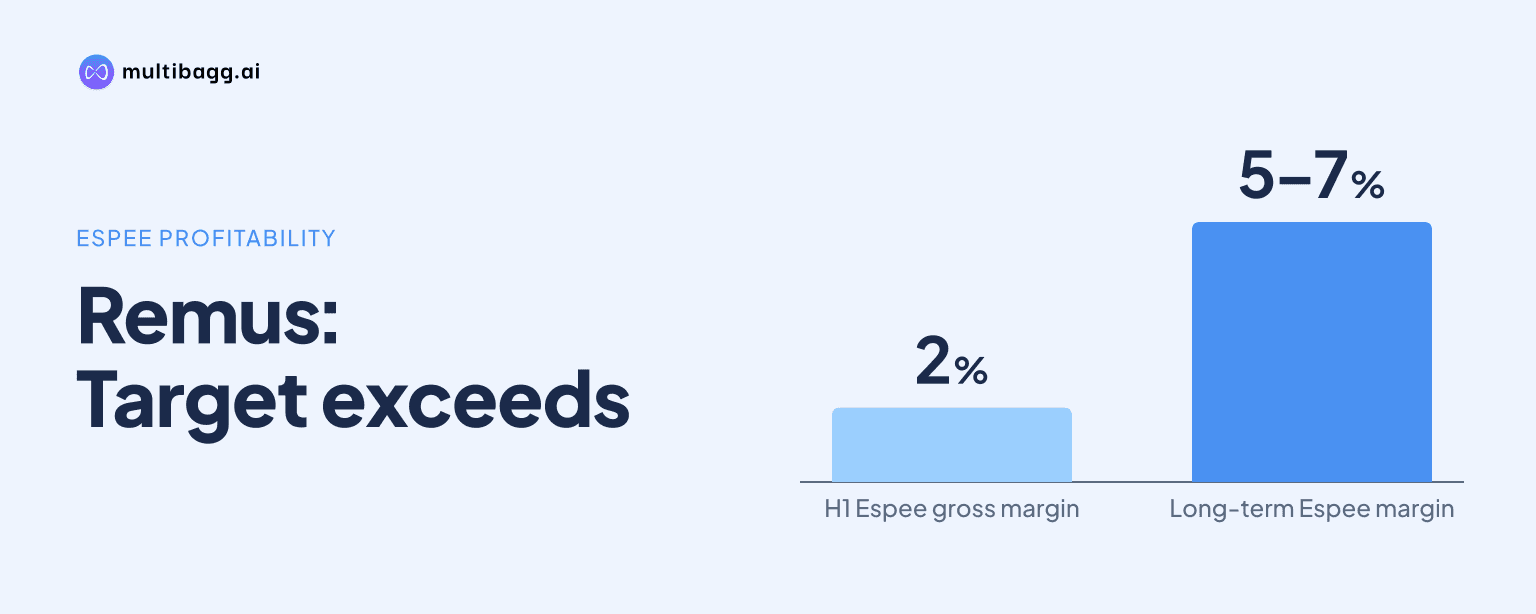
Remus said its Espee US distribution business is targeting a 5%-7% long-term margin after H1 bulk orders at roughly 2% gross margin lifted revenue without a comparable profit increase. Espee contributed about Rs 550 crore of Remus’s almost Rs 614 crore consolidated H1 revenue, according to management.
Know Remus Pharmaceuticals inside out
Results, valuation, peers and who's buying, in one view.
Why did Remus revenue growth not translate into similar H1 profit growth?
Remus said Espee accepted a couple of opportunity-driven H1 orders at gross margins of about 2%, which increased distribution revenue but added limited profit. Management said the transactions were paid in advance and were undertaken on a transactional basis to retain customers and create opportunities for additional products and orders in H2.
Espee accounted for most of the reported consolidated revenue base. Management put consolidated revenue at almost Rs 614 crore, Espee revenue at about Rs 550 crore and standalone core-business revenue at Rs 62 crore. The figures indicate that a low-margin order within Espee could have a material effect on consolidated profitability even while the core business grew.
Remus described Espee as a Chicago-based US distributor of reference listed drugs, or RLDs, which management also called innovator products. Management said Espee ranks among the top three participants in RLD distribution, a high-value but lower-margin activity, explaining why Espee’s sales profile differs from the group’s emerging-markets business.
Management said the H1 orders were not intended to establish a permanent 2% pricing model. It expects Espee to pursue products with better margins in H2 and said its absolute earnings before interest, tax, depreciation and amortisation, or EBITDA, and profit after tax, or PAT, should improve from H1. It did not provide a numerical H2 forecast.
What long-term margin is Remus targeting for Espee?
Remus is targeting a 5%-7% long-term margin for Espee, management said in response to an investor question. Management did not define whether that range refers to EBITDA, PAT, gross margin or another measure, so it is a stated target rather than a directly comparable reported H1 margin.
The target contrasts with the roughly 2% gross margin on the specific H1 bulk orders. Management said those orders produced a revenue increase without a substantial increase in the bottom line, while its aim is to improve the mix of a distribution operation that remains focused on high volumes.
Management linked the 5%-7% objective to growth in Espee’s revenue base over the next three years. It said that if the business maintains its trajectory, even a margin within that range would produce a larger absolute profit amount. That outcome depends on both continued sales growth and a shift away from low-margin transactions.
Remus also cited growth in its standalone operation. Management gave ballpark year-on-year increases of 33% in revenue, 47% in EBITDA and 56% in PAT for that business. These figures show that management sees both core-business growth and an improved Espee mix as contributors to future consolidated absolute earnings.
Got a follow-up? Ask IRIS
How does Remus plan to improve Espee’s product mix?
Remus plans to improve Espee’s mix through biosimilars, biological products and other expensive products, according to management. It said clients are moving toward these categories and that access is limited to a smaller group of distributors, which management expects to support margins above those earned on the H1 opportunity orders.
Management said Espee’s RLD distribution position gives it access to high-value products. It cited an example of a product costing US$500,000, but did not identify the product or disclose the financial contribution expected from such products. The company’s case for the 5%-7% target therefore rests on a planned portfolio change rather than disclosed sales from biosimilars.
Remus is also extending services around Espee’s distribution activity through Espee Global Clinical Trial Services. The service entity received government approvals in May and began operations from a 25,000-square-foot facility near Ahmedabad, where it can store, transport, repackage and relabel products for contract research organisations, or CROs, and multinational companies.
Management said Espee Global Clinical Trial Services had signed an agreement with Amneal, had been inspected by Novo Nordisk and was working with Zydus on potential service-side products. It described the unit as forward integration intended to generate additional revenue from Espee’s client base, but did not disclose H1 revenue, EBITDA or PAT from the service operation.
How do Remus’s core operations compare with Espee and what is expected in H2?
Remus said its business-to-consumer, or B2C, brands have gross margins of 70%-80%, while business-to-business, or B2B, activity has margins of around 40%. These management estimates cannot be directly compared with Espee’s undefined 5%-7% long-term margin goal, but they show the different economics of branded products and US distribution.
An investor said B2C contributed about 14% of H1 revenue, which management affirmed. Remus said B2C expansion requires free medical samples, doctor engagement, patient awareness activity and launch offers, including 10 free units with a pack of 30. Those costs are part of brand-building even where gross margins are higher.
Management said the previous year’s consolidated gross margin was around 56%-58%, while noting it did not recall the exact figure. It expects the mix to improve as B2C expands, but said it will continue to pursue B2B opportunities rather than intentionally reduce that channel. Consolidated outcomes will therefore depend on sales across branded, tender and distribution activities.
For H2, Remus said its current standalone order bookings support growth equal to or above H1 growth, while also stating that its H2 periods have historically been better than H1. Management similarly expects Espee’s absolute EBITDA and PAT to exceed H1, based on better-margin products, but disclosed no value or timing for the relevant orders.
Conclusion
Remus’s explanation for the H1 gap between revenue and profit is concentrated in Espee: the distributor generated about Rs 550 crore of almost Rs 614 crore in consolidated revenue, while a couple of bulk transactions carried only about 2% gross margin. Management’s 5%-7% Espee margin objective relies on adding biosimilars, biological products and other higher-value products, alongside growth in the standalone business.
The next item to watch is H2 execution against management’s expectation of higher Espee absolute EBITDA and PAT than in H1. Investors can also monitor whether the clinical-trial services operation, launched after May approvals from its 25,000-square-foot Ahmedabad facility, converts agreements and client discussions into disclosed revenue or profitability.