










Remus targets 25%-30% B2C mix despite brand spending
Key highlights
- Remus said B2C represented approximately 14% of H1 Financial Year 27 revenue and is targeting a 25%-30% contribution.
- Management said established B2C brands could generate 70%-80% gross margins, versus around 40% for B2B.
- Remus is introducing more than five own-label brands in Guatemala and received brand approvals in Dominican Republic during H1.
- Latin America and the Caribbean accounted for 1,805 of Remus's 2,443 registrations and applications in H1.
powered by IRIS
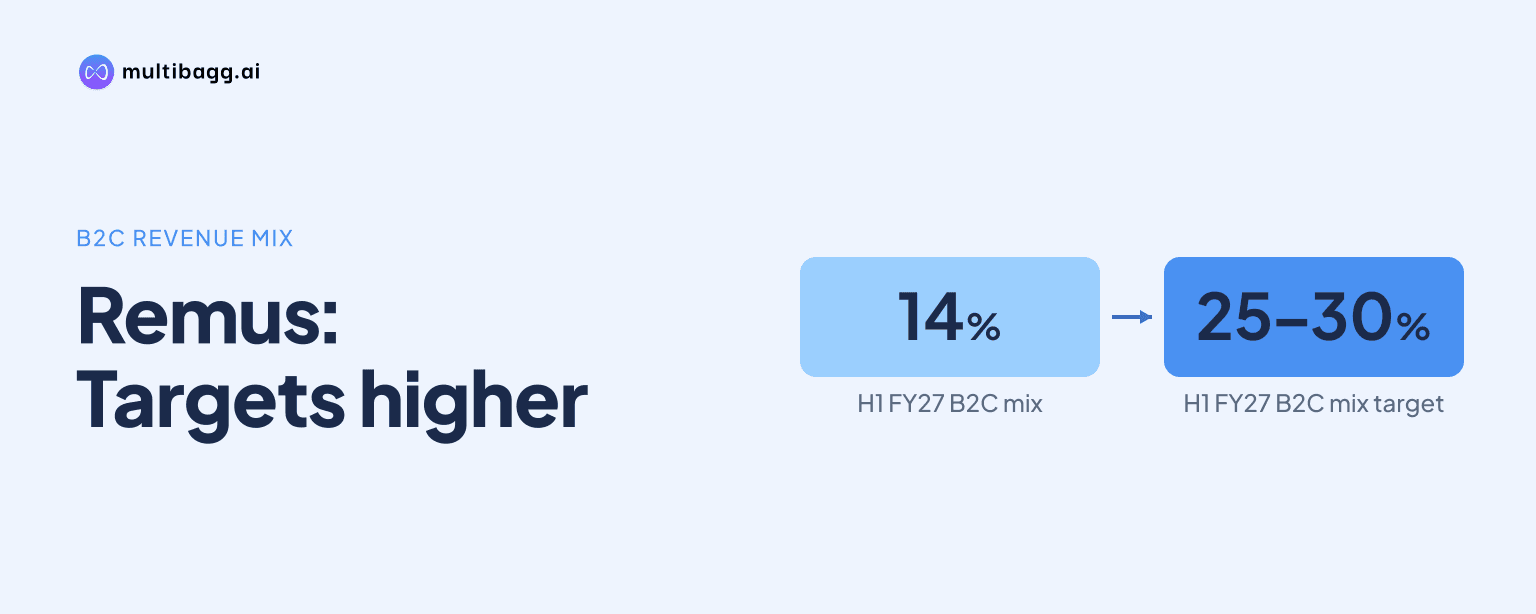
Remus is targeting a 25%-30% B2C revenue contribution from approximately 14% in the first half of Financial Year 27, while management says free samples, doctor outreach and promotional packs will keep the own-brand business in an investment phase before established brands can deliver 70%-80% gross margins.
Know Remus Pharmaceuticals inside out
Results, valuation, peers and who's buying, in one view.
What is Remus targeting for B2C revenue?
Remus is targeting B2C revenue contribution of 25%-30%, compared with approximately 14% in H1 of Financial Year 27. Management told an investor that the increase would be gradual because building pharmaceutical brands requires sustained activity with doctors, patients and pharmacies. It said the B2C effort had been under way for about one to one-and-a-half years, rather than representing a newly launched strategy.
Remus does not plan to reach the 25%-30% mix by reducing B2B sales. Management said it would treat B2B and B2C as complementary channels and continue pursuing tender, distributor and sub-distributor opportunities. B2B remains a source of revenue and profit contribution, while B2C is intended to expand sales of Remus's own-label formulations through pharmacy, doctor and patient relationships.
Management said the previous year's consolidated gross margin was around 56%-58%, but it did not give a consolidated margin target for Financial Year 27. The expected benefit from a higher B2C share depends on brands moving beyond launch activity, when medical samples, free medication and marketing expenses can reduce the immediate impact of the quoted 70%-80% gross-margin potential.
How is Remus building its consumer brands?
Remus is using free medical samples, doctor visits, direct patient engagement and brand-awareness activity to support its B2C rollout through its Relius subsidiary. Management said it receives feedback through pharmacovigilance, or drug-safety monitoring, from patients and doctors on product acceptance. It also said some pharmacy customers were requesting Remus brands specifically rather than choosing generic or competing brands.
Remus is offering free medication when launching new brands, including a pack of 10 at no charge with a purchased pack of 30. Management described these promotions as part of the investment needed to establish brands, rather than a permanent feature of the mature sales model. The approach is designed to build awareness and repeat demand before the company expects products to sell more consistently from pharmacy shelves.
The company identified central nervous system, or CNS, and cardiovascular system, or CVS, products as categories for the brand-building effort. Management said it competes with multinational companies in these therapies, making brand acceptance a longer process. It also said Remus receives approvals for trademarks and products at an average pace of around 20 to 25 products every month or two, supporting launches across therapeutic categories.
Which markets support Remus's B2C expansion?
Remus disclosed B2C brand activity in Dominican Republic and Guatemala during H1 of Financial Year 27. It received trademarks and brand approvals for pharmaceutical products in Dominican Republic. In Guatemala, it is introducing more than five brands to be marketed and sold under its own label, while using the distribution capabilities and B2B operations already in place.
Latin America and the Caribbean are the largest regulatory base for Remus's wider product rollout. The region accounted for 1,805 registrations and applications, comprising 869 registered products and 936 under registration, out of a global portfolio of 2,443 registrations and applications. The global total included 955 registered products and 1,448 under registration, which provides potential launch opportunities but does not establish future sales volumes.
Bolivia illustrates how Remus intends to combine its institutional and own-brand operations. The company secured tenders covering 24 pharmaceutical products in Bolivia during the year and described the country as one of its largest markets. Management said it aims to add a broader formulation portfolio there alongside existing institutional business and distribution relationships.
Got a follow-up? Ask IRIS
How do B2C and B2B margin profiles compare?
Remus said established B2C brands could generate gross margins of 70%-80%, compared with around 40% for B2B. Management framed this as a comparison of channel-level gross-margin potential, not as a forecast for consolidated profitability. It said B2C brands can show a different margin outcome during launch periods because marketing costs, samples and promotional product packs are necessary to establish demand.
B2B continues to provide more than a margin comparison for Remus because tenders and distributors support market reach and payment recovery. Management said its distributor and sub-distributor network helps it reach locations across each country, while tender business can provide additional opportunities. As a result, the timing of a shift to 25%-30% B2C depends on own-brand sales growing faster than B2B, rather than on an announced reduction in B2B activity.
Consolidated margins are also affected by Espee, a United States distribution business acquired about two-and-a-half years earlier. Management cited approximately Rs 550 crore of Espee revenue and approximately Rs 62 crore of standalone core-business revenue within nearly Rs 614 crore of consolidated revenue discussed on the call. It said Espee's high-volume distribution activity has thinner margins than the emerging-markets B2B and B2C formulation business.
What could affect progress toward the B2C target?
Remus identified the time needed to gain acceptance from doctors, patients and pharmacies as the principal limitation on B2C expansion. Management said that awareness cannot be built overnight, particularly in CNS and CVS products where it competes with multinational companies. The 25%-30% objective therefore relies on repeat demand, continued launches, trademark approvals and medical outreach, and management did not disclose a deadline for reaching the target.
Product approvals and commercialization plans could broaden the product base available to Remus. In Peru, the company was filing 60 products and said approvals could take less than four to six months, with commercialization probably in H2. It also said approved semaglutide tablets and injections were planned for H2 commercialization in eligible markets without patent issues, but did not state what proportion of those sales would be B2C.
Remus is simultaneously advancing B2B tenders, registrations and in-licensed products. It secured a direct government tender in Venezuela and initiated filings for more than 100 products in Venezuela and other markets linked to its patch portfolio. These activities could add sales outside the B2C channel, meaning the B2C percentage will depend both on branded revenue growth and on the pace of institutional and distribution revenue.
Conclusion
Remus is seeking to change its revenue mix through own-brand formulations while retaining B2B tenders and distribution as active channels. Management's case is that B2C can rise from approximately 14% of H1 Financial Year 27 revenue to 25%-30% and, once brands are established, offer 70%-80% gross margins compared with around 40% in B2B. The near-term trade-off is continuing spend on samples, promotional packs and medical engagement.
The next points to watch are H2 commercialization plans, including the 60 products being filed in Peru and the planned semaglutide launches in eligible markets. Investors can also monitor whether the more than five Guatemala brands and Dominican Republic approvals produce repeat pharmacy demand, and whether management sets a timeline for the 25%-30% B2C target or provides a Financial Year 27 consolidated-margin outlook.