










RKFL EBITDA margin rises to 18.2% as Q2 revenue grows
Key highlights
- RKFL's consolidated EBITDA margin increased to 18.2% in Q2 FY27 from 13.5% in Q2 FY26.
- Consolidated EBITDA rose 109.1% year on year to Rs 256 crore, while revenue increased 54.9% to Rs 1,405 crore.
- Forging volume grew 34.8% to 53,104 tonnes and casting volume rose 126.5% to 11,583 tonnes in Q2 FY27.
- RKFL secured new orders worth Rs 673 crore in Q2 FY27, with a four-year programme life.
powered by IRIS
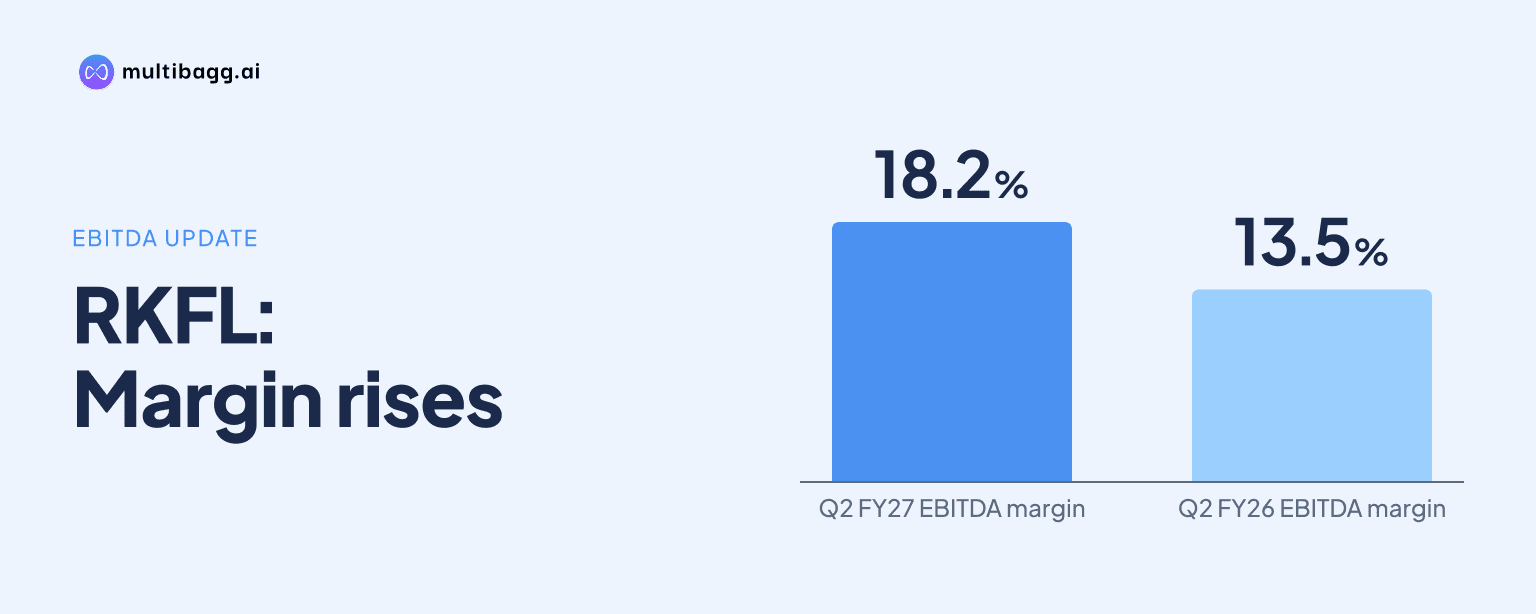
Ramkrishna Forgings reported a consolidated EBITDA margin of 18.2% in Q2 FY27, up 4.7 percentage points from 13.5% in Q2 FY26. EBITDA, excluding other income, rose 109.1% year on year to Rs 256 crore, while revenue increased 54.9% to Rs 1,405 crore, alongside higher forging and casting volumes.
Know Ramkrishna Forgings inside out
Results, valuation, peers and who's buying, in one view.
What drove RKFL's Q2 FY27 EBITDA margin recovery?
RKFL's Q2 FY27 margin recovery reflected EBITDA growth of 109.1%, which exceeded revenue growth of 54.9%. Consolidated revenue, excluding other income, rose from Rs 908 crore in Q2 FY26 to Rs 1,405 crore in Q2 FY27, while EBITDA increased from Rs 123 crore to Rs 256 crore.
The margin also rose sequentially, to 18.2% from 18.0% in Q1 FY27. Revenue increased 15.5% from Rs 1,217 crore in Q1 FY27, and EBITDA increased 17.3% from Rs 218 crore, producing a 0.2-percentage-point increase in the quarterly margin.
Management attributed the first-half performance to domestic demand, improving international business and operational efficiency. It said its priorities include higher capacity utilisation, improved efficiencies and greater profitability from investments made in recent years, including the scale-up of casting and aluminium forging operations.
How did RKFL's pre-tax profitability change in Q2 FY27?
RKFL reported consolidated profit before tax, or PBT, before exceptional items of Rs 96 crore in Q2 FY27, compared with a Rs 5 crore loss in Q2 FY26. The corresponding PBT margin was 6.8%, whereas the prior-year loss was marked not meaningful in the presentation.
PBT also increased from Rs 65 crore in Q1 FY27, when the margin was 5.4%, representing sequential growth of 47.1%. The presentation does not provide a quarterly breakdown of every expense movement underlying the change, but it shows EBITDA and revenue both increasing in Q2 FY27.
RKFL's standalone EBITDA margin was lower than its consolidated measure in Q2 FY27. Standalone revenue was Rs 1,255 crore, EBITDA was Rs 215 crore and the margin was 17.1%, against consolidated revenue of Rs 1,405 crore, EBITDA of Rs 256 crore and an 18.2% margin.
Has RKFL's first-half profitability recovered from FY25 and FY26?
RKFL's consolidated EBITDA margin was 18.1% in H1 FY27, compared with 14.1% in H1 FY26. H1 EBITDA increased 75.1% to Rs 475 crore from Rs 271 crore, while revenue grew 36.4% to Rs 2,622 crore from Rs 1,923 crore.
The H1 FY27 margin was above the full-year levels reported in FY25 and FY26, when the consolidated income statement showed margins of 13.87% and 15.17%, respectively. It remained below the 20.86% margin reported in FY24, after the margin had declined from FY24 to FY25 and then improved in FY26.
Pre-tax profitability followed the same direction. H1 FY27 PBT before exceptional items was Rs 161 crore, compared with Rs 19 crore in H1 FY26, and the margin increased to 6.2% from 1.0%.
The consolidated income statement reported a gross profit margin of 53.43% for H1 FY27, versus 48.99% in FY26. Gross profit was Rs 1,401 crore on revenue from operations of Rs 2,622 crore, while employee cost, power and fuel, and other expenses were Rs 153 crore, Rs 150 crore and Rs 624 crore, respectively.
Got a follow-up? Ask IRIS
Which volumes and capacity measures supported RKFL's growth?
RKFL's forging volume rose 34.8% year on year to 53,104 tonnes in Q2 FY27 from 39,409 tonnes in Q2 FY26. Domestic forging volume increased to 37,048 tonnes from 26,763 tonnes, while export volume rose to 16,056 tonnes from 12,646 tonnes.
Domestic forging realisation was Rs 2.08 lakh per tonne in Q2 FY27, compared with Rs 1.78 lakh per tonne in Q2 FY26. Export realisation increased to Rs 2.52 lakh per tonne from Rs 2.19 lakh per tonne over the same period.
Casting volume expanded 126.5% to 11,583 tonnes from 5,113 tonnes, while casting realisation increased to Rs 1.33 lakh per tonne from Rs 1.27 lakh per tonne. In H1 FY27, forging volume was 100,116 tonnes and casting volume was 20,176 tonnes, compared with 83,580 tonnes and 9,763 tonnes in H1 FY26.
Total capacity utilisation reached 72% in Q2 FY27, based on annualised installed capacity, compared with 68% in Q1 FY27 and 62% in Q2 FY26. Casting utilisation rose to 88% from 69% a year earlier, while forging utilisation increased to 69% from 53%.
What revenue mix and orders did RKFL report in Q2 FY27?
RKFL's standalone domestic revenue increased 59.1% year on year to Rs 821.57 crore in Q2 FY27, while export revenue increased 52.7% to Rs 424.52 crore. Other income and export incentive were Rs 16.71 crore, bringing total standalone revenue to Rs 1,262.80 crore.
The company secured new orders worth Rs 673 crore during Q2 FY27, with a programme life of four years. India accounted for Rs 323 crore, North America Rs 272 crore and Europe Rs 78 crore, while commercial vehicles accounted for Rs 304 crore and light vehicles for Rs 272 crore.
About 48% of the new orders were from domestic markets and 52% from export markets, according to RKFL. By segment, commercial vehicles represented 45% of the orders, light vehicles 41%, farm equipment 13% and electric vehicles the remaining 1%.
Conclusion
RKFL's Q2 FY27 results show that the increase in revenue, volumes and capacity utilisation coincided with higher operating and pre-tax profitability. The consolidated EBITDA margin rose to 18.2% from 13.5% a year earlier, and PBT before exceptional items changed from a Rs 5 crore loss to a Rs 96 crore profit. The H1 FY27 EBITDA margin of 18.1% was also above the FY25 and FY26 full-year levels, though below FY24.
The next measures to watch are capacity utilisation, the ramp-up of casting and aluminium forging operations, and the conversion of Rs 673 crore of Q2 FY27 order wins over their four-year programme life. Management has identified cash-flow improvement, balance-sheet strengthening, higher utilisation and profitability from prior investments as priorities, while citing global trade policies, geopolitical developments and supply-chain uncertainty as continuing challenges.