










Sai Silks says festive sales rose 27-30% after Dussehra shift
Key highlights
- Sai Silks said festive-to-festive business grew by more than 27-30% year on year.
- Sai Silks said Dussehra moved from Q2 last year to Q3 this year, affecting H1 SSSG comparisons.
- Sai Silks retained its full-year turnover outlook of Rs 1,850 crore to Rs 1,900 crore.
- Sai Silks said inventory days improved by 20-30 days over the past three years.
powered by IRIS
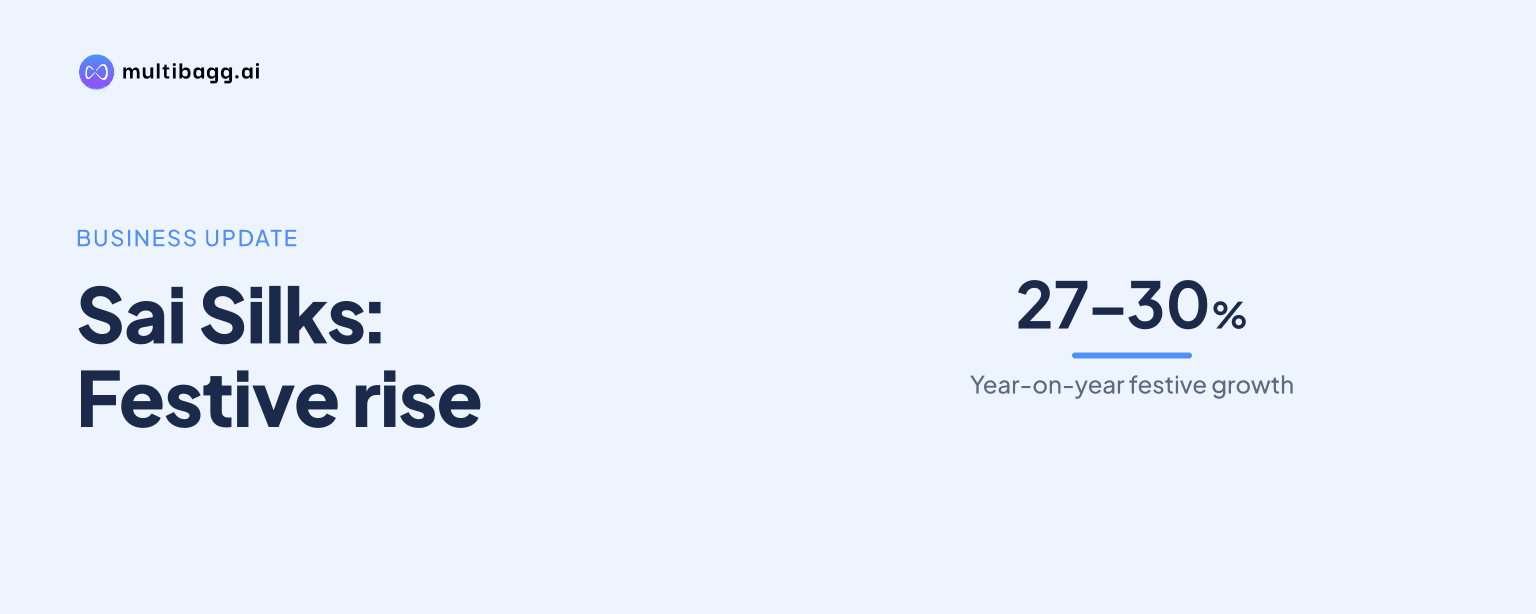
Sai Silks said overall festive-to-festive business grew by more than 27-30% year on year after Navaratri, and management said Dussehra’s move from Q2 last year to Q3 this year was the primary reason H1 same-store sales growth was negative.
Know Sai Silks (Kalamandir) inside out
Results, valuation, peers and who's buying, in one view.
How much did Sai Silks' festive business grow?
Sai Silks said its overall festive-to-festive business rose by more than 27-30% from the comparable festive period a year earlier. Management gave the update after Navaratri had ended and while the Diwali season was under way, without disclosing a separate Dussehra-quarter revenue figure.
Management said the increase extended beyond footfall. Average selling prices, or ASPs, average bill values, or ABVs, and other key performance indicators rose across formats, according to Sai Silks. It also said the KLM Fashion Mall format recorded a much higher festive-period growth number than a year earlier, although no format-specific percentage was provided.
The 27-30% measure is a festive-period comparison rather than reported quarterly same-store sales growth, or SSSG. Sai Silks used the result to argue that demand improved when the relevant festival dates arrived, while the reported H1 comparison reflected a different festival calendar from the previous year.
Why did Sai Silks report negative H1 same-store sales growth?
Sai Silks said H1 SSSG was negative primarily because Dussehra, which fell in Q2 in the prior year, shifted to Q3 in the current year. Management called this a technical calendar change and noted that Dussehra fell in the second or third week of October in the current year.
Adhik Maas was the other factor management identified as moving wedding and festive buying from H1 to H2. Sai Silks said the wedding and festival season was concentrated in H2, and management therefore retained the original overall projections despite describing H1 as a small setback.
The calendar matters because Sai Silks described its business as wedding-based and festive-led. Management said Dussehra is followed by Diwali and then a continuing wedding calendar, placing several demand events in Q3 and Q4 instead of aligning them with the prior year's quarterly pattern.
Can Sai Silks meet its full-year sales target?
Sai Silks said it was maintaining its earlier full-year turnover range of Rs 1,850 crore to Rs 1,900 crore, with no change to the outlook. Management said that range remained possible from the company's current position.
Management said H2 needs double-digit SSSG to offset the negative H1 comparison and deliver around 5% SSSG for the full year. An analyst described the earlier annual growth framework as about 15%, comprising around 5% from SSSG and 10% from store additions; Sai Silks responded that double-digit H2 SSSG was required to reach its overall annual target.
Sai Silks linked the anticipated H2 recovery chiefly to the festival shift and wedding calendar, while also citing new stores in Tamil Nadu and Karnataka that it said perform during Diwali. Management is reconsidering pricing as raw-material costs increase product values, assessing where costs can be passed to customers and where they should be absorbed.
On profitability, management said H2 should improve considerably with greater activity and store productivity. An analyst referred to an H2 earnings before interest, tax, depreciation and amortisation, or EBITDA, margin of 17.5-18%; management said Sai Silks had achieved such levels in the prior year and expected higher activity and productivity to support H2, without giving new formal margin guidance.
Got a follow-up? Ask IRIS
What supports Sai Silks' H2 demand outlook?
Sai Silks said its wedding-date pipeline was healthy and more evenly spread, with most wedding dates falling in Q3 and some in Q4. Management said this distribution supports its expectation that demand can continue through January and February, when a large part of the festival calendar is positioned.
Management said Sai Silks had one of its best Dussehras so far and that Diwali was among the company's best Diwali seasons. These were management assessments rather than separately reported sales figures, but they were cited alongside the more than 27-30% festive-to-festive growth figure.
In Andhra Pradesh and Telangana, management said competitors were opening stores and running clearance-style exhibitions in function halls. Sai Silks said store-level advertising and marketing campaigns countered some of that pressure during Dussehra, when it reported a very good festive period despite the exhibitions.
Tamil Nadu was a particular focus for advertising and direct customer outreach in lower-productivity areas. Management said it expected those efforts to improve productivity during the peak season, while noting that a cyclone in Andhra Pradesh had closed stores for one day.
How do inventory and KLM affect Sai Silks' recovery plan?
Sai Silks said inventory rises at September 30 and again at December-end because stores must be stocked ahead of Dussehra and then Sankranti and Pongal. Management said inventory should be assessed year on year because quarter-end balances include stock built for the next festival and wedding period.
Management said inventory days had improved by 20-30 days over the past three years, while average inventory in every store was lower than three years earlier. It nevertheless said larger inventory is necessary in a wedding-led and festive-led business to support revenue per square foot, and management said it would take steps to improve the balance sheet by year-end.
KLM remains an unresolved part of the recovery plan. Sai Silks said KLM was on a recovery path and that it was making specific operating interventions, but management deferred a fuller explanation until the end of Q3, when it expected the recovery path to be clearer.
Conclusion
Sai Silks' explanation for H1 combines a calendar effect with a festive-period demand rebound: Dussehra shifted from Q2 last year to Q3 this year, while the subsequent festive comparison showed more than 27-30% growth. Management also cited higher ASPs, ABVs and other customer metrics across formats, as well as higher growth at KLM Fashion Mall during the festive period.
The next test is whether Diwali and the wedding calendar produce the double-digit H2 SSSG management says is needed to support the Rs 1,850 crore to Rs 1,900 crore turnover outlook. Management has also scheduled a clearer discussion of KLM's recovery at the end of Q3, while December-end inventory will include stocking for Sankranti and Pongal.