










Sai Silks pauses silver jewellery expansion after trial
Key highlights
- Sai Silks will not expand silver jewellery aggressively after a 12-18 month trial showed limited growth potential.
- Sai Silks holds approximately Rs 6-7 crore of silver-jewellery inventory.
- Management said silver prices had risen by more than 50-60% since the experiment began.
- Sai Silks had about 86 stores and close to 8.20 lakh square feet of retail area on September 30, 2026.
powered by IRIS
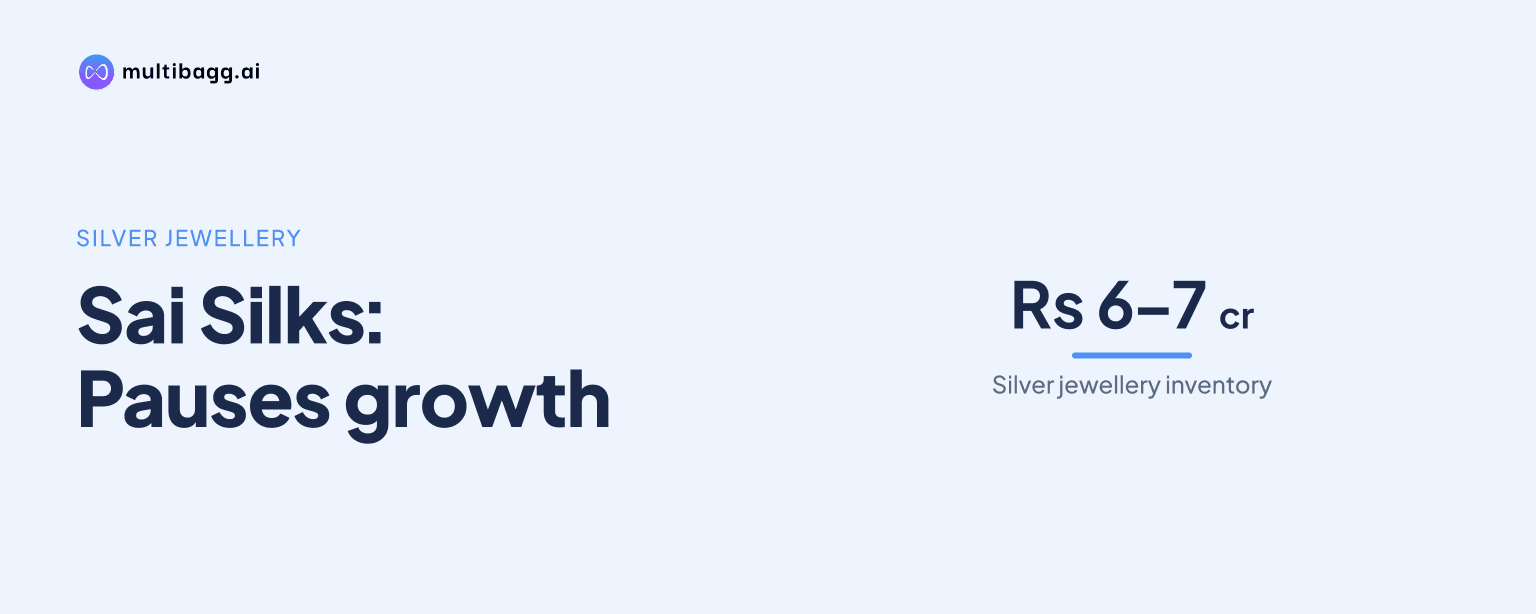
Sai Silks has paused aggressive silver-jewellery expansion after a 12-18 month trial showed limited growth potential, management said, retaining the category only in select existing stores with approximately Rs 6-7 crore of inventory rather than pursuing dedicated outlets.
Know Sai Silks (Kalamandir) inside out
Results, valuation, peers and who's buying, in one view.
Why is Sai Silks slowing silver jewellery expansion?
Sai Silks is slowing expansion because its initial findings from the past year to year-and-a-half did not show enough growth potential to support aggressive decisions on opening silver-jewellery stores. Management said it tested the category in service areas within larger existing stores rather than developing it as a standalone retail format.
Silver-price movements were a key constraint in the assessment. Management said silver prices had appreciated by more than 50-60% since it began the experiment, while describing the wider silver-jewellery business as taking a nosedive during the past year. That backdrop reduced the case for a broad rollout, even though management said the business remained net positive in absolute inventory terms.
Competition from fashion jewellery also shaped the decision. Management said customers are increasingly choosing between fashion jewellery and gold jewellery, leaving silver jewellery in an intermediate position that has not delivered the results Sai Silks would require before making aggressive store-expansion decisions.
Where will Sai Silks continue selling silver jewellery?
Sai Silks will continue selling silver jewellery in select existing stores where it has small excess service areas and sees customer demand. Management described the category as an experiment in three places and as a means of using available space, rather than as part of its main business line.
The business is self-sustainable so far and doing decently, according to management. Sai Silks is therefore not withdrawing from the category, but is taking it at a slower pace with approximately Rs 6-7 crore of inventory and a narrower purpose linked to local customer enquiries and spare store capacity.
That approach reflects the configuration of its retail network. As of September 30, 2026, Sai Silks had about 86 stores spanning close to 8.20 lakh square feet, while management said its average store size was around 6,000-7,000 square feet. Most locations are planned around saree inventories, restricting space for a separate jewellery offer.
Can Sai Silks use a jewellery shop-in-shop model?
Sai Silks has considered a shop-in-shop, or SIS, model but says its existing stores generally lack the space and layout required. Management said such an arrangement becomes feasible in much bigger stores, while saree inventory and saree throughput currently make better use of available selling area.
The company explored one or two options in the past, including a lab-grown jewellery operator, but did not proceed because of store-fitout and presentation constraints. An SIS partner would seek visibility in the entrance or welcoming area, management said, but Sai Silks has positioned those areas around its saree business.
Management left open the possibility of selective partnerships later, without setting a timeline or commitment. If average store sizes increase, Sai Silks said it could consider such opportunities in select locations, but its majority of stores are currently planned to maintain adequate saree inventory levels.
Got a follow-up? Ask IRIS
How does the decision fit Sai Silks' core retail strategy?
The silver-jewellery decision keeps Sai Silks focused on its five ethnic-wear formats: Kalamandir for middle- and upper-middle-income consumers, Varamahalakshmi for traditional silk and wedding wear, Mandir for premium ethnic wear, KLM Fashion Mall for ethnic value fashion, and Valli Silks for affordable traditional ethnic wear.
During H1 FY27, Sai Silks opened six stores and added close to 56,000 square feet of retail area, while closing one KLM Fashion Mall store of about 20,000 square feet. Its company-owned, company-operated model gives it direct control of merchandising, inventory and customer experience, which management cited as part of its store-planning approach.
Its inventory levels also follow a wedding- and festival-led cycle. Management said stock naturally builds at September 30 ahead of Dussehra and again at December-end ahead of Sankranti and Pongal. It said inventory days had improved by 20-30 days over the past three years, though it did not disclose a current inventory-turn target.
What was Sai Silks' financial backdrop for this decision?
Sai Silks reported Q2 FY27 revenue of Rs 434 crore, down 2.3% from Rs 444 crore in Q2 FY26, while profit after tax was Rs 31 crore and the profit-after-tax margin was 7.2%. Management attributed the weaker year-on-year performance partly to a festival-calendar shift and a relatively high comparison base.
For H1 FY27, revenue was Rs 809 crore, down 1.7% from Rs 823 crore in H1 FY26, while same-store sales growth, or SSSG, declined 9.2%. The comparison improved sequentially: Q2 FY27 revenue rose 15.7% from Q1 FY27, and earnings before interest, tax, depreciation and amortisation, or EBITDA, increased 18.8% to Rs 62 crore, with a 14.2% margin.
Management said festive-to-festive business grew by more than 27-30% versus the prior year's Navaratri period after Dussehra shifted into Q3. It maintained its earlier FY27 revenue expectation of Rs 1,850-1,900 crore and said it expected positive, double-digit second-half SSSG. Those figures are management expectations rather than reported results.
Conclusion
Sai Silks' silver-jewellery trial has resulted in a limited ancillary category rather than a new growth format. The company sees a use for its approximately Rs 6-7 crore inventory in three selected locations, but management cited volatile silver prices, fashion-jewellery competition and constrained store layouts as reasons not to pursue aggressive expansion.
The next point to watch is whether the festive and wedding season delivers management's expectation of positive, double-digit second-half SSSG and Rs 1,850-1,900 crore of FY27 revenue. Management also said larger average store sizes could allow selective SIS opportunities in future, while it plans efforts to improve the balance sheet by year-end.