










Sai Silks retains FY27 revenue target despite weak H1
Key highlights
- Sai Silks maintained FY27 revenue guidance of Rs 1,850-1,900 crore.
- Management said Navaratri festive-to-festive sales grew by more than 27-30%.
- Sai Silks said H2 needs double-digit SSSG to offset negative H1 SSSG and reach about 5% for FY27.
- Tamil Nadu stores reached about Rs 36,000 per square foot in H1 against a Rs 45,000-48,000 FY27 aim for Varamahalakshmi stores.
powered by IRIS
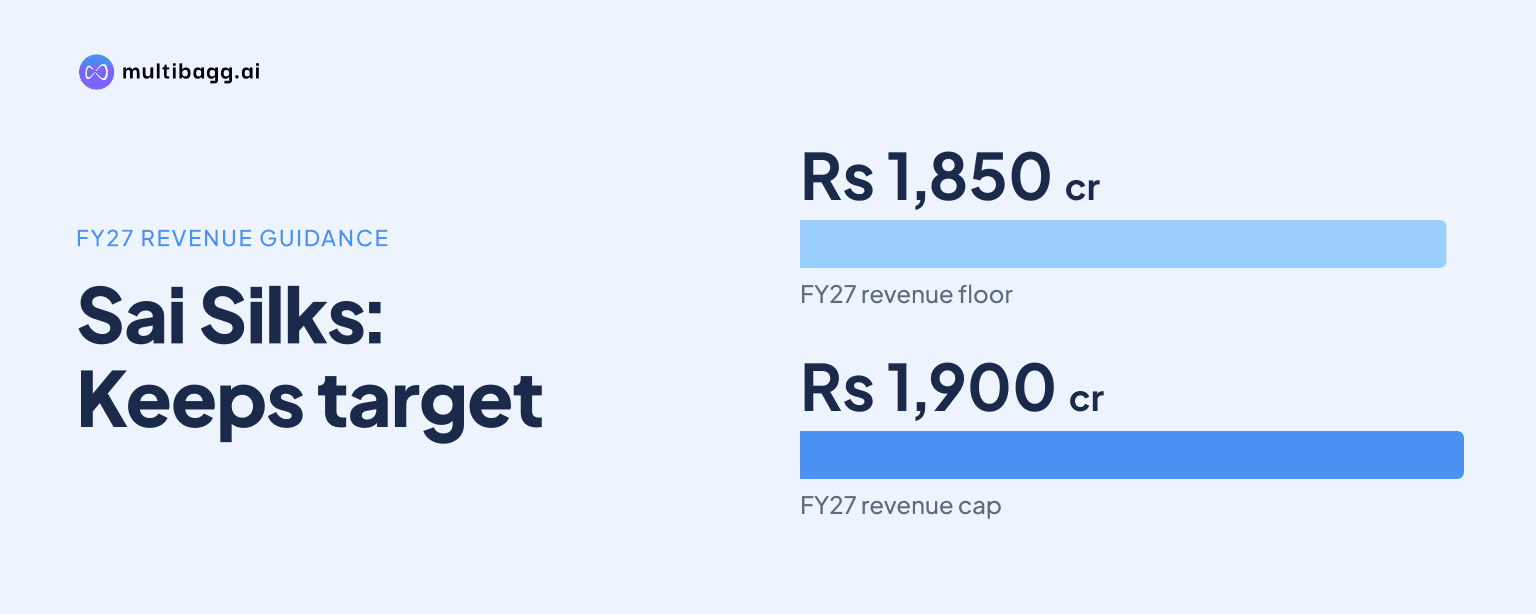
Sai Silks retained its FY27 revenue target of Rs 1,850-1,900 crore despite negative H1 same-store sales growth, with management citing more than 27-30% festive-to-festive sales growth during Navaratri and a wedding calendar concentrated in H2. Management said H2 needs double-digit same-store sales growth to meet the annual plan.
Know Sai Silks (Kalamandir) inside out
Results, valuation, peers and who's buying, in one view.
Why is Sai Silks retaining its FY27 revenue target?
Sai Silks is retaining its Rs 1,850-1,900 crore FY27 revenue target because management attributes the negative H1 same-store sales growth, or SSSG, mainly to Adhik Maas and a change in the festival calendar. Management said Dussehra fell in Q2 in the previous year but moved to Q3 in the current year, reducing the comparability of the H1 periods.
Management said the wedding and festival season is concentrated in H2, beginning with Dussehra and Diwali and followed by wedding demand. It said average selling prices, average bill values and other key performance indicators rose across formats during Navaratri, although it did not provide format-level SSSG or sales figures for that period.
Sai Silks had earlier framed FY27 growth at about 15%, with roughly 5% expected from SSSG and 10% from store additions. Management said H2 double-digit SSSG is needed not only to restore positive growth after H1, but also to deliver the roughly 5% full-year SSSG included in that original framework.
What evidence does Sai Silks cite for an H2 recovery?
Sai Silks cited more than 27-30% growth in festive-to-festive business during Navaratri compared with the corresponding festive period a year earlier. Management said this comparison better reflects consumer demand because the reported quarterly numbers were affected by the Dussehra shift from Q2 to Q3.
Management said footfalls, average selling prices and average bill values improved during Navaratri across all formats. It also said the KLM Fashion Mall format recorded higher festive growth than in the preceding year, although it did not disclose a percentage or separate sales figure for KLM Fashion Mall.
The company also expects recently opened stores in Tamil Nadu and Karnataka to contribute during Diwali. Management said those markets perform well during the Diwali season, but acknowledged that a quarter-on-quarter comparison is distorted when the relevant festival falls in different reporting periods.
H2 profitability is part of management's expectation as activity and store productivity increase. When an analyst suggested H2 earnings before interest, tax, depreciation and amortisation, or EBITDA, margin of about 17.5-18%, management said similar margins had been achieved in the prior year and should be expected in H2, while linking the H1 outcome to negative SSSG.
Got a follow-up? Ask IRIS
Which drivers could support Sai Silks' H2 sales plan?
Sai Silks expects Diwali, an evenly spread wedding calendar and local marketing to support H2 demand. Management said most wedding dates fall in Q3 and a smaller portion in Q4, while customer sentiment could continue through January and February, when further festival activity is scheduled.
Management described the wedding-date pipeline as healthy and said the dates are more evenly distributed in H2 than in H1. It also said the Ugadi season in Karnataka will be delayed by a couple of days into Q1 of the following year, meaning wedding demand rather than Ugadi is more relevant to the remaining FY27 target.
Tamil Nadu is a specific productivity opportunity in the plan. Sai Silks said its Tamil Nadu stores reached about Rs 36,000 per square foot in H1, compared with a previously discussed FY27 aim of about Rs 45,000-48,000 per square foot for Varamahalakshmi stores. Management has identified lower-visibility locations and is using advertising and other methods to improve productivity by year-end.
Pricing is another operational factor because management said raw-material costs have risen by about 5-6%. Sai Silks said it is reviewing where the higher product value can be passed to customers and where it must be absorbed, with the stated aim of avoiding customer attrition from price increases.
What could prevent Sai Silks from meeting the target?
Sai Silks faces regional competition in Andhra Pradesh and Telangana, where management said new stores and exhibition-based clearance sales increased in late Q2. These exhibitions use temporary venues such as function halls, and management expects the activity to continue through Q3 and Q4.
Management said store-level advertising and marketing helped counter those exhibitions during Dussehra. It did not quantify the cost or sales impact of the campaigns, but said the efforts improved visibility and supported festive demand despite competing formats seeking customer footfall.
Weather remains a potential disruption rather than a quantified financial risk. Management said a cyclone in Andhra Pradesh forced store closures for one day, but it did not anticipate a material impact from poor rainfall or El Nino at the time of the call. It said Andhra Pradesh and Tamil Nadu had received significant recent rain and would be major markets over the next two to three months.
KLM Fashion Mall is an unresolved element of the recovery case. Management said KLM is on a path to recovery and should show marked improvement in FY27, but provided no H1 sales, margin or SSSG figure. It said the end of Q3 would be a more appropriate point to discuss a clearer recovery path for the format.
Conclusion
Sai Silks' unchanged Rs 1,850-1,900 crore FY27 target depends on a pronounced H2 improvement after negative H1 SSSG. Management's rationale is that Adhik Maas and the movement of Dussehra affected the first-half comparison, while Navaratri festive business rose by more than 27-30% and operating indicators improved across formats.
The next disclosures to watch are reported H2 SSSG, the conversion of Diwali and wedding demand into revenue, and Tamil Nadu productivity against the Rs 45,000-48,000 per square foot aim for Varamahalakshmi stores. Management has also said that the end of Q3 should provide a clearer view of KLM Fashion Mall's recovery, while 5-6% raw-material inflation and regional exhibitions remain relevant factors.