










Sai Silks outlines test-store entry in Maharashtra, Kerala
Key highlights
- Sai Silks may test Maharashtra, Kerala and other territories with a few initial stores.
- Sai Silks currently focuses on four states and serves five consumer segments.
- Tamil Nadu Varamahalakshmi Silks stores achieved about Rs 36,000 per square foot in H1.
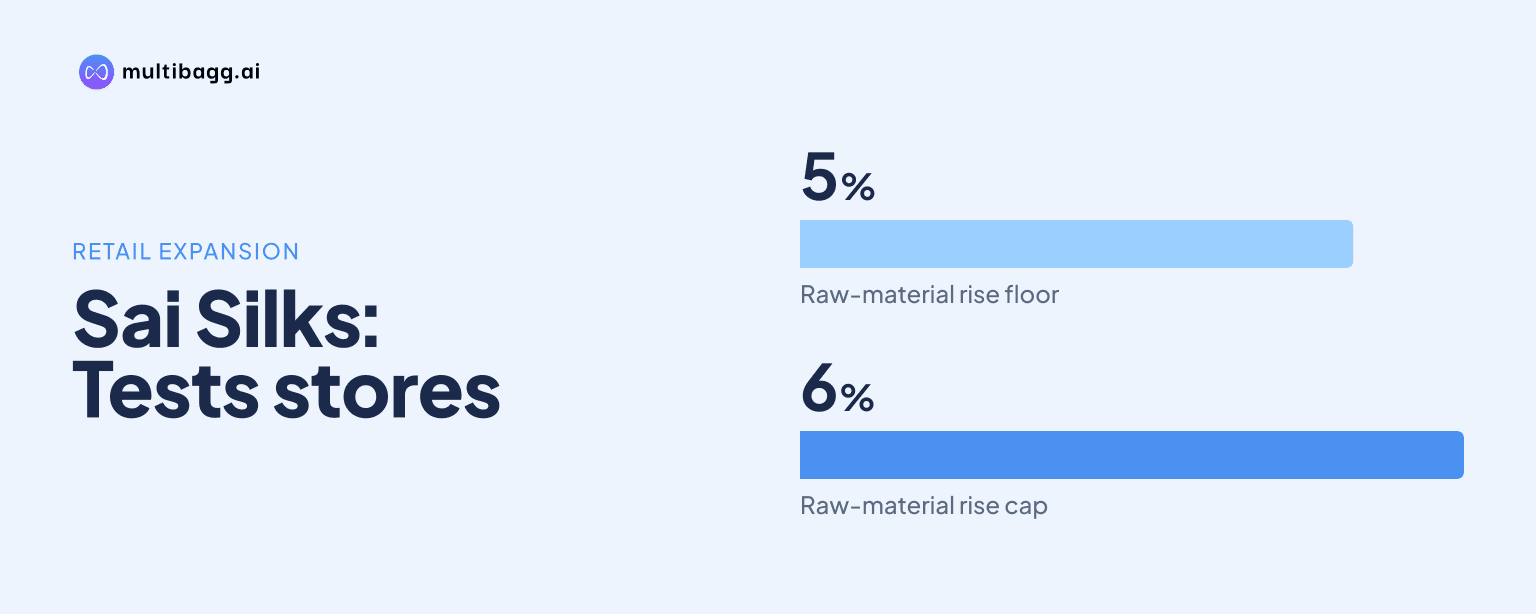
- Management said raw-material prices increased by about 5% to 6%.
powered by IRIS
Sai Silks said it plans to test Maharashtra, Kerala and potentially other territories with a few stores before wider expansion, taking its cluster-led approach beyond four current focus states. Management said it will assess store performance and consumer behaviour before adding formats more aggressively across markets that serve its five consumer segments.
Know Sai Silks (Kalamandir) inside out
Results, valuation, peers and who's buying, in one view.
How will Sai Silks enter Maharashtra and Kerala?
Sai Silks intends to begin any new-state entry with a limited store cluster rather than a broad launch. Management said it was actively exploring markets outside its four focus states and could soon notify the market about stores in Maharashtra, Kerala and other territories. It did not provide an opening date, city list, store count, capital expenditure figure or confirmed first format for either state.
The proposed sequence is to open a few stores, study their performance and understand local consumer behaviour, then expand gradually and add formats more aggressively. This makes the initial stores a test phase rather than a commitment to a statewide rollout. Sai Silks said it serves five consumer segments, so the local response to an initial format would help determine which additional formats, if any, fit the cluster.
Management’s wording leaves the entry conditional. It referred to Maharashtra, Kerala and other markets as possible territories, rather than confirming leases or a launch calendar. The next concrete marker would be a market notification of an opening, because the call did not identify whether a Varamahalakshmi Silks, Kalamandir or another format would be the first outlet in a new state.
Why is Sai Silks slowing Karnataka expansion?
Sai Silks said it will slow Karnataka expansion somewhat while actively expanding in Tamil Nadu again. Management said Karnataka had historically operated with a lower store count than Andhra Pradesh and Telangana despite its potential, leading the company to activate store additions there during the current year. Tamil Nadu, by comparison, led the company’s overall expansion over the previous two years.
The Karnataka build-out has included Kalamandir additions in Bangalore and Mysore, alongside plans to add Varamahalakshmi Silks stores where possible. Management said Bangalore had only a few Kalamandir stores and Karnataka’s overall network was relatively small. The strategy was therefore not to choose one format permanently, but to increase the presence of formats that address different customer segments in a market with fewer existing outlets.
Tamil Nadu provides the operating comparison for the renewed expansion priority. Varamahalakshmi Silks stores there achieved about Rs 36,000 per square foot in H1, versus management’s earlier FY27 objective of about Rs 45,000 to Rs 48,000 per square foot. Management identified stores where visibility could improve relative to productivity and said advertising and other measures were being used to lift performance in H2 and by year-end.
How does Sai Silks' cluster-led expansion model work?
Sai Silks starts a cluster by opening one brand in a location and considers a second format after the first has matured. Management said the company first penetrates a location with one brand, gains learning from that operation and then introduces another brand. It said this structure can create operating leverage in warehousing and administration as stores and formats accumulate in the same local area.
That mechanism explains why management does not intend to copy the Karnataka format mix automatically into Maharashtra or Kerala. The first few stores would be used to establish how consumers respond and how the format performs in a new market. Only after those observations would Sai Silks look to broaden the network and add new store formats more aggressively.
The company’s recent state sequencing reflects this staged model. Tamil Nadu was the principal expansion market over the prior two years, while Karnataka became more active in the current year because its store network was smaller than Andhra Pradesh and Telangana. Management’s plan to moderate Karnataka additions while revisit Tamil Nadu and explore new territories suggests expansion is being allocated according to market maturity and store-network development rather than evenly across states.
Got a follow-up? Ask IRIS
Which Sai Silks formats could be used in new states?
Sai Silks has not selected a format for Maharashtra or Kerala, and management said there is no limitation on opening Varamahalakshmi Silks versus Kalamandir stores. The company’s stated objective is to add formats based on the characteristics of the particular market. Management also said Varamahalakshmi Silks stores will continue to open in the years ahead.
Valli remains another format under review, but it is not yet a disclosed driver of the new-state plan. Management said Valli stores had opened only last year and that it was waiting for the format to mature. Valli is designed to be in line with Kalamandir, and management expected to know more broadly by year-end; it did not disclose Valli sales per square foot, earnings before interest, tax, depreciation and amortisation margin, internal rate of return or payback period.
The format decision will also be made against competition and pricing conditions. Management said raw-material prices had increased by about 5% to 6% and that it was seeking to pass through pricing while keeping customers from walking away. In Andhra Pradesh and Telangana, management reported store openings and clearance-style exhibitions in late Q2, with such activity expected to continue through Q3 and Q4; it said store-level advertising supported Dussehra trading despite that competition.
What evidence will show whether Sai Silks' new-state strategy is working?
The clearest initial evidence will be the identity and performance of the first few new-territory stores. Sai Silks has disclosed the decision process, but not store economics, locations, timing or format selection for Maharashtra or Kerala. A later decision to add a second format in the same cluster would indicate that management believes the initial stores have delivered sufficient learning on local demand and operations.
Tamil Nadu productivity is another relevant measure because management is pursuing renewed expansion there while testing other states. Its H1 Varamahalakshmi Silks productivity of about Rs 36,000 per square foot was below the earlier FY27 range of Rs 45,000 to Rs 48,000 per square foot. Management expects improvement from visibility initiatives and seasonal H2 activity, but it did not revise the FY27 productivity objective on the call.
Conclusion
Sai Silks is pairing a more measured Karnataka expansion with renewed Tamil Nadu activity and a potential test-store entry into Maharashtra, Kerala and other markets. The common mechanism is a cluster model: establish one brand, assess performance and consumer behaviour, then use shared warehousing and administration before adding another format. The approach gives management flexibility across five consumer segments, but the first-state rollout details remain undisclosed.
The next items to watch are any notification of new-territory stores, management’s end-of-Q3 update on KLM recovery and its ability to comment more confidently on the FY27 earnings before interest, tax, depreciation and amortisation margin aspiration of 17.5% to 18%. Management also said it expects a broader view of the Valli format by year-end, which could affect later decisions on format allocation.