










Sai Silks Q2 FY27 Revenue Declines 2.3% to Rs 434 Crore
Key highlights
- Sai Silks reported Q2 FY27 revenue of Rs 434 crore, down 2.3% year on year.
- Gross margin improved 20 basis points to 42.1% in Q2 FY27.
- EBITDA was Rs 62 crore, up 18.8% quarter on quarter, with a 14.2% margin.
- Same-store sales growth declined 10.6% in Q2 FY27 across a network of 86 stores.
powered by IRIS
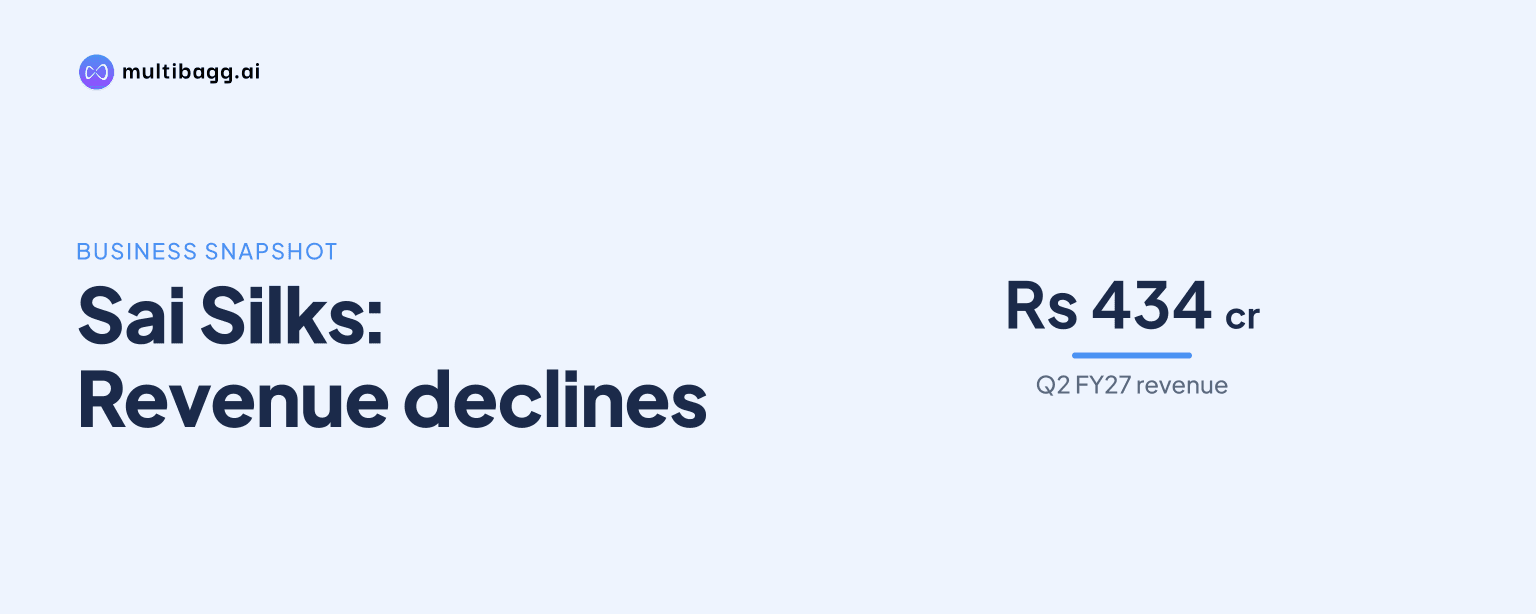
Sai Silks (Kalamandir) Limited reported Q2 FY27 revenue of Rs 434 crore, down 2.3% year on year, as a festive calendar shift and a high comparison base weighed on demand. The company still improved gross margin by 20 basis points to 42.1% and delivered stronger sequential revenue and EBITDA growth during the quarter.
Know Sai Silks (Kalamandir) inside out
Results, valuation, peers and who's buying, in one view.
Why did Sai Silks' quarterly revenue decline?
Sai Silks' quarterly revenue declined because the festive calendar shift affected consumer demand during the July-September period, while the comparable quarter a year earlier had a relatively high base. Revenue from operations stood at Rs 434 crore in Q2 FY27, compared with Rs 444 crore in Q2 FY26.
Chief Executive Officer Bharadwaj Rachamadugu said the timing shift and the higher base weighed on the company's quarterly performance. Same-store sales growth, or SSSG, declined 10.6% in the quarter, indicating that demand pressure was more pronounced at existing outlets.
The company nevertheless described its performance as resilient because profitability metrics remained positive and sequential momentum improved. The Q2 numbers cover the period ending September 2026 and were discussed in the earnings call held after the results were declared on November 3, 2026.
What did Sai Silks report for Q2 FY27?
Sai Silks reported gross profit of Rs 183 crore, EBITDA of Rs 62 crore and profit after tax of Rs 31 crore for Q2 FY27. Gross margin rose to 42.1%, while EBITDA margin was about 14.2% and PAT margin was 7.2%.
The company reported that EBITDA grew 18.8% quarter on quarter, ahead of the 15.7% quarter-on-quarter rise in revenue. EBITDA margin expanded by about 37 basis points from Q1 FY27, showing improved operating leverage on the sequential recovery.
Net profit of Rs 31 crore was lower than Rs 40 crore reported in the year-ago quarter, according to the results information provided. The year-on-year decline in PAT was 22.46%, which was steeper than the revenue decline and reflects the pressure on quarterly earnings despite the improvement in gross margin.
Got a follow-up? Ask IRIS
How did festive timing affect demand and stores?
The festive timing affected demand by shifting a part of seasonal purchasing outside the quarter, according to management. Sai Silks said this effect, combined with a relatively high base in the corresponding period, reduced consumer activity and weighed on reported sales.
The impact was visible in same-store sales, which fell 10.6% in Q2 FY27. For the first half of FY27, SSSG declined 9.2%, indicating that the softer trend extended beyond one quarter at stores that had been operating for a comparable period.
Sai Silks operates 86 stores across four states, according to the information supplied with the results. Its H1 FY27 revenue was Rs 809.13 crore, while first-half gross margin was 41.98%. These figures provide context for the second-quarter sequential improvement, although the company did not disclose a forward revenue or profit target in the supplied material.
What do the results mean for investors and retail operations?
The results show that Sai Silks protected gross margin even as sales were lower than the prior-year quarter. A 42.1% gross margin and sequential EBITDA-margin expansion suggest that product mix, pricing or inventory economics supported profitability, though the company did not provide a detailed breakdown of those factors in the supplied call excerpts.
For investors, the key contrast is between the year-on-year decline and the quarter-on-quarter recovery. Revenue rose 15.7% sequentially and EBITDA increased 18.8%, but existing-store demand remained weak on a year-on-year basis. Both trends are relevant when assessing the sustainability of the reported margin performance.
For retail operations, the calendar effect matters because festive demand is an important driver of quarterly sales for apparel and ethnic-wear retailers. The company made no announcement in the supplied material about changes to its store count, expansion programme or guidance. Its disclosures instead focused on the reported quarterly and first-half operating outcomes.
Conclusion
Sai Silks ended Q2 FY27 with revenue of Rs 434 crore, 2.3% below the year-ago quarter, while gross margin improved to 42.1% and sequential operating performance strengthened. The results point to demand disruption from festive timing and a high base, alongside maintained profitability at the gross and EBITDA levels.
The next material issue to watch is whether same-store sales improve after the festive calendar effect, following the 10.6% Q2 FY27 decline and 9.2% H1 FY27 decline. Investors can also track subsequent quarterly disclosures for updates on revenue momentum, EBITDA margin and the operating performance of Sai Silks' 86-store network.