










Salzer Targets 25%+ Exports as Saudi Start Is Conditional
Key highlights
- Salzer reported a 21.29% export mix in H1 FY27 and targets more than 25% in the medium term.
- Salzer cites a US tariff reduction from 50% to 18% under a February 6, 2026 trade deal.
- Salzer Saudi Arabia Ltd is targeting production in April 2027, conditional on the Middle Eastern war situation.
- Salzer reports a direct network across 50 countries and 40 international distributors.
powered by IRIS
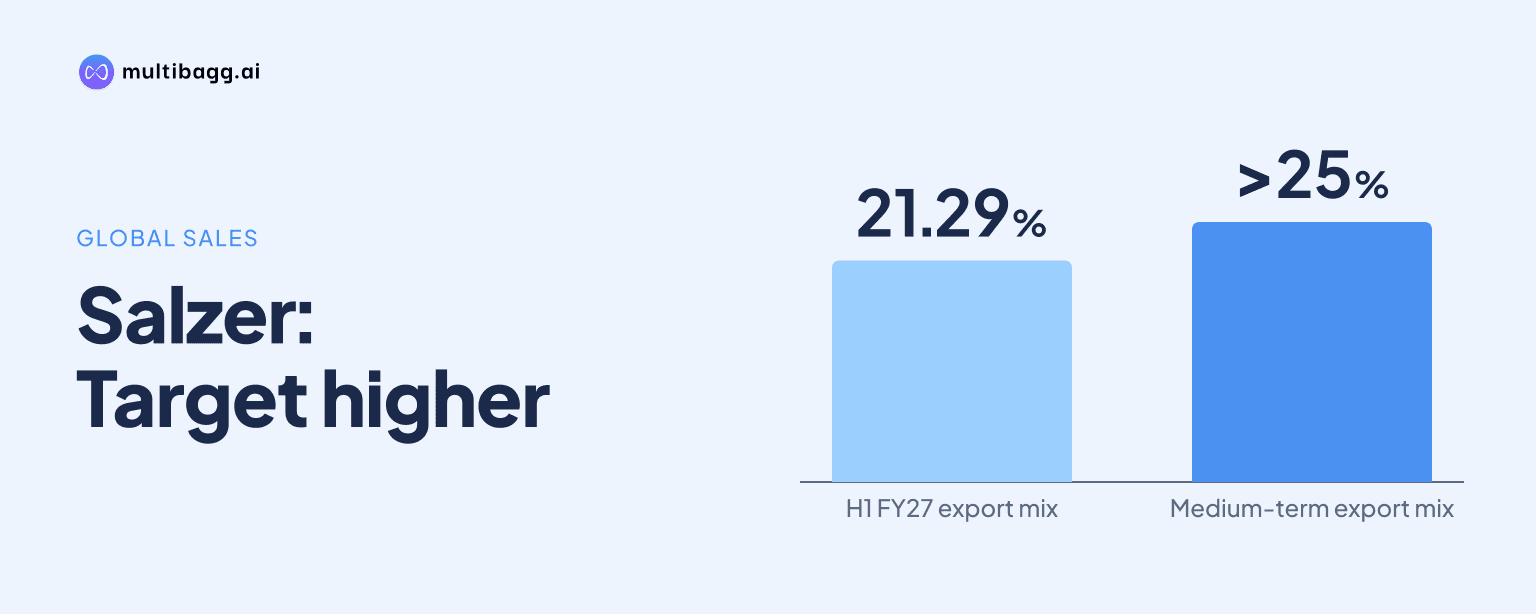
Salzer is targeting exports above 25% of revenue in the medium term, versus 21.29% reported in H1 FY27, after its presentation cited a US tariff reduction from 50% to 18% and set April 2027 as the Saudi production target, subject to the Middle Eastern war situation.
Know Salzer Electronics inside out
Results, valuation, peers and who's buying, in one view.
What is Salzer’s current export position and target?
Salzer reported exports at 21.29% of its mix in H1 FY27 and is targeting a contribution above 25% in the medium term. This implies an increase of at least 3.71 percentage points from the reported H1 FY27 level, although the presentation does not set a date for reaching the target. On its distribution slide, Salzer rounds the same H1 FY27 export-sales figure to 21%.
The target is linked to two stated drivers: the US tariff reset and Saudi expansion. Salzer describes the US change as an immediate volume lever and the Saudi facility as a route to long-term localised access to regional infrastructure projects. The presentation does not disclose export revenue in rupees, the contribution of any individual country, or the volume assumptions behind the 25%+ goal.
What changed in the US tariff for Salzer?
Salzer’s presentation says the US-India Interim Trade Deal dated February 6, 2026 reduced the tariff on Indian goods from 50% to 18%. The slide identifies North America, specifically the USA, as a major catalyst for the export plan. It presents the tariff reduction as a factor that could improve the company’s ability to pursue export volumes in the US market.
The stated reduction is 32 percentage points, but Salzer does not specify which of its products qualify, the tariff classification involved, or the value of US sales exposed to the rate. Salzer manufactures electrical products including cam-operated switches, contactors, overload relays and transformers through technology arrangements cited in the presentation. Therefore, the presentation establishes the announced tariff rate as a strategic input, not a quantified revenue or profit outcome.
When is Salzer’s Saudi factory expected to start production?
Salzer is targeting production at Salzer Saudi Arabia Ltd in April 2027, but the stated milestone depends on the Middle Eastern war situation. The Saudi entity is described as a 100% subsidiary, and machinery installation was underway when the presentation was prepared. Salzer says the facility is intended to target local infrastructure projects rather than solely supply those projects from its India headquarters.
The April 2027 date is consequently conditional rather than a firm commissioning commitment. Salzer does not disclose the factory’s investment amount, installed capacity, product list, employee count, customer orders or construction timetable beyond machinery installation. The presentation’s strategy is to use Saudi localisation for regional market access, while retaining India headquarters as the manufacturing hub shown on the global-expansion slide.
Saudi localisation also differs from the US element of the strategy. The US case rests on the stated drop from a 50% tariff to 18%, whereas the Saudi case rests on producing locally through a wholly owned subsidiary. Salzer frames these as a dual approach, combining a nearer-term US volume opportunity with longer-term regional access, but provides no annual export target for Saudi Arabia after the planned April 2027 start.
Got a follow-up? Ask IRIS
How do Europe, distributors and Indian operations support the plan?
Salzer says the UK and Europe are intended to be margin drivers because of zero import duty and favourable currency movement. Its stated focus in those markets is high-margin engineered switchgear products. The presentation does not quantify European sales, the exchange-rate benefit, or the margin difference between Europe and other export destinations, so those points remain management’s strategic rationale rather than reported segment financial results.
The company reports a direct international network across 50 countries and 40 international distributors, while another slide describes global reach as more than 40 international distributors. It plans to expand in the US, Africa and the Middle East. In India, Salzer has a tie-up with LK that provides access to more than 350 dealers, alongside a direct modular-switch network of 50 stockists across 12 southern, eastern and western states.
Operationally, Salzer says more than 80% of components are made in-house and its type-testing laboratory handles loads up to 500 amps. Its research and development centre has more than 100 engineers, and research and development expense rose from Rs 15.53 crore in FY25 to Rs 19.14 crore in FY26. These capabilities provide the manufacturing and engineering base cited alongside the export plan, though the presentation does not allocate them by export region.
A separate slide labels FY26 revenue growth as above 20%, without stating whether that figure is actual performance, guidance or a target. Salzer also reports about 25% market share in cam-operated switches, more than 20 differentiated product families and Tier-1 supply relationships with global original equipment manufacturers including GE and Schneider. Those product and customer credentials are presented as support for international expansion, not as a forecast of export sales.
Conclusion
Salzer’s strategy combines a stated US market-access change with planned local production for the Middle East, while Europe is positioned around duty and currency factors. Its existing international footprint of 50 countries and 40 distributors provides a distribution base, and its India operations support manufacturing through more than 80% in-house component production and research and development spending of Rs 19.14 crore in FY26.
The key item to watch is whether machinery installation at Salzer Saudi Arabia Ltd progresses to production in April 2027, because management explicitly makes that timing dependent on the Middle Eastern war situation. Investors can also track whether planned expansion in the US, Africa and the Middle East changes the reported export share from the 21.29% H1 FY27 base toward the 25%+ medium-term target.