










Salzer Electronics Revenue Rises 38.4% as Margins Narrow
Key highlights
- Salzer reported Q2 FY27 revenue of ₹579.77 crore, up 38.4% year on year.
- EBITDA excluding other income rose 9.25% to ₹39.95 crore, while EBITDA margin declined to 6.89%.
- Consolidated net profit increased 11.09% year on year to ₹14.87 crore, with no exceptional item reported.
- Salzer expects the Bengaluru project to generate ₹2 crore to ₹2.5 crore in monthly recurring revenue from February 2027.
powered by IRIS
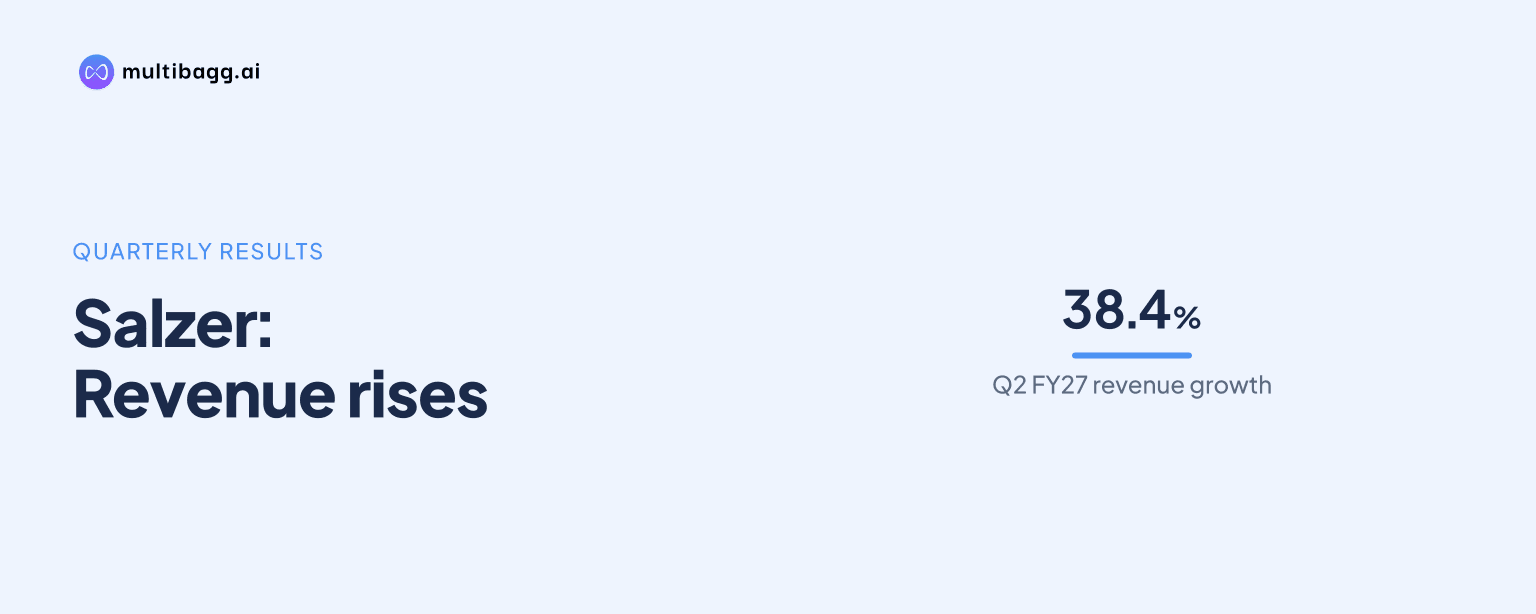
Salzer Electronics Ltd reported Q2 FY27 revenue of ₹579.77 crore, a 38.4% year-on-year increase, but its EBITDA margin narrowed to 6.89% from 8.73% amid raw-material cost volatility. The company also reported consolidated net profit of ₹14.87 crore, up 11.09% year on year, and outlined plans to recover margins.
Know Salzer Electronics inside out
Results, valuation, peers and who's buying, in one view.
What did Salzer report in Q2 FY27?
Salzer reported revenue of ₹579.77 crore for Q2 FY27, compared with the corresponding quarter a year earlier, representing growth of 38.4%. The company submitted its investor presentation on November 13, 2026, covering unaudited financial results for the quarter and half year ended September 30, 2026.
Revenue growth was accompanied by a more moderate increase in profitability. EBITDA excluding other income rose 9.25% year on year to ₹39.95 crore, while consolidated net profit increased 11.09% to ₹14.87 crore. The presentation reported no exceptional item for the quarter.
The figures show that Salzer expanded sales at a faster rate than operating earnings. This difference is reflected in the decline in EBITDA margin, which fell by 1.84 percentage points from the prior-year level. For investors, the quarter therefore combines strong top-line growth with a clear indication that input costs affected operating leverage.
Why did Salzer's operating margin decline?
Salzer attributed the margin pressure to volatility in raw-material costs and said it has plans to recover margins. The company reported an EBITDA margin of 6.89% in Q2 FY27, below 8.73% in the year-earlier quarter despite the increase in revenue and EBITDA.
Management had previously revised FY27 EBITDA-margin guidance to 8% to 8.5% from an earlier 10% target. During an earnings call, Joint Managing Director D Rajesh Kumar cited the global situation, the West Asia conflict and fluctuating raw-material prices as reasons for lowering the full-year outlook.
Management stated that pressure was expected to continue in Q2 and expected margins to normalise in Q3 and Q4, with a stated expectation of 9% to 9.5% margins in those quarters. These are management expectations rather than reported results. The company also said the investor presentation would be corrected to align with the revised FY27 guidance.
The margin movement matters because Salzer operates across electrical product categories where material procurement can have a direct effect on manufacturing costs. The reported revenue growth indicates demand and execution across its businesses, but the lower margin shows that revenue expansion alone did not offset cost volatility during the quarter.
What are Salzer's Bengaluru and EV expansion plans?
Salzer expects its Bengaluru energy-management project to generate ₹2 crore to ₹2.5 crore of monthly recurring revenue from February 2027. The project is linked to an approximately ₹200 crore opportunity for comprehensive street-light management and energy-efficiency solutions for Bengaluru city under the Bruhat Bengaluru Mahanagara Palike, or BBMP.
The project is to be executed through Effilume SPV, in which Salzer held a 41.91% stake as of December 2025. Salzer described the expected income as an annuity revenue model, meaning recurring service income rather than a one-time sale of hardware. The company said the project had been delayed from initial estimates.
In electric-vehicle charging, Salzer invested ₹8 crore for a 30% stake in UltraFast Chargers. The venture has sold about 85 units and generated about ₹9 crore in revenue to date, according to the presentation material.
Salzer identifies EV charging as a strategic growth area alongside industrial switchgear, building electrical products, wire and cable, energy-management products and smart meters. Its distribution disclosures also include an L&T tie-up providing access to more than 350 dealers in India and a modular-switch network of 50 stockists across four southern and western states.
Got a follow-up? Ask IRIS
How could the projects affect Salzer's operations and investors?
The Bengaluru project could add a service-led recurring-revenue component to Salzer's established electrical-products portfolio if it begins generating revenue from February 2027 as stated. A monthly run rate of ₹2 crore to ₹2.5 crore would differ from the company's traditional project and equipment sales because it is characterised as annuity income.
For operations, the BBMP work broadens Salzer's involvement in energy efficiency and street-light management. It also places execution through Effilume SPV at the centre of the opportunity, making the project's timetable and operational delivery relevant to the expected revenue start.
The UltraFast Chargers investment gives Salzer exposure to EV charging equipment through a minority stake rather than a wholly owned operation. The disclosed record of about 85 units sold and about ₹9 crore of revenue provides an initial operating reference point, though the material does not provide profitability, order-book or future sales figures for the venture.
For shareholders, these initiatives are relevant because they add new business lines while the core business manages input-cost pressure. However, the stated Bengaluru revenue timing is an estimate, and management's expected margin improvement remains dependent on conditions it identified, including raw-material-price movement.
What is the broader context for Salzer's strategy?
Salzer is a Coimbatore-headquartered provider of electrification and automation solutions, with operations spanning industrial switchgear, wire and cable, building electrical products, smart metering, EV charging and energy management. The company was incorporated in 1985 and has seven manufacturing units in Tamil Nadu, according to its earlier corporate disclosures.
The current strategy combines established electrical categories with newer areas such as smart metering, energy management and EV charging. The Bengaluru project is notable in this context because it combines energy-efficiency work with a municipal service model, rather than focusing solely on product sales.
The prior-year comparison also provides useful context for the latest quarter. Salzer had reported Q2 FY26 consolidated revenue of ₹418.9 crore, up 21.7% year on year. The Q2 FY27 revenue figure of ₹579.77 crore shows a higher growth rate, while the lower EBITDA margin demonstrates the effect of cost pressure on the quality of that growth.
Conclusion
Salzer's Q2 FY27 performance showed revenue growth of 38.4% to ₹579.77 crore and a 11.09% increase in consolidated net profit to ₹14.87 crore. At the same time, EBITDA margin declined to 6.89% as raw-material-cost volatility limited the conversion of higher sales into operating profit.
The next disclosed milestones are the expected February 2027 start of ₹2 crore to ₹2.5 crore in monthly Bengaluru project revenue and management's stated expectation of margin normalisation in Q3 and Q4. Investors will also watch whether the company delivers within its revised FY27 EBITDA-margin guidance of 8% to 8.5%.