










Salzer® targets 9-10% FY28 EBITDA margin via product mix
Key highlights
- Salzer® targets a blended EBITDA margin of about 9% to 10% by FY28, versus a current 6.5% presentation baseline.
- Industrial Switchgear represented about 55% of H1 FY27 revenue and reported a 7.92% EBITDA margin.
- Wire & Cable represented about 38% of H1 FY27 revenue, with a 5.11% EBITDA margin and a 6.5% target.
- Salzer® reported FY26 revenue of Rs 1,758.4 crore as EBITDA margin declined to 8.4% from 9.4% in FY25.
powered by IRIS
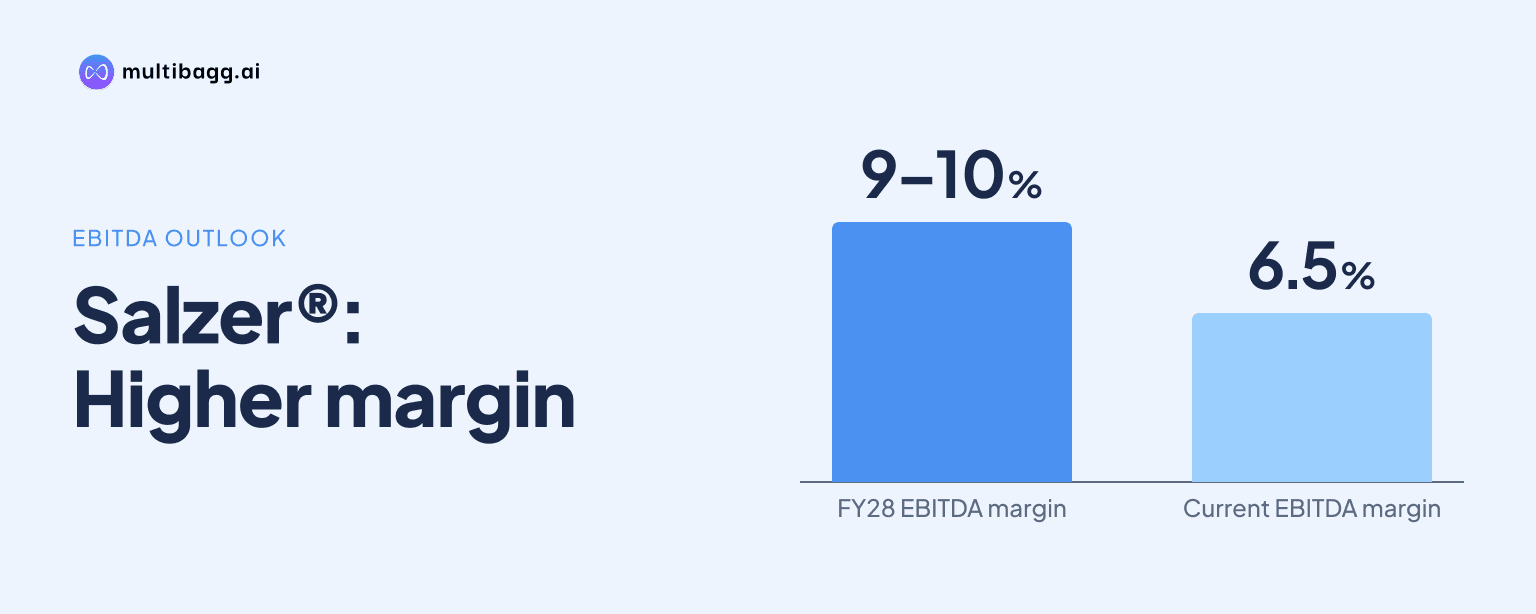
Salzer® targets a blended earnings before interest, tax, depreciation and amortisation (EBITDA) margin of about 9% to 10% by FY28, compared with the presentation’s current 6.5% baseline, by increasing engineered and export-led products as FY26 revenue reached Rs 1,758.4 crore but EBITDA margin fell to 8.4%.
Know Salzer Electronics inside out
Results, valuation, peers and who's buying, in one view.
How does Salzer® plan to reach a 9-10% EBITDA margin by FY28?
Salzer® plans to raise blended EBITDA margin from about 6.5% currently to about 7.5% to 8% in FY27 and about 9% to 10% in FY28. The presentation identifies high-value engineered products and export-led stock-keeping units (SKUs) as the main mechanisms to offset commodity volatility and expand the blended margin.
The strategy centres on Industrial Switchgear, which represented about 55% of H1 FY27 revenue and was the company’s largest segment. The segment reported a 7.92% EBITDA margin against a target of about 12.5%, and the presentation attributes its expected margin recovery to export volumes and a focus on engineered products.
Industrial Switchgear had an approximately 40% high-value and 60% standard-product mix in H1 FY27. Wiring ducts, toroidal transformers, rotary switches, load break switches, motor control products and cable assemblies are among the products listed for the segment, although the presentation does not disclose individual product margins or revenue by product category.
Which businesses are expected to drive Salzer®'s margin recovery?
Industrial Switchgear is expected to be the principal driver because its 55% H1 FY27 revenue share was larger than Wire & Cable’s approximately 38% and Building Electrical’s approximately 7%. Its 7.92% margin was also 2.81 percentage points above the 5.11% margin reported by Wire & Cable, while its 12.5% target is higher than Wire & Cable’s 6.5% target.
The segment’s disclosed gap between the 7.92% reported margin and the approximately 12.5% target shows the scale of the planned improvement. However, Salzer® does not provide a numerical bridge showing how much of that difference is expected to come from exports, high-value product mix, pricing, volume growth or manufacturing efficiency.
Wire & Cable is described as the volume driver, but copper-price volatility is identified as its operating challenge. Salzer® plans to use pass-through pricing discipline, higher capacity utilisation, branding and wider distribution in this segment, which generated about 38% of H1 FY27 revenue and had a 5.11% EBITDA margin.
Building Electrical contributed about 7% of H1 FY27 revenue and is described as a volume-led business dependent on scale. Salzer® plans to use the L&T dealer network of more than 350 dealers and expand its modular-switch and specialty-product portfolio, but the presentation gives no EBITDA margin or numerical margin target for this segment.
Got a follow-up? Ask IRIS
How did Salzer®'s annual margins change as revenue increased?
Salzer® increased revenue to Rs 1,758.4 crore in FY26 from Rs 1,418.3 crore in FY25 and Rs 605.6 crore in FY21. EBITDA also rose in absolute terms, reaching Rs 147.1 crore in FY26 from Rs 133.9 crore in FY25 and Rs 61.8 crore in FY21, but EBITDA margin declined to 8.4% from 9.4% and 10.2%, respectively.
The annual record shows that the margin change was not linear. EBITDA margin moved from 10.2% in FY21 to 8.1% in FY22, recovered to 9.3% in FY23 and 10.0% in FY24, then declined to 9.4% in FY25 and 8.4% in FY26.
Salzer®’s FY28 range of about 9% to 10% would return the margin to the FY24 range at the upper end. It would still be below FY21’s 10.2% margin at the lower end of the range, while the presentation’s current 6.5% baseline and FY26 annual reported margin of 8.4% are disclosed in different presentation contexts.
Net profit increased to Rs 53.8 crore in FY26 from Rs 52.5 crore in FY25, while net profit margin fell to 3.1% from 3.7%. Earnings per share fell to Rs 29.94 in FY26 from Rs 35.3 in FY25, despite the increase in reported net profit.
What financial measures accompany Salzer®'s margin plan?
Salzer® reported debt-to-equity of 0.92 times in FY26, compared with 0.86 times in FY25 and 0.65 times in FY24. Return on capital employed, defined by the presentation as earnings before interest and tax divided by total capital employed, declined to 10.79% in FY26 from 11.59% in FY25 and 12.57% in FY24.
Working capital rose to Rs 292.6 crore in FY26 from Rs 272.5 crore in FY25, while working-capital days improved to 153 from 170. Short-term borrowings increased to Rs 503.36 crore from Rs 435.04 crore, and long-term borrowings rose to Rs 28.08 crore from Rs 22.32 crore over the same period.
The consolidated balance sheet dated September 30, 2026 reported current borrowings of Rs 568.80 crore, compared with Rs 503.36 crore at March 31, 2026. Consolidated inventories rose to Rs 494.09 crore from Rs 468.35 crore and trade receivables increased to Rs 506.14 crore from Rs 445.53 crore during those six months.
These balance-sheet movements are reported alongside the FY27 and FY28 margin targets, but Salzer® does not directly connect the rise in borrowings, inventories or receivables to the mix-improvement strategy. The disclosed figures instead provide measures to track as the company pursues its stated target of a higher share of engineered and export-led products.
Conclusion
Salzer®’s FY28 margin plan relies on changing the composition of growth rather than solely increasing sales volume. Revenue rose by Rs 1,152.8 crore between FY21 and FY26, but EBITDA margin declined by 1.8 percentage points to 8.4%; the company’s response is to seek more engineered and export-led switchgear sales while improving price pass-through and utilisation in Wire & Cable.
The next disclosed milestone is the FY27 blended EBITDA-margin target of about 7.5% to 8%, ahead of the FY28 range of about 9% to 10%. Progress in Industrial Switchgear’s high-value mix, which was about 40% in H1 FY27, its margin progression from 7.92% toward about 12.5%, and the effect of copper volatility and higher current borrowings will indicate execution against that plan.