










Salzer raises research spend to Rs 19.14 crore, over 80% in-house
Key highlights
- Salzer's R&D expenditure rose to Rs 19.14 crore in FY26 from Rs 15.53 crore in FY25.
- Salzer reports three patented products and two patents in process.
- More than 80% of Salzer's components are made in-house.
- Salzer's in-house R&D centre has more than 100 engineers.
powered by IRIS
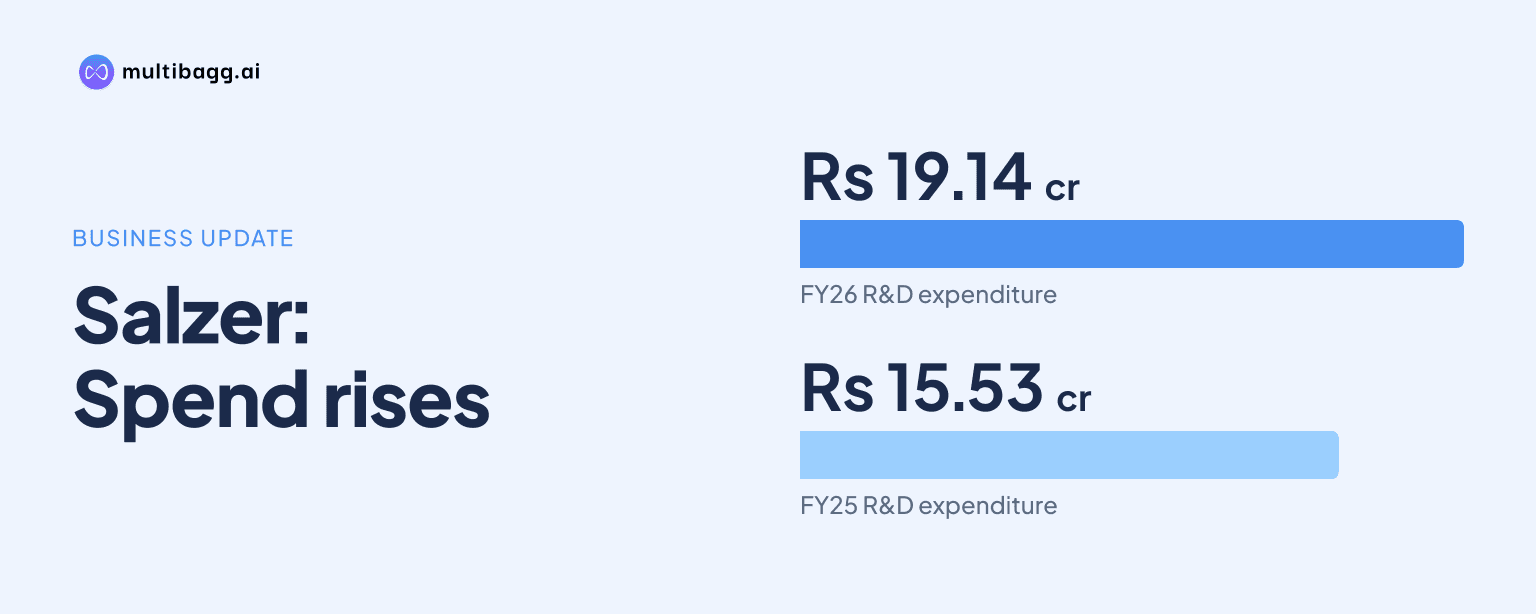
In financial year 2026 (FY26), Salzer raised research and development (R&D) spending to Rs 19.14 crore from Rs 15.53 crore in FY25 and reported that more than 80% of components were made in-house. Salzer also reports three patented products, two patents in process and an R&D centre with more than 100 engineers.
Know Salzer Electronics inside out
Results, valuation, peers and who's buying, in one view.
How much did Salzer increase R&D spending?
Salzer increased R&D expenditure by Rs 3.61 crore, or about 23%, from FY25 to FY26. The FY26 amount of Rs 19.14 crore was Rs 7.14 crore above FY24 expenditure of Rs 12.00 crore, placing engineering spending at a higher level over the latest two-year period disclosed in the presentation.
The spending path was not linear across the six reported years. R&D expenses fell by Rs 0.33 crore between FY22 and FY23, then rose by Rs 2.96 crore in FY24, Rs 3.53 crore in FY25 and Rs 3.61 crore in FY26. FY26 expenditure was more than double the Rs 9.07 crore recorded in FY21.
What intellectual property has Salzer developed?
Salzer reports three patented products and two patents in process. Its recently disclosed granted patent is a high-voltage disconnecting and earthing device designed specifically for railway locomotive applications.
Salzer lists load break switches, single-hole mounting switches, halogen-free cable ducts, flat wire ducts, flexible bus bars, water-cooled magnetics and high-frequency transformers among products designed and manufactured in-house. The presentation describes these as including first-of-their-kind products in India, but does not disclose individual sales, launch dates or revenue associated with the patents.
Salzer cites more than 20 differentiated product families and about 25% market share in cam-operated switches. It also identifies itself as a Tier-1 supplier to global original equipment manufacturers (OEMs), naming GE and Schneider, while a separate slide says it has developed 15 products in-house.
How does Salzer make more than 80% of components in-house?
Salzer says more than 80% of its components are made in-house through its manufacturing and process capabilities. The company links this structure to product development and customisation, rather than presenting it as a separately measured cost saving or production-cost target.
Salzer's in-house tool room manufactures and services moulds and press tools. Its equipment includes computer numerical control (CNC) wire-cut and spark-erosion machines, a CNC machining centre, electrical discharge machining drilling equipment, conventional machines and digital measuring equipment; the presentation says GE Tool Division inspected and certified the facility.
Salzer also operates a type-testing laboratory with load-testing capability up to 500 amperes. The laboratory includes an environmental chamber for humidity testing and salt-spray testing, as well as other basic tests to Underwriters Laboratories (UL) standards, placing testing capacity alongside component production and tooling functions.
Got a follow-up? Ask IRIS
What manufacturing facilities support Salzer's engineering work?
Salzer lists seven manufacturing facilities assigned to different electrical products and components. Unit 1 makes rotary switches, contactors and relays, panel assemblies, lighting energy savers, automatic meter-reading equipment and three-phase dry-type transformers, while Unit 2 makes toroidal transformers, isolators, terminals, wiring ducts, wire harnesses and three-phase transformers.
The remaining locations extend the product range into wiring accessories, wires and cables, flexible bus bars, bunched conductors, tinned wires and enamelled copper wires. The Hosur plant makes wire harnesses and toroidal transformers, while the Annur plant is listed for smart meters, separating meter production from the products assigned to the five numbered units.
Salzer's in-house R&D centre has more than 100 engineers across electrical, electromechanical, magnetics, electronics and process engineering. Salzer says the centre has been recognised by the Department of Science, Government of India, for the past 20 years, covering both product disciplines and manufacturing processes.
Which partnerships and markets are linked to Salzer's engineering strategy?
Salzer links its engineering effort to technology alliances for transformers and contactors, alongside certified-vendor status with the Indian Navy. The presentation says the defence certifications validate quality standards and open access to defence offset opportunities, but does not state the value or timing of any resulting orders.
Salzer also cites a technical collaboration with Plitron for toroidal transformers and a joint venture with C3Controls for contactors and relays. These arrangements sit alongside Salzer's claim that its portfolio has international certifications and a distribution network reaching 50 countries through 40 international distributors.
Exports accounted for 21% of sales in H1 FY27, compared with management's medium-term goal of more than 25%. Salzer plans expansion in the United States, Africa and the Middle East, and says its 100%-owned Saudi subsidiary is installing machinery for local infrastructure projects, with production targeted for April 2027 depending on the Middle Eastern war situation.
Conclusion
Salzer's FY26 R&D expenditure of Rs 19.14 crore, three patented products and more than 80% in-house component production describe an operating model combining engineering work with internal tooling, testing and manufacturing. The increase from Rs 9.07 crore in FY21 to Rs 19.14 crore in FY26 coincides with a product range spanning switches, magnetics, transformers, cables, bus bars and smart meters.
The next disclosed milestones are whether the two patents in process are granted, whether export contribution moves from 21% in H1 FY27 toward management's goal of more than 25%, and whether the Saudi facility starts production in April 2027. That production schedule is explicitly dependent on the Middle Eastern war situation, leaving an execution factor unresolved in Salzer's presentation.