










Salzer’s smart-meter revenue reached ₹2.87 crore in H1 FY27
Key highlights
- Salzer reported ₹2.87 crore of smart-meter revenue in H1 FY27.
- Salzer states annual smart-meter manufacturing capacity of 4 million units.
- Tender eligibility norms and delayed smart-meter project rollouts constrained Salzer’s order flow.
- Salzer plans consortium bids and subcontract manufacturing to access smart-meter volumes.
powered by IRIS
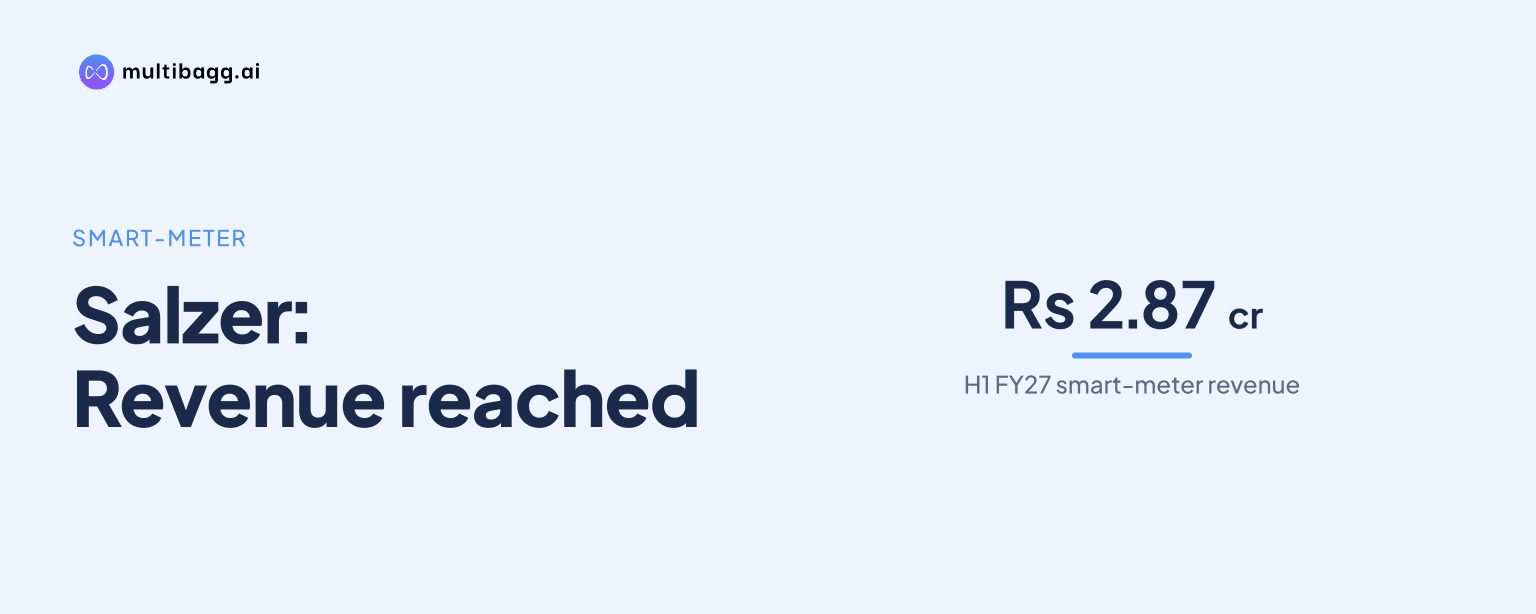
Salzer recorded ₹2.87 crore of smart-meter revenue in the first half of financial year 2027, against annual capacity of 4 million units, as tender eligibility norms and slower project rollouts limited order flow; management plans consortium bids and subcontract manufacturing to pursue a FY27 ramp-up.
Know Salzer Electronics inside out
Results, valuation, peers and who's buying, in one view.
Why did Salzer report ₹2.87 crore of smart-meter revenue in H1 FY27?
Salzer reported ₹2.87 crore of smart-meter revenue in H1 FY27 because, according to the presentation, stringent eligibility norms for new entrants and industry-wide delays in smart-meter project execution constrained order flow. The company says the tender conditions limited direct participation, while slower implementation delayed the timing of manufacturing demand.
The reported revenue sits beside annual manufacturing capacity of 4 million units, but Salzer does not disclose meter production, dispatches, installations or inventory for H1 FY27. The presentation therefore shows a difference between available capacity and recognised revenue, rather than providing a plant-utilisation percentage. Management describes the situation as a short-term execution issue linked to tender access and rollout timing.
The presentation does not provide a prior-period smart-meter revenue figure, a smart-meter order book or an average selling price per unit. As a result, ₹2.87 crore is the only disclosed H1 FY27 commercial measure for the segment, and it cannot be converted into a reported volume measure against the 4-million-unit annual capacity.
What smart-meter capacity and products does Salzer have?
Salzer has a fully integrated smart-meter facility in Coimbatore with annual capacity of 4 million units. Its manufacturing overview separately identifies the Annur plant for smart meters, while the smart-meter page describes backward integration for critical components as part of the manufacturing setup.
Salzer’s smart-meter range includes single-phase and three-phase meters. The presentation says the products use a certified Wirepas mesh platform and describes the architecture as cost-effective and scalable for dense urban deployments. These are stated product and technology features, rather than evidence of a disclosed deployment volume in H1 FY27.
The capacity-revenue comparison is central to the current ramp-up position: Salzer has 4 million units of stated annual capacity but reported ₹2.87 crore of smart-meter revenue in H1 FY27. The company does not state how much of the capacity is allocated to either single-phase or three-phase meters, nor does it disclose customer or geographic concentration for the segment.
How is Salzer addressing smart-meter tender restrictions?
Salzer is adopting a consortium strategy to address tender eligibility barriers affecting new entrants. Management says consortium bids are intended to bypass constraints that limit direct participation, creating a route to projects where Salzer alone may not meet the stated tender requirements.
The company is also seeking subcontract manufacturing volumes through partnerships with established smart-meter project participants. That mechanism could allow the 4-million-unit facility to manufacture meters for a project holder rather than requiring Salzer to be the direct tender winner. The presentation does not name consortium members, subcontracting partners, tender values or awarded manufacturing volumes.
These two routes address different parts of the disclosed constraint. Consortium participation is aimed at tender access, while subcontracting is aimed at obtaining production volumes through established participants. Neither route had an associated order announcement or revenue contribution quantified in the H1 FY27 disclosure.
Got a follow-up? Ask IRIS
What is Salzer’s smart-meter outlook for FY27?
Salzer expects a significant smart-meter ramp-up in FY27 as consortium bids materialise, according to its stated roadmap. Management says it is de-bottlenecking operations so the facility can scale volume rapidly once orders flow, rather than indicating that the required orders had already been secured in H1 FY27.
Management’s view is based on an expected next wave of smart-meter deployments in FY27, supported by the company’s integrated manufacturing capacity and Wirepas mesh technology. This is an outlook linked to the consortium plan, not a quantified forecast: Salzer gives no FY27 smart-meter revenue target, unit-sales target, capacity-utilisation target or order-book figure.
The distinction between reported and expected performance matters. ₹2.87 crore is reported H1 FY27 smart-meter revenue, whereas a significant FY27 ramp-up is management’s expectation contingent on consortium bids materialising. The presentation does not specify the quarter in FY27 when those bids could convert into manufacturing revenue.
How does energy management connect with Salzer’s smart-meter plans?
Salzer identifies Internet of Things capabilities in energy management as an adjacent smart-meter synergy, citing the Bengaluru project. The project has an indicated value of about ₹200 crore and is to be executed through Effilume, in which Salzer held a 41.91% stake as of December 2025.
The presentation says the Bengaluru work covers street-light management and energy-efficiency solutions, using Salzer’s smart controllers and connected capabilities. Management expected recurring revenue of ₹2 crore to ₹2.5 crore per month from the project, beginning in the second quarter of financial year 2027, after commencement was delayed from earlier estimates.
The two activities were at different disclosed stages. Smart meters generated ₹2.87 crore of hardware revenue in H1 FY27, while the Bengaluru energy-management revenue was prospective and service-based at the time of the presentation. Salzer presents the project as a potential showcase for future municipal contracts, but it does not provide a direct revenue linkage between the Bengaluru project and smart-meter sales.
Conclusion
The combined disclosure shows that Salzer’s smart-meter opportunity was limited by access to tenders and project execution rather than by stated manufacturing infrastructure. Its 4-million-unit capacity, single-phase and three-phase product range, and Wirepas mesh platform had not yet translated into disclosed commercial volumes comparable with the available production base.
The next point to watch is whether consortium bids lead to named orders or whether subcontract manufacturing produces measurable revenue during FY27. Management’s de-bottlenecking plan depends on orders flowing, while the delayed second-quarter FY27 start targeted for the Bengaluru energy-management project is a separate scheduled test of its connected-solutions plans.