










Sattva's ₹486 crore backlog shifts to treatment projects
Key highlights
- Sattva reported a ₹486 crore order book in H1 FY27.
- Five sewage and water treatment projects account for ₹363.1 crore of listed balance work.
- Sattva's two Bangalore sewage treatment projects carry ₹114.3 crore of remaining value.
- Revenue from operations rose from ₹76.9 crore in FY24 to ₹143.2 crore in FY26.
powered by IRIS
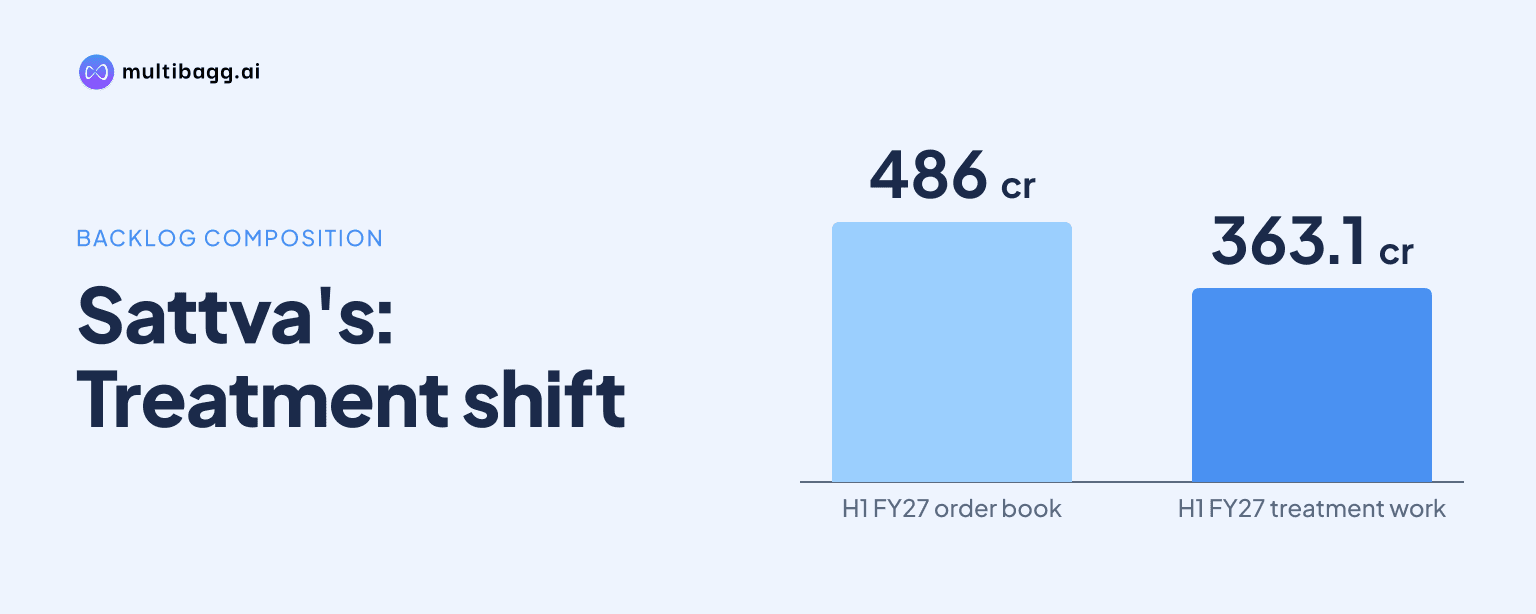
Sattva Engineering Construction Limited reported a ₹486 crore order book in H1 FY27, with ₹363.1 crore, or 74.7% of listed balance value, concentrated in five sewage and water treatment plant contracts; ₹114.3 crore of that balance sits in two Bangalore projects, supporting its stated entry into Karnataka.
Know Sattva Engineering Construction inside out
Results, valuation, peers and who's buying, in one view.
How is Sattva's ₹486 crore order book divided?
Sattva's ₹486 crore H1 FY27 order book is diversified across water supply schemes, underground sewerage systems, sewage treatment plants and water treatment plants. The 15 project-level balance values in the presentation also total ₹486 crore, with five treatment-plant contracts accounting for ₹363.1 crore and the other 10 projects accounting for ₹122.9 crore.
The concentration is in treatment infrastructure rather than distribution or civil works. Based on the listed balances, sewage treatment plant and water treatment plant contracts represent 74.7% of the total, while water-supply upgrades, sewerage works, odour-control systems, pumping mains and site development represent the remaining 25.3%.
Sattva's largest balance is ₹105.7 crore at Thiruverkadu, Chennai, for a 46 million litres per day, or MLD, sewage treatment plant under a design-build-operate-transfer arrangement. The second-largest is ₹89.8 crore for a 47 MLD water treatment plant at Surapet, Chennai, against an original contract value of ₹106.2 crore.
Which treatment projects carry most of Sattva's balance work?
Sattva's five largest treatment projects carry balances ranging from ₹45.9 crore to ₹105.7 crore, combining plant construction with treatment technology or operations and maintenance, or O&M, obligations. Thiruverkadu and Surapet alone account for ₹195.5 crore, equal to 40.2% of the ₹486 crore listed order book.
At Koramangala, Bangalore, Sattva has ₹68.4 crore of balance work on a 20 MLD sewage treatment plant with tertiary treatment, odour-control units and seven years of O&M. At Hosur, the balance is ₹53.3 crore on a ₹90.7 crore contract covering 12.5 MLD and 20.1 MLD sequential batch reactor, or SBR, sewage treatment plants.
The Basavanpura, Bangalore contract adds ₹45.9 crore of balance work on a ₹47.8 crore, 10 MLD sewage treatment plant. Its scope includes SBR technology, biological nutrient removal, tertiary treatment, odour-control units and seven years of O&M, showing that the larger balance includes both construction and longer-duration operating commitments.
Got a follow-up? Ask IRIS
How does Karnataka change Sattva's project footprint?
Sattva's two Bangalore contracts have a combined balance value of ₹114.3 crore, comprising ₹68.4 crore at Koramangala and ₹45.9 crore at Basavanpura. Their original combined contract value is ₹123.9 crore, making Karnataka a material addition to a project list otherwise weighted towards Chennai and other Tamil Nadu locations.
The two Bangalore projects account for 23.5% of the ₹486 crore project-level balance and both are sewage treatment assignments with tertiary treatment, odour control and seven-year O&M. This differs from several Chennai-area balances, including ₹29.9 crore for Villivakkam water-distribution upgrades and ₹25.4 crore for odour-control systems at 46 sewage pumping stations.
Management identifies Tamil Nadu as Sattva's established execution base and says entry into Karnataka includes participation in Bangalore Water Supply and Sewerage Board tenders. The presentation does not disclose award dates for the two Bangalore projects, future Karnataka tender values or a timetable for further contracts in the state.
What supports execution of Sattva's larger backlog?
Sattva says it has executed more than 50 water and wastewater projects and has experience in capacities from 12.5 MLD to 50 MLD. Its execution model includes in-house design, hydraulic and process engineering, system integration and supervisory control and data acquisition systems for real-time plant-performance monitoring.
In April 2026, Sattva implemented Nway enterprise resource planning software to strengthen internal controls and operational efficiency. Management also cites value engineering and investment in advanced technologies to support larger projects, but the presentation does not quantify savings, costs or project-level margin effects from those measures.
The financial record preceding H1 FY27 shows revenue from operations rose from ₹76.9 crore in FY24 to ₹108.6 crore in FY25 and ₹143.2 crore in FY26. Profit after tax increased from ₹4.6 crore in FY24 to ₹13.1 crore in FY26, while gross profit margin declined from 28.1% to 23.2% over the same period.
Management says it is increasing its focus on engineering, procurement and construction contracts paired with O&M to support margin and cash-flow stability. The seven-year O&M commitments in Bangalore and the 10-year O&M component in the ₹15.8 crore balance at Nesapakkam provide examples of that stated contract mix.
Conclusion
Sattva's H1 FY27 backlog is principally a treatment-infrastructure pipeline, with five sewage and water treatment contracts carrying ₹363.1 crore of the ₹486 crore balance. The ₹114.3 crore Bangalore component provides current project evidence of Karnataka expansion, while the wider order book retains work across Chennai and other Tamil Nadu locations.
What to watch next is the conversion of the ₹486 crore order book into revenue, execution of the two Bangalore contracts with seven-year O&M obligations, and management's plan to use initial public offering proceeds for long-term working capital and participation in larger projects. Management also discloses a strategy of bidding selectively, independently and through partnerships, for larger water-supply and sewage-treatment engineering, procurement and construction opportunities.