










Sattva turns operating cash flow positive at Rs 15.9 crore in H1 FY27
Key highlights
- Sattva generated Rs 15.9 crore of operating cash flow in H1 FY27 after outflows of Rs 5.6 crore in FY25 and Rs 12.7 crore in FY26.
- Working-capital changes added Rs 5.6 crore of cash in H1 FY27, compared with a Rs 30.5 crore outflow in FY26.
- Sattva’s cash conversion cycle declined to 126 days in FY26 from 188 days in FY25.
- Trade receivables were Rs 51.6 crore at H1 FY27, up Rs 2.1 crore from Rs 49.5 crore at FY26.
powered by IRIS
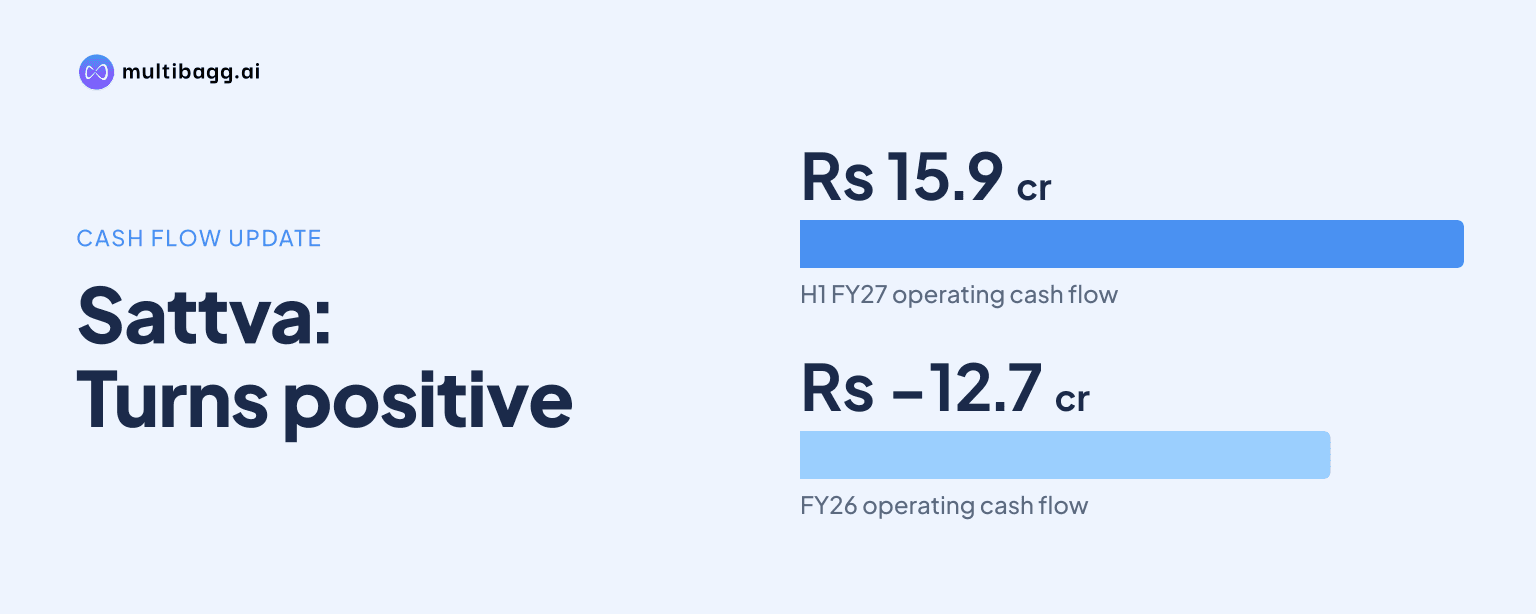
Sattva Engineering Construction Limited generated Rs 15.9 crore of net cash from operating activities in H1 FY27, reversing outflows of Rs 5.6 crore in FY25 and Rs 12.7 crore in FY26. The immediate driver was a Rs 5.6 crore positive working-capital movement, compared with a Rs 30.5 crore outflow in FY26.
Know Sattva Engineering Construction inside out
Results, valuation, peers and who's buying, in one view.
How did Sattva turn operating cash flow positive in H1 FY27?
Sattva turned operating cash flow positive because profit before tax, non-cash adjustments and a working-capital inflow exceeded direct taxes paid in H1 FY27. Profit before tax was Rs 10.2 crore, non-cash and non-operating adjustments were Rs 2.8 crore, and direct taxes paid were Rs 2.6 crore, while working capital added Rs 5.6 crore of cash.
The outcome contrasts with the preceding two full financial years. Net cash from operating activities was negative Rs 5.6 crore in FY25 and negative Rs 12.7 crore in FY26, after a positive Rs 5.7 crore in FY24. Profit before tax increased from Rs 12.6 crore in FY25 to Rs 17.7 crore in FY26, but the working-capital outflow widened from Rs 20.7 crore to Rs 30.5 crore.
The reported H1 FY27 result shows that accounting profit and operating cash had diverged in FY25 and FY26. The move from a Rs 30.5 crore working-capital outflow in FY26 to a Rs 5.6 crore inflow in H1 FY27 represents a Rs 36.1 crore change, although the full-year and half-year periods are not directly comparable.
What changed in Sattva’s working capital and cash conversion?
Sattva’s disclosed cash-conversion indicators had improved by FY26, before the Rs 5.6 crore working-capital cash inflow reported in H1 FY27. The cash conversion cycle fell to 126 days in FY26 from 188 days in FY25 and 185 days in FY24, while debtor days declined to 104 from 107 and 146, respectively.
Inventory days accounted for most of the FY25-to-FY26 reduction in the cash conversion cycle. Inventory days fell by 73 days to 84 in FY26 from 157 in FY25, whereas debtor days declined by 3 days. The presentation does not disclose H1 FY27 debtor days, inventory days or the cash conversion cycle.
Management attributes its working-capital approach to milestone-based billing, timely receivable collections, procurement and inventory optimisation, and supplier-payment cycles. It also says it is increasing engagement with government-backed and institutionally funded counterparties, but does not provide a component-by-component bridge for the Rs 5.6 crore H1 FY27 working-capital inflow.
Revenue growth formed the operating backdrop to the change. Revenue from operations rose 25% year on year to Rs 81.1 crore in H1 FY27 from Rs 65.0 crore, while earnings before interest, taxes, depreciation and amortisation, or EBITDA, increased 52% to Rs 12.8 crore and the EBITDA margin rose 280 basis points to 15.8%.
Got a follow-up? Ask IRIS
What do Sattva’s receivables and payables show at H1 FY27?
Sattva’s trade receivables and inventories both increased at H1 FY27 despite the positive working-capital movement. Trade receivables rose to Rs 51.6 crore from Rs 49.5 crore at FY26, while inventories increased to Rs 9.0 crore from Rs 7.4 crore. The cash-flow statement does not identify the separate contribution of these accounts to the Rs 5.6 crore inflow.
Trade payables increased by Rs 6.8 crore to Rs 25.4 crore at H1 FY27 from Rs 18.6 crore at FY26. Other current assets rose by Rs 0.7 crore to Rs 58.6 crore and short-term loans and advances increased by Rs 1.2 crore to Rs 10.8 crore, showing that multiple balance-sheet accounts changed during the half year.
Current assets increased to Rs 140.7 crore at H1 FY27 from Rs 132.8 crore at FY26, while current liabilities decreased to Rs 68.9 crore from Rs 69.8 crore. As the presentation reports only an aggregate working-capital cash-flow figure, it does not establish how changes in receivables, inventories, payables and other current accounts were timed during H1 FY27.
How did financing and investing flows affect Sattva’s cash balance?
Sattva’s closing cash and cash equivalents increased by Rs 2.3 crore to Rs 10.6 crore at H1 FY27 from Rs 8.4 crore at FY26. The Rs 15.9 crore operating inflow was partly used for Rs 0.9 crore of investing outflow and Rs 12.8 crore of financing outflow during the half year.
The financing outflow included Rs 12.1 crore of net repayments of borrowings and Rs 3.0 crore of interest and lease payments, partly offset by Rs 2.3 crore of proceeds from long-term borrowings. Short-term borrowings declined to Rs 17.7 crore at H1 FY27 from Rs 29.9 crore at FY26, while long-term borrowings increased to Rs 2.6 crore from Rs 0.3 crore.
Investing activities used Rs 0.9 crore in H1 FY27, compared with Rs 3.1 crore in FY26. The half-year figure included Rs 0.4 crore for net fixed assets and Rs 0.9 crore for other non-current assets, partly offset by Rs 0.3 crore of interest and dividend received and Rs 0.1 crore of rental income.
Conclusion
Sattva’s H1 FY27 operating-cash reversal was principally associated with a Rs 5.6 crore working-capital inflow after outflows in FY25 and FY26. The result coincided with revenue of Rs 81.1 crore, up 25% year on year, and profit after tax of Rs 7.4 crore, up 64%, although trade receivables increased by Rs 2.1 crore from FY26.
The next measure to watch is whether Sattva can maintain its stated focus on collections, milestone billing, procurement and supplier-payment cycles as it participates in larger projects. Management says initial public offering proceeds will support long-term working capital and larger-project participation, while the presentation does not disclose an H1 FY27 cash-conversion-cycle figure or a quantified working-capital target.