










Sattva cuts FY27 growth outlook to 30% after project delays
Key highlights
- Sattva cut FY27 revenue-growth guidance to 30% from its earlier 60% aspiration.
- H1 FY27 revenue rose 25% to Rs 81.1 crore and PAT increased 64% to Rs 7.38 crore.
- Delayed STP awards include Rs 123.9 crore of BWSSB contracts and a Rs 108.4 crore Thiruverkadu project.
- Total borrowings fell by about Rs 9.7 crore to about Rs 20.4 crore at September 2026.
powered by IRIS
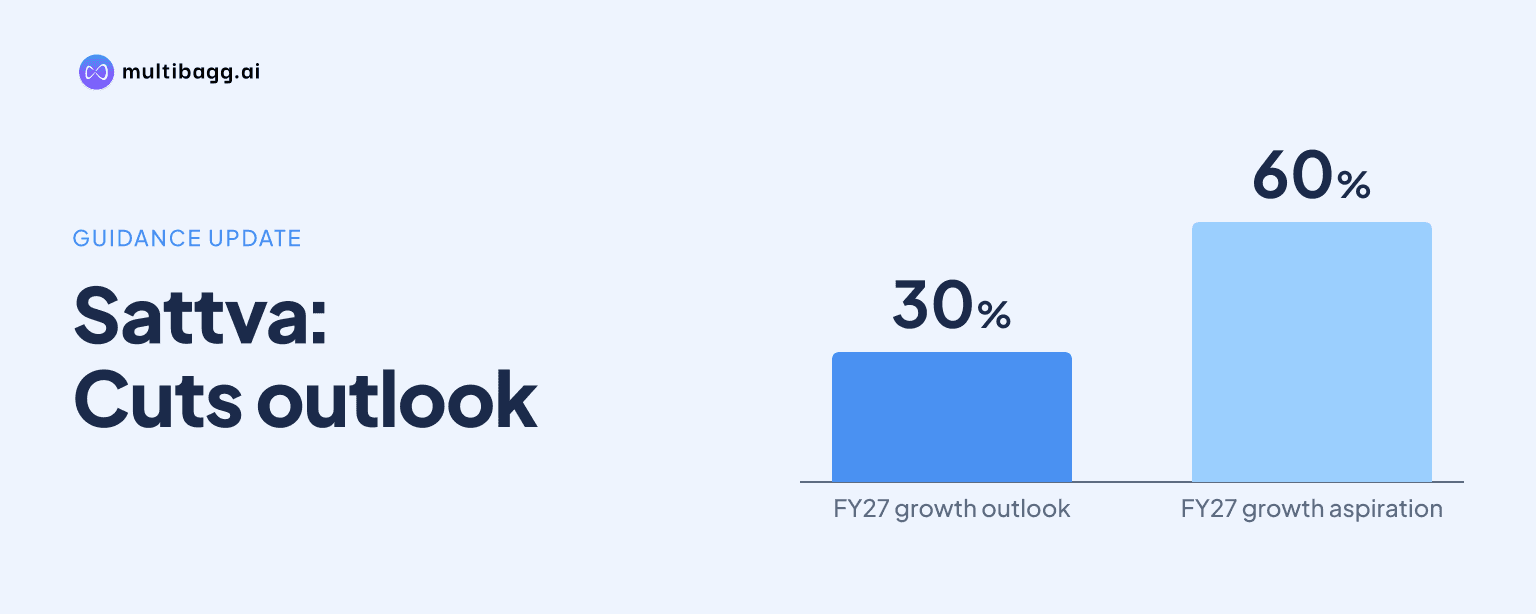
In FY27, Sattva Engineering Construction Limited (Sattva) cut its revenue-growth guidance to 30%, from an earlier 60% aspiration, after statutory clearances and land handovers delayed three secured sewage-treatment projects until revenue is expected toward the end of Q4 FY27. The revision follows first-half FY27 revenue growth of 25% to Rs 81.1 crore.
Know Sattva Engineering Construction inside out
Results, valuation, peers and who's buying, in one view.
Why did Sattva cut its FY27 revenue-growth guidance?
Sattva cut its FY27 revenue-growth guidance because approvals and project-site possession delayed execution of two Karnataka sewage-treatment plant projects and one Tamil Nadu project secured in May and June 2026. Management had earlier stated a 60% revenue-growth aspiration for FY27 and FY28, but now guides for 30% growth in FY27 and an aspiration of 30% to 35% for FY28.
The delayed projects remain in Sattva’s secured order book, but the timing of their execution and associated revenue conversion has moved back. Management had expected to complete initial design activity for the Bangalore Water Supply and Sewerage Board, or BWSSB, projects by September 2026, but said progress was slower than anticipated.
Management attributed the slower progress to statutory clearances, including pollution-control-board approvals, and delays in handing over acquired land for execution. Sattva received possession of land for one project toward the end of August 2026, while possession for the other two projects was still awaited at the November 16, 2026 earnings call.
When will Sattva’s delayed projects begin contributing revenue?
Sattva expects revenue from the three delayed projects to begin toward the end of Q4 FY27 and build progressively thereafter. Land possession and statutory approvals are prerequisites for design and subsequent execution activities, according to management, so the projects offer less near-term revenue visibility than when the company set its earlier 60% aspiration.
The two BWSSB contracts, awarded in May 2026, have a combined value of Rs 123.9 crore. They cover a 20 million litres a day, or MLD, sewage treatment plant, or STP, at Koramangala and a 10 MLD STP at Basavanapura, with design, construction and commissioning followed by seven years of operation and maintenance, or O&M.
In June 2026, a consortium involving Sattva secured a Rs 108.4 crore wastewater-treatment contract from Thiruverkadu Municipality in Tamil Nadu. The project is a 46 MLD STP at Koladi village under a design-build-operate-transfer model, comprising Rs 78.8 crore of construction work and Rs 29.6 crore of O&M over 10 years.
How did Sattva perform in H1 FY27?
Sattva reported first-half FY27 revenue from operations of Rs 81.1 crore, up 25% from Rs 65 crore in the corresponding period of FY26, while profit after tax rose 64% to Rs 7.38 crore from Rs 4.5 crore. The profit increase outpaced revenue growth despite the later expected contribution from the three STP projects.
Operating earnings before interest, tax, depreciation and amortisation, or EBITDA, increased 52% to Rs 12.8 crore from Rs 8.4 crore, and the EBITDA margin rose to 15.8% from about 13%. Profit before tax increased 66% to Rs 10.15 crore, while the profit-after-tax, or PAT, margin rose to 9.1% from 6.9%.
Management said it remains focused on sustaining EBITDA margin around 15% and PAT margin around 9% as Sattva expands. Operating cash flow turned positive at Rs 15.9 crore in H1 FY27, compared with negative operating cash flow of Rs 12.7 crore for the full FY26 year, while cash generated from operations before direct-tax payments was about Rs 18.6 crore.
Got a follow-up? Ask IRIS
What does Sattva’s order book and pipeline show?
Sattva’s order book stood at Rs 486 crore as of September 30, 2026, including the secured projects whose execution has been delayed. Management said it is seeking to balance order-book expansion with execution capability, project economics and the quality of counterparties.
Sattva also re-entered the industrial and utility-building segment with an August 2026 order from Bimbo Bakeries India Private Limited. The civil-construction contract for a Tamil Nadu manufacturing facility is valued at Rs 9.51 crore and has a 20-week execution period, making it smaller and shorter in duration than the water and wastewater contracts.
Sattva has quoted for projects worth Rs 225 crore in aggregate, and management said it is confident of converting about 40% to 50% into the order book. That is management’s assessment rather than an awarded-order figure, and conversion depends on tender outcomes, approvals and the pace of project decisions.
How have cash collections and borrowings changed at Sattva?
Sattva reduced total borrowings by about Rs 9.7 crore during H1 FY27, to about Rs 20.4 crore at September 2026 from about Rs 30.1 crore at March 31, 2026. Short-term borrowings declined to Rs 17.7 crore from Rs 29.9 crore, while long-term borrowings stood at Rs 2.6 crore at the end of September.
Cash and bank balances were about Rs 10.65 crore at the end of H1 FY27. Management linked the lower borrowing balance to positive operating cash flow, collection of receivables and its effort to reduce reliance on external funding, although receivables and certain current assets continued to absorb funds.
By September 30, 2026, Sattva had collected 95% of its FY26 outstanding trade receivables. Management said it expected to release about 80% of September 2026 receivables by the end of November, while continuing to focus on collection efficiency and working-capital discipline.
Conclusion
Sattva’s revised 30% FY27 growth guidance reflects delayed conversion of three secured STP projects rather than their removal from the Rs 486 crore order book. First-half financial results improved, with revenue reaching Rs 81.1 crore, PAT reaching Rs 7.38 crore and operating cash flow turning positive at Rs 15.9 crore, but these outcomes did not offset the timing impact on the full-year outlook.
The next disclosed milestones are possession of land and statutory approvals for the remaining delayed projects, which management says must occur before design and execution can progress toward late-Q4 FY27 revenue contribution. Management’s 30% to 35% FY28 growth aspiration also depends on its existing execution base, anticipated tender activity and conversion of opportunities from the Rs 225 crore bidding pipeline.