










Sattva H1 EBITDA margin reaches 15.8% as PAT rises by 64%
Key highlights
- Sattva's H1 FY27 revenue rose 25% to Rs 81.1 crore.
- Sattva's H1 FY27 EBITDA grew 52% to Rs 12.8 crore and margin reached 15.8%.
- Sattva's H1 FY27 PAT increased 64% to Rs 7.4 crore.
- Sattva reported an Rs 486 crore unexecuted order book as of September 2026.
powered by IRIS
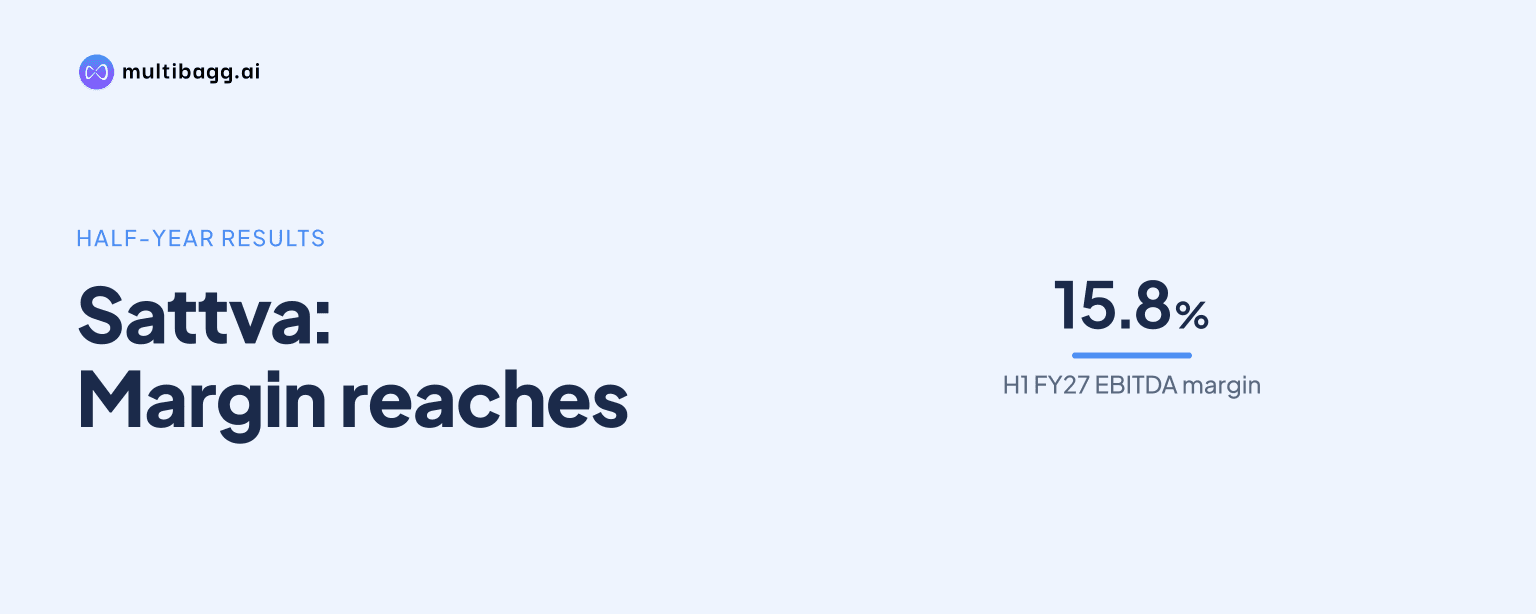
Sattva Engineering Construction Limited reported a 15.8% EBITDA margin in H1 FY27, up 280 basis points year on year, as profit after tax rose 64% to Rs 7.4 crore on 25% revenue growth to Rs 81.1 crore. Earnings before interest, taxes, depreciation and amortisation (EBITDA) increased 52% to Rs 12.8 crore.
Know Sattva Engineering Construction inside out
Results, valuation, peers and who's buying, in one view.
How did Sattva perform in H1 FY27?
Sattva converted Rs 81.1 crore of H1 FY27 revenue into Rs 12.8 crore of EBITDA and Rs 7.4 crore of profit after tax (PAT). Compared with H1 FY26, revenue rose from Rs 65.0 crore, EBITDA increased from Rs 8.4 crore, and PAT grew from Rs 4.5 crore. The respective growth rates were 25%, 52% and 64%, meaning profit expanded faster than revenue during the six-month period.
The margin outcome was higher at both operating and net-profit levels. EBITDA margin was 15.8% in H1 FY27 versus 13.6% in H1 FY26, a 280-basis-point year-on-year increase. PAT margin rose to 9.1% from 6.9%, a reported increase of 218 basis points. Profit before tax increased 66% to Rs 10.2 crore from Rs 6.1 crore, while tax expense rose 73% to Rs 2.8 crore.
What drove Sattva's H1 FY27 margin expansion?
Sattva's reported expense movements show that costs grew more slowly than revenue in H1 FY27. Contract expenses and materials consumed increased 24% to Rs 62.0 crore from Rs 49.9 crore, against the 25% increase in revenue. Employee benefits expense declined 3% to Rs 3.9 crore, while other expenses fell 9% to Rs 2.4 crore from Rs 2.6 crore a year earlier.
The segment mix also changed substantially during the period. Revenue from sewage treatment plants (STP) and water treatment plants (WTP) rose 368% to Rs 35.6 crore, while the reported other-services category increased 666% to Rs 21.9 crore. Sattva does not disclose separate segment margins, so the presentation shows a concurrent mix shift rather than assigning the margin expansion to a particular business.
Finance costs rose 19% to Rs 3.0 crore in H1 FY27 from Rs 2.5 crore, even as EBITDA increased by Rs 4.4 crore. Other income increased to Rs 0.6 crore from Rs 0.4 crore, while depreciation and amortisation was Rs 0.2 crore in both periods. These items took profit before tax to Rs 10.2 crore, up from Rs 6.1 crore.
How did Sattva's revenue mix change in H1 FY27?
Sattva's H1 FY27 growth came from STP and WTP projects and other services, while water supply scheme (WSS) and underground sewerage system (UGSS) revenue declined. STP and WTP became the largest disclosed revenue category at Rs 35.6 crore, or 44% of revenue, compared with Rs 7.6 crore, or 12%, in H1 FY26. WSS revenue fell 50% to Rs 15.7 crore from Rs 31.2 crore.
UGSS revenue decreased 66% to Rs 7.9 crore from Rs 23.3 crore. The Rs 21.9 crore other-services category included Rs 18.3 crore from odour-control systems and Rs 0.8 crore from the industrial segment, both of which had nil revenue in H1 FY26. The change means that the two previously larger WSS and UGSS categories together contributed Rs 23.6 crore in H1 FY27, compared with Rs 54.5 crore a year earlier.
Got a follow-up? Ask IRIS
What do Sattva's order book and cash flow show?
Sattva had an unexecuted order book of Rs 486 crore as of September 2026, up 89% year on year, and reported H1 FY27 order inflow of Rs 242 crore versus Rs 106 crore in H1 FY26. The resulting book-to-bill ratio was 1.9, lower than 3.1 in H1 FY26. Sattva also cited a Rs 225 crore bid pipeline for coming quarters.
Two Bangalore Water Supply and Sewerage Board orders, together worth Rs 123.9 crore, were secured for 20 million litres per day and 10 million litres per day STPs in Karnataka. Separately, Sattva re-entered the industrial and utility-building segment through a Rs 9.5 crore Bimbo Bakeries India contract with a 20-week execution period. These orders extend the project base beyond Sattva's established Tamil Nadu presence.
Operating cash flow was positive at Rs 15.9 crore in H1 FY27, compared with negative Rs 12.7 crore for FY26. The cash-flow statement shows a Rs 5.6 crore positive working-capital change in H1 FY27, against a negative Rs 30.5 crore change in FY26. Debtor days were 114 in H1 FY27 versus 104 in FY26, while the cash conversion cycle improved to 73 days from 126 days and net debt to equity was 0.1 times versus 0.2 times.
What is Sattva targeting through FY28?
Sattva management is targeting annual revenue growth of 30% to 35% through FY27 and FY28, sustainable EBITDA margin of around 15%, and PAT margin of around 9%. H1 FY27 EBITDA margin of 15.8% and PAT margin of 9.1% were above those approximate management objectives, while Sattva reported Rs 81.1 crore of revenue for the first half.
Management says planned growth is to be funded primarily through internal accruals, supplemented by incremental debt financing supported by working-capital management. As of H1 FY27, Sattva said it had collected 95% of FY26 outstanding trade receivables and aimed to collect 80% to 90% of all pending receivables by November 2026. The presentation also identifies larger water-infrastructure projects and expansion into Karnataka as elements of its growth strategy.
Conclusion
Sattva's H1 FY27 figures show EBITDA and PAT rising faster than revenue, with EBITDA increasing 52% to Rs 12.8 crore and PAT increasing 64% to Rs 7.4 crore. The financial result coincided with lower employee and other expenses, alongside a revenue mix led by Rs 35.6 crore of STP and WTP work and Rs 21.9 crore of other services.
The next disclosed measures to watch are progress toward management's 30% to 35% annual revenue-growth target through FY28, execution of the Rs 486 crore order book, and receivable collections by November 2026. Management's stated plan is to fund growth mainly through internal accruals while using working-capital management to support incremental debt financing.