










Sattva operating cash flow turns positive at Rs 15.9 crore
Key highlights
- Sattva generated Rs 15.9 crore in operating cash flow in H1 FY27 versus an Rs 12.7 crore outflow in full-year FY26.
- Sattva's total borrowings declined by about Rs 9.7 crore to about Rs 20.4 crore at September 2026.
- Sattva collected 95% of FY26 outstanding trade receivables by September 30, 2026.
- Sattva reported H1 FY27 revenue of Rs 81.1 crore and PAT of Rs 7.38 crore, up 25% and 64% year on year, respectively.
powered by IRIS
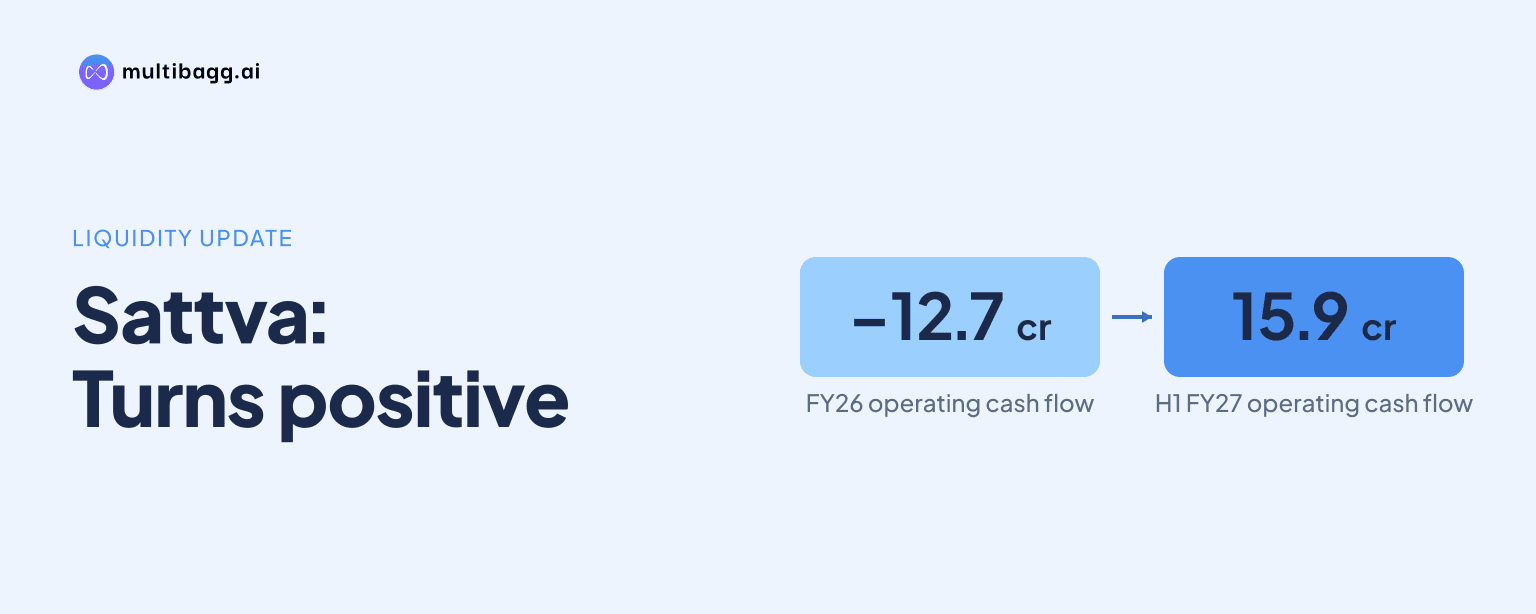
Sattva Engineering Construction Limited reported Rs 15.9 crore of positive cash flow from operating activities in H1 FY27, reversing an Rs 12.7 crore outflow in full-year FY26, while total borrowings fell Rs 9.7 crore to Rs 20.4 crore at September 30, 2026. The change accompanied collection of 95% of FY26 outstanding trade receivables.
Know Sattva Engineering Construction inside out
Results, valuation, peers and who's buying, in one view.
How did Sattva's operating cash flow change in H1 FY27?
Sattva generated Rs 15.9 crore of positive cash flow from operating activities in H1 FY27, compared with an Rs 12.7 crore negative operating cash flow for full-year FY26. The periods are not like-for-like because H1 FY27 covers six months and FY26 covers a full year, but the reported direction of operating cash generation changed. Cash generated from operations before direct-tax payments was Rs 18.6 crore in H1 FY27.
The cash-flow improvement came with higher operating profit in H1 FY27. Revenue from operations rose 25% year on year to Rs 81.1 crore from Rs 65 crore in H1 FY26, while earnings before interest, tax, depreciation and amortisation, or EBITDA, increased about 52% to Rs 12.8 crore from Rs 8.4 crore. Profit after tax, or PAT, increased 64% to Rs 7.38 crore from Rs 4.5 crore, and PAT margin rose to 9.1% from 6.9%.
Sattva's chief financial officer said the H1 FY27 outcome reflected operating profitability and movements in working capital. Receivables and certain current assets continued to absorb funds, but improvements in operating liabilities, including trade payables and current liabilities, offset that use of cash. This means the Rs 15.9 crore operating inflow was linked to both profit and changes in working-capital balances.
What supported Sattva's receivable collections?
Sattva said it had collected 95% of FY26 outstanding trade receivables by September 30, 2026, and said collections continued after that date. Based on the collection position discussed on the call, management expected about 80% of September 2026 receivables to be released by the end of November. The company did not disclose the rupee value of either receivables pool.
Management said its objective is to ensure growth converts into cash through tighter working-capital management. H1 FY27 revenue increased by Rs 16.1 crore year on year, while operating cash flow reached Rs 15.9 crore. Those figures do not establish that all incremental revenue was collected during the period, but they show that collections and changes in operating liabilities coincided with the reported cash inflow.
The collection focus applies to an order book of Rs 486 crore as of September 30, 2026. Management said Rs 123.9 crore of that order book was in Karnataka, with the remaining balance in Tamil Nadu. As these water, wastewater and pipeline projects are executed, Sattva said it will continue to prioritise collection efficiency and incremental operating cash generation.
How much did Sattva reduce borrowings in H1 FY27?
Sattva reduced total borrowings by about Rs 9.7 crore in H1 FY27, to about Rs 20.4 crore at September 2026 from about Rs 30.1 crore at March 31, 2026. Short-term borrowings declined to Rs 17.7 crore from Rs 29.9 crore, while long-term borrowings stood at Rs 2.6 crore at the September period-end. Cash and bank balances were about Rs 10.65 crore at September 2026.
Management attributed the fall in borrowings to financial discipline, lower dependence on external funding and improved operating cash generation. The Rs 12.2 crore reduction in short-term borrowings was greater than the Rs 9.7 crore reduction in total borrowings because Rs 2.6 crore of long-term borrowings remained at September 2026. The transcript did not disclose long-term borrowings at March 31, 2026.
Got a follow-up? Ask IRIS
Can Sattva execute its order book through internal accruals?
Sattva's management said it expects to execute its Rs 486 crore order book through internal accruals and is not planning fund generation in the near future. Management said the order book as of September 30, 2026 spans about 18 to 24 months. This is management's stated funding plan rather than a forecast of future cash needs.
Sattva has also quoted for projects worth Rs 225 crore and said it was confident of converting about 40% to 50% of this bidding pipeline into orders. Potential awards would add to the Rs 486 crore order book, making cash collections and working-capital control relevant to the stated internal-accrual plan. Management did not provide a capital-expenditure amount or a project-level funding schedule on the call.
The order book includes two Bangalore Water Supply and Sewerage Board sewage-treatment projects worth Rs 123.9 crore and a Rs 108.4 crore Thiruverkadu Municipality wastewater project secured through a consortium. Management told an analyst that Sattva executes 100% of the consortium work and that payments are routed through the consortium arrangement. That structure could affect the administrative route of receipts from the Thiruverkadu project.
What could affect Sattva's cash generation in the second half?
Sattva said statutory clearances and land handover delayed the start of three sewage-treatment projects secured in May and June 2026, deferring execution and associated revenue conversion. The company received possession of land for one project toward the end of August 2026, while possession for the remaining two was still awaited. Management expects revenue contribution from these projects to begin toward the end of Q4 FY27 and build progressively thereafter.
The delayed portfolio comprises two Karnataka projects from Bangalore Water Supply and Sewerage Board and one Tamil Nadu project at Thiruverkadu Municipality. Sattva revised its FY27 revenue-growth guidance to 30%, after previously stating an aspiration of 60% growth for FY27 and FY28. For FY28, management stated a growth aspiration of 30% to 35%, supported by the execution base, tender activity and expansion into newer geographies.
Management also said tendering activity in Tamil Nadu was subdued in H1 FY27 following a change in government. Projects were progressing through administrative approvals, technical evaluations, financial assessments and funding arrangements, with the timing of tenders dependent on government departments and project authorities. Delays in those processes could affect order conversion, project mobilisation and the timing of future operating cash flows.
Conclusion
Sattva's H1 FY27 results show a reported Rs 15.9 crore operating cash inflow, compared with an Rs 12.7 crore outflow in FY26, alongside a Rs 9.7 crore reduction in total borrowings. Revenue of Rs 81.1 crore, PAT of Rs 7.38 crore and collection of 95% of FY26 outstanding receivables were the reported financial and working-capital developments accompanying the shift.
The next disclosed milestones are management's expectation to release about 80% of September 2026 receivables by end-November and its expectation that delayed sewage-treatment projects begin contributing revenue toward the end of Q4 FY27. Investors can also track whether Sattva maintains its 30% FY27 revenue-growth guidance, its plan to fund execution through internal accruals and its stated EBITDA margin range of about 15% to 16%.